Almost every buyer arrives at this question the same way. They tried a general assistant on company files, it sounded completely certain, and then it quoted a leave policy that nobody had ever written. So the hunt starts for the best AI chatbot for enterprise data, and within a week the shortlist has fifteen names on it.
However, those fifteen names are not competing in the same category at all. Some deflect customer tickets. Others search internal wikis for employees. A few are frameworks rather than finished products. Because of that mismatch, side-by-side feature tables usually mislead more than they clarify.
This guide takes a different route. First it separates the categories, so you compare products that actually do the same job. Then it hands you a nine-point scorecard you can apply to any vendor in about an hour. After that it covers real pricing, a 30-day evaluation plan, and the questions buyers keep asking me about the best AI chatbot for enterprise data.
Why enterprise data breaks ordinary chatbots
Public web content is tidy by comparison. Enterprise data is not. It lives in five systems, contradicts itself across three versions, and half of it is restricted to people with the right role. Therefore a model that simply reads everything and answers confidently will fail in ways that matter.
In practice, four properties cause most of the damage:
- Permissions. A salary band or an unreleased roadmap must never surface to the wrong reader, so retrieval has to respect access control lists at query time.
- Contradiction. Old and new versions of the same policy sit side by side, and the model has no way to know which one still applies unless you tell it.
- Vocabulary drift. Your teams use internal names for products, forms and processes, and generic embeddings have never seen them.
- Consequence. A wrong answer about a refund window or a compliance deadline costs real money, which is why confident guessing is worse than an honest refusal.
As a result, finding the best AI chatbot for enterprise data is not really a question about which model a vendor uses. It is about how the platform retrieves, filters, refuses and cites. I wrote about the underlying failure modes in more detail in how to reduce AI chatbot hallucinations, and the same logic drives everything below.
The four categories of enterprise AI chatbot
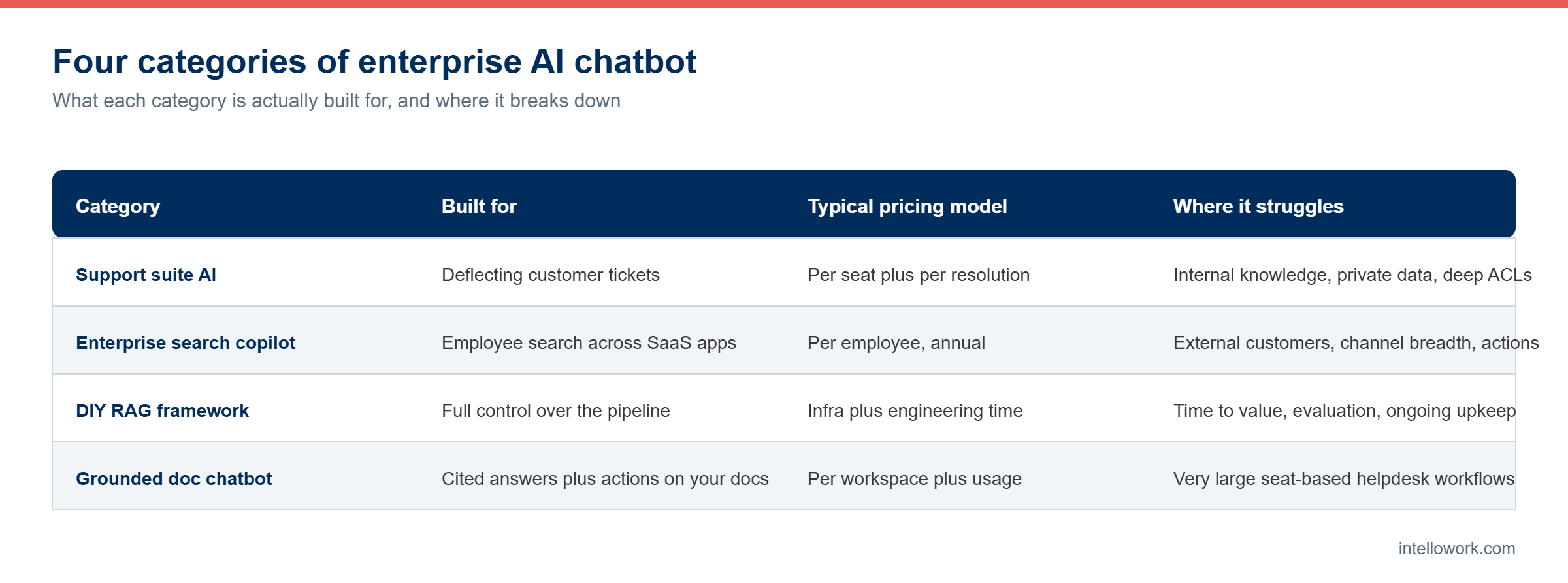
Before you score anything, sort your shortlist into these four buckets. Otherwise you will compare a support suite against a retrieval framework and conclude, wrongly, that one of them is broken. Only inside a single category does the phrase best AI chatbot for enterprise data mean anything precise.
1. Support suite AI
Intercom, Zendesk, Freshworks and Gorgias all bolt an answer engine onto an existing helpdesk. Consequently they are excellent at customer-facing deflection, ticket routing and agent assist. Meanwhile they are weaker on private internal knowledge, deep permission models and channels outside the support inbox. Choose this category when the primary job is closing customer tickets and your agents already live in that suite.
2. Enterprise search copilots
Glean, Coveo and Microsoft Copilot index the SaaS applications your employees use, then answer across them. Their strength is breadth of connectors and identity-aware search. On the other hand, pricing usually scales per employee, external customer deployments are rarely the point, and taking actions through your own APIs is limited. Pick this category for an internal knowledge problem at large headcount.
3. Do-it-yourself RAG frameworks
LangChain, LlamaIndex and a vector database give you total control. Naturally that appeals to engineering-heavy teams. Still, you are now the vendor: you own evaluation, reranking, guardrails, channel adapters, upgrades and on-call. Teams underestimate that last part badly, which is exactly what I covered in seven lessons from running RAG in production.
4. Grounded document chatbots
This category turns your existing documentation, sites and APIs into cited answers across many channels. Intellowork sits here, alongside a handful of similar products. For teams who want customer-facing and employee-facing answers from one knowledge base, with citations and actions, and no retrieval team to staff, this category usually holds the best AI chatbot for enterprise data. However, it is a poor fit if you need thousands of helpdesk seats with full CRM workflow.
A nine-point scorecard for the best AI chatbot for enterprise data
Now score each shortlisted platform out of two on every line, giving eighteen points in total. Above all, do this before anyone shows you a price, because pricing conversations reliably distort feature judgement.
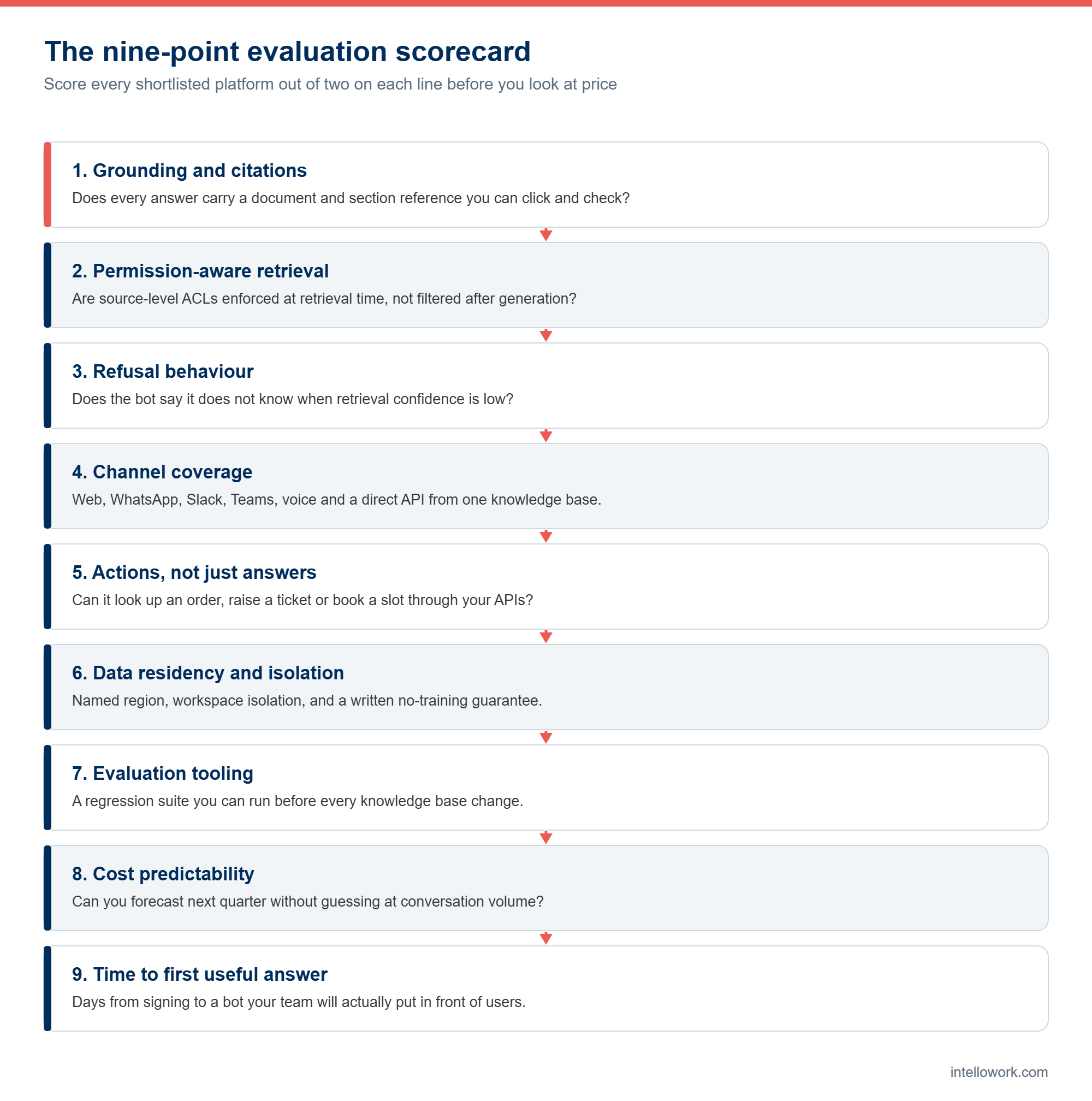
Grounding, citations and refusal
Ask the vendor to show an answer with its sources attached, then click through to the source. If the citation is a document title rather than the passage that produced the claim, the feature is decorative. Similarly, ask what happens when the knowledge base holds no answer. A platform that refuses cleanly is worth far more than one that improvises. My post on why grounded answers beat confident ones goes deeper into this test.
Permission-aware retrieval
There is a meaningful difference between filtering results after generation and filtering candidates before retrieval. Only the second approach prevents restricted content from influencing the answer. Therefore ask precisely where in the pipeline access control lists are applied, and request a demonstration with two accounts at different permission levels.
Channels, actions and evaluation
Next, check whether one knowledge base powers every channel you care about, including web, WhatsApp, Slack and Microsoft Teams. Then ask whether the bot can do things rather than only explain things. Looking up an order, raising a ticket or booking a slot through your own APIs changes the return dramatically. Finally, ask to see the evaluation tooling. Without a regression suite, every knowledge base update becomes a gamble.
How grounded retrieval actually works
It helps to know what happens between the question and the answer, because vendors describe this stage very differently while doing broadly similar things.
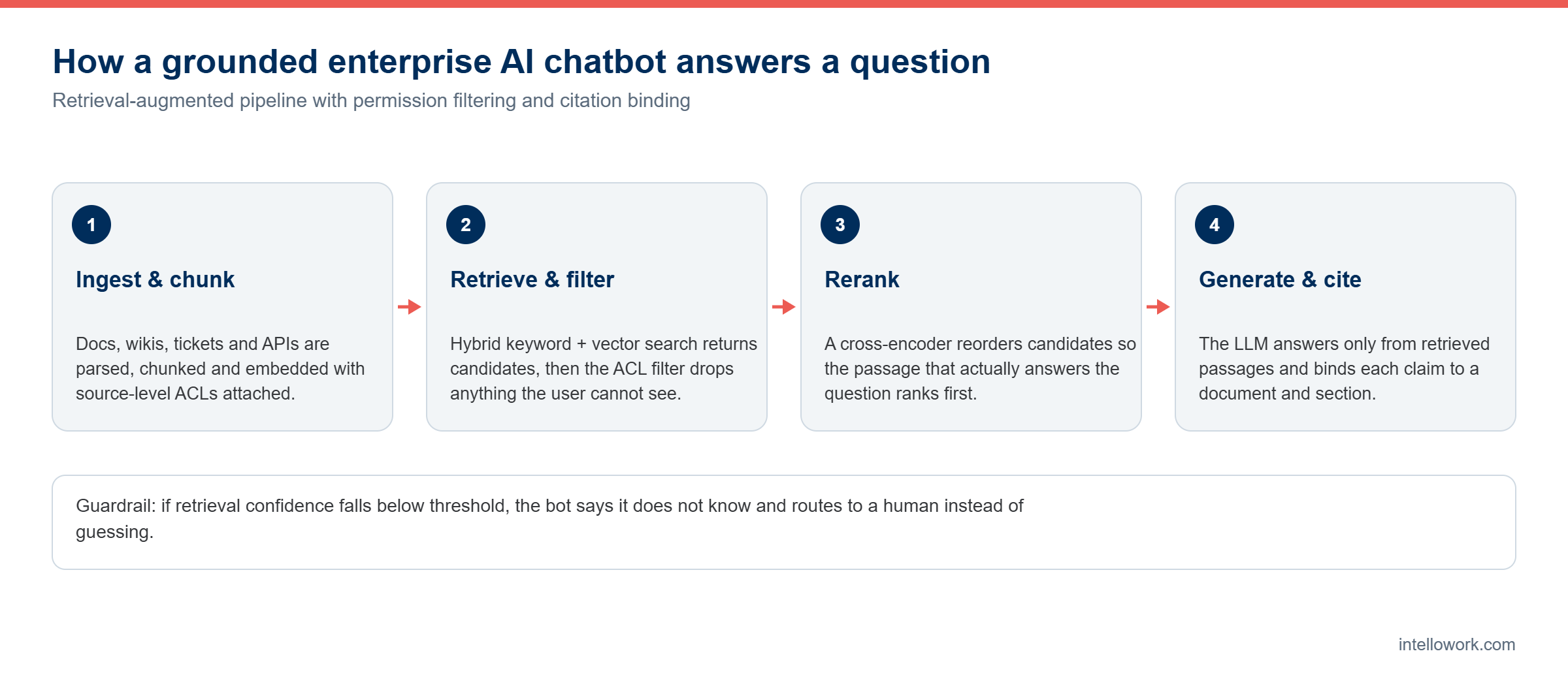
The reranking step deserves particular attention. Initial retrieval is fast but blunt, so the passage that truly answers the question often lands fourth or seventh. A cross-encoder reorders those candidates and pushes the right passage to the top. Consequently answer quality frequently improves more from better reranking than from a larger model.
This is also why fine-tuning is usually the wrong first move for private knowledge. I compared the two approaches properly in RAG versus fine-tuning when you actually have to ship.
What the best AI chatbot for enterprise data really costs
Published pricing splits into three models, and each one fails in a different way at scale. Seat-based pricing punishes large support teams. Per-resolution pricing punishes success, since a bot that answers more costs more. Workspace plus usage pricing is the most forecastable, although you must still watch the usage add-ons.
For reference, publicly listed 2026 figures include Intercom Fin at roughly one dollar per resolution, Gorgias at about a dollar per AI resolution, Zendesk suite tiers from around fifty-five to one hundred and sixty-nine dollars per agent each month, and Tidio Lyro at about thirty-two dollars monthly for fifty AI conversations. Vendors revise these regularly, so treat them as a starting shape rather than a quote. Notably, the cheapest option is almost never the best AI chatbot for enterprise data once you model a full year.
Meanwhile the licence is rarely the largest line. Content preparation, integration work, evaluation and ongoing curation usually cost more in year one. I broke that down in the build versus buy decision for AI chatbots, and the infrastructure side in the cost of running large language models at scale.
A 30-day evaluation plan that actually settles the question
Demos are theatre. Instead, run every finalist through the same short pilot, using your own content and your own questions. Thirty days of evidence beats six months of opinion when you are choosing the best AI chatbot for enterprise data.
- Days 1 to 3. Collect one hundred real questions from tickets, chat logs and internal search queries. Include twenty that your documentation genuinely cannot answer.
- Days 4 to 10. Load an identical, modest corpus into each platform. Do not let vendors curate it for you.
- Days 11 to 18. Run all one hundred questions. Then score accuracy, citation quality and refusal behaviour separately, because a single satisfaction score hides the interesting failures.
- Days 19 to 24. Test permissions with two accounts, test one action through your API, and test your second language if you have one.
- Days 25 to 30. Model twelve-month cost at your realistic volume, then compare it against the scorecard totals.
Above all, keep the twenty unanswerable questions. They reveal more about a platform than the eighty answerable ones combined.
Where Intellowork fits on this list
I should be direct about the bias here, since I build in this space. Intellowork is a grounded document chatbot: it turns existing documentation, websites, Solr indexes and APIs into cited answers, then serves them through a web widget, WhatsApp, Instagram, Messenger, Slack and a direct API, with Microsoft Teams and voice arriving next.
The design choices map closely onto the scorecard above. Answers carry document and section citations. Retrieval respects source-level access control lists. Action agents can look up an order, raise a ticket or book a slot rather than only describing the process. Data residency defaults to the Mumbai region with European and United States options, and you can bring your own model from OpenAI, Bedrock or Anthropic.
That combination fits mid-sized teams, and for them it is a strong candidate for the best AI chatbot for enterprise data. Conversely, if you need a thousand helpdesk seats with deep CRM workflow, a support suite will serve you better, and I would say so in a sales call.
Five mistakes that ruin the shortlist
Having sat through a fair number of these selections, I keep seeing the same five errors. Each one is avoidable, yet each one reliably costs a quarter.
Mistake one: judging the model instead of the pipeline
Buyers ask which model sits underneath, then stop. However, two products on the same model can differ enormously in answer quality, because chunking, retrieval, reranking and guardrails do most of the work. So ask about the pipeline, not the badge.
Mistake two: piloting on clean documentation
Vendors love a tidy corpus. Meanwhile your real content includes a 2019 policy nobody archived and a spreadsheet that three teams disagree about. Consequently a pilot on curated content tells you almost nothing about production behaviour.
Mistake three: ignoring the second language
If your users write in Hindi, Hinglish or a mix of both, test that on day one. Retrieval quality often collapses across languages even when generation looks fine, and by then the contract is signed.
Mistake four: treating permissions as a later phase
Access control is architectural. Therefore a platform that plans to add it next quarter is not the best AI chatbot for enterprise data for you, however good the demo looked.
Mistake five: buying without an exit
Ask how you would export your processed content, your evaluation set and your conversation logs. Vendors who answer that question comfortably tend to be the ones worth keeping.
Questions that reveal the best AI chatbot for enterprise data
Send this list before the second call. Written answers expose differences that a live demo smooths over, and comparing the replies side by side makes the best AI chatbot for enterprise data obvious surprisingly quickly.
- Where in the pipeline do you apply source-level access control lists, and can you show two accounts seeing different answers?
- Does each citation point to the passage that produced the claim, or only to the document?
- What triggers a refusal, and can we tune that threshold ourselves?
- Which channels share one knowledge base today, and which are still on the roadmap?
- Can the assistant call our APIs to complete a task, with validation and a confirmation step?
- Which region stores our content, and is our data ever used to train shared models?
- What evaluation tooling ships with the product, and can we run it in our own pipeline?
- How is pricing structured, and what happens to the bill if usage triples?
- What does the first thirty days of onboarding look like in practice?
- How do we export everything if we leave?
Notably, the last three questions predict long-term satisfaction better than any feature answer. A vendor confident about exit terms is usually confident about retention for the right reasons.
Matching the best AI chatbot for enterprise data to your situation
Finally, a quick way to narrow things. If your dominant problem is customer tickets inside an existing helpdesk, start with support suite AI. When employees are hunting across many SaaS tools at large headcount, start with an enterprise search copilot. If retrieval is genuinely your product, build. Otherwise, a grounded document chatbot is usually the best AI chatbot for enterprise data for the money, since it covers customers and employees from one corpus.
Whichever category wins, the scorecard still applies. Grounding, permissions, refusal, channels, actions, residency, evaluation, cost predictability and time to value decide the outcome. Everything else is packaging. For a broader view of the surrounding stack, my piece on enterprise search software covers where these systems sit next to classic search.
Frequently asked questions
What makes an AI chatbot suitable for enterprise data?
Three things: retrieval that enforces permissions before generation, answers that cite the exact passage behind each claim, and a refusal path when confidence is low. Model choice matters far less than those three controls, so weigh them first when you compare candidates for the best AI chatbot for enterprise data.
Is a general assistant enough if I just upload our documents?
Rarely, because uploads flatten permissions and lose version context. That approach works for a small pilot, yet it breaks as soon as different readers should see different answers.
How long does deployment usually take?
A focused first deployment on a single well-maintained corpus commonly reaches useful quality within two to four weeks. Broad rollouts across many messy systems take considerably longer, mostly because of content cleanup rather than technology.
Should we build our own instead?
Build when retrieval is your product or your constraints are genuinely unusual. Otherwise buy, since the ongoing evaluation and guardrail work is where most in-house projects quietly stall.
Which metric proves it is working?
Track resolution rate rather than containment, alongside citation click-through and escalation quality. I unpacked the difference in what 40 to 60 percent deflection actually means.
The short version
Sort the shortlist into categories first. Then score nine lines before you discuss price. After that, run one identical pilot with your own hundred questions, and keep the twenty that nobody can answer. Do that, and picking the best AI chatbot for enterprise data stops being a matter of taste and becomes a matter of evidence.
If you want to see what a grounded, cited, permission-aware deployment looks like on your own documentation, Intellowork is the fastest way to test the idea.