Artificial intelligence is transforming how modern applications process and retrieve information. One of the most important innovations powering this transformation is the use of vector databases. As AI systems become more advanced, traditional databases are no longer sufficient to handle complex data relationships and semantic understanding.
Vector databases are specifically designed to store and retrieve high-dimensional data such as embeddings. These embeddings represent the meaning of text, images, or other data in numerical form. This allows AI systems to perform similarity searches and deliver more relevant results.
In this guide, we will explore what vector databases are, how they work, and why they are essential for AI applications.
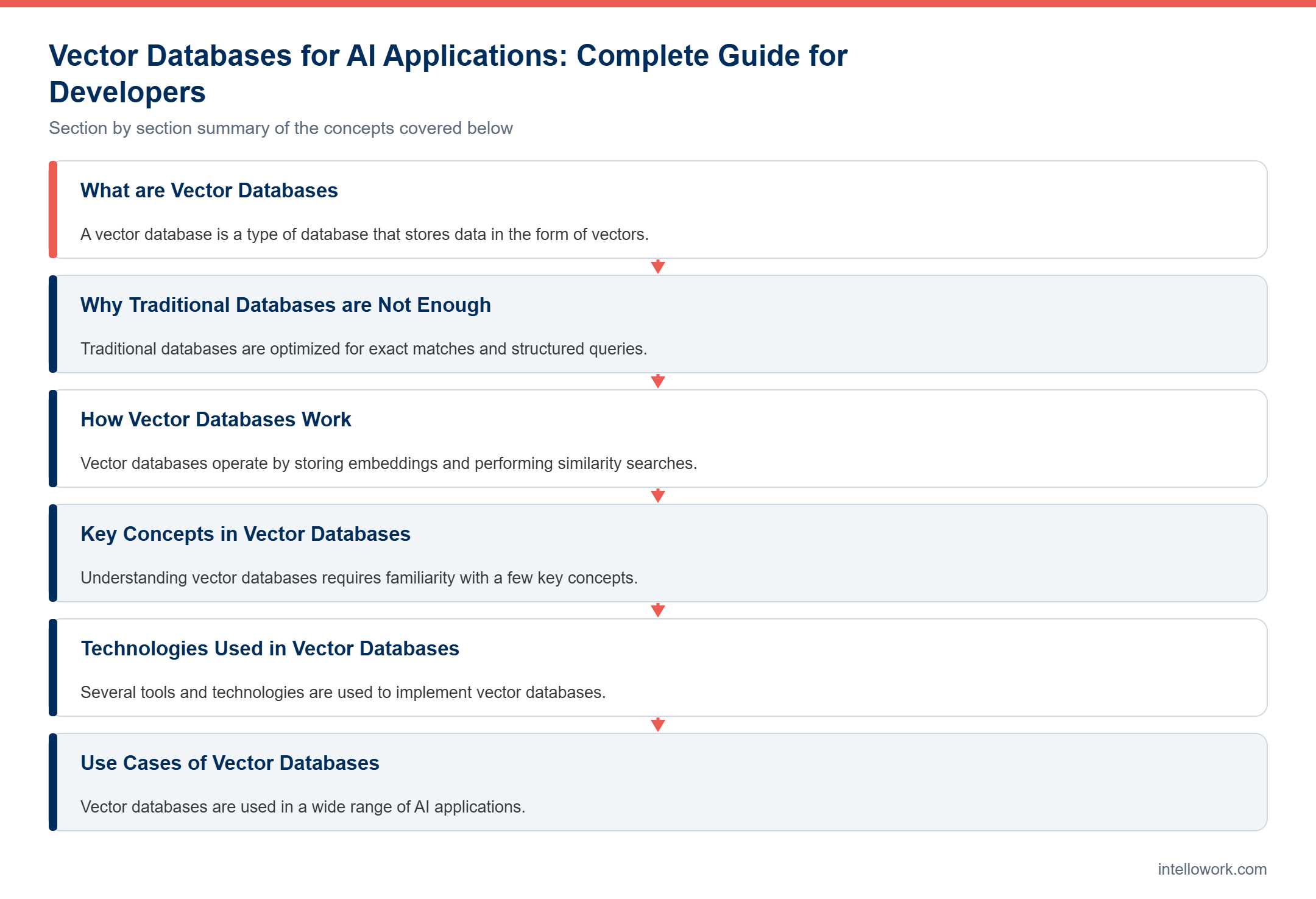
What are Vector Databases
A vector database is a type of database that stores data in the form of vectors. Unlike traditional databases that store structured data in rows and columns, vector databases store numerical representations of data.
These vectors capture the semantic meaning of the original data.Similar sentences will have similar vector representations.
This makes vector databases ideal for applications that require semantic understanding, such as search engines, recommendation systems, and AI chatbots.
Why Traditional Databases are Not Enough
Traditional databases are optimized for exact matches and structured queries. They work well for tasks such as retrieving records based on specific conditions.
However, they struggle with tasks that require understanding meaning and context. For example, if a user searches for “affordable smartphones,” a traditional database may not return results labeled as “budget phones.”
This limitation makes traditional databases unsuitable for modern AI applications that rely on semantic understanding.
Vector databases solve this problem by enabling similarity-based searches instead of exact matches.
How Vector Databases Work
Vector databases operate by storing embeddings and performing similarity searches.
The process begins with converting data into embeddings using AI models. These embeddings are high-dimensional vectors that represent the meaning of the data.
Once stored, the database uses similarity metrics such as cosine similarity or Euclidean distance to compare vectors. When a query is entered, it is converted into a vector and compared with stored vectors to find the closest matches.
This allows the system to retrieve results based on meaning rather than exact keywords.
Key Concepts in Vector Databases
Understanding vector databases requires familiarity with a few key concepts.
Embeddings are numerical representations of data. They capture semantic meaning and relationships between different pieces of data.
Similarity search is the process of finding vectors that are closest to a query vector. This is the core functionality of vector databases.
Indexing is used to organize vectors for efficient searching. Advanced indexing techniques improve speed and scalability.
Distance metrics are used to measure how similar two vectors are. Common metrics include cosine similarity and Euclidean distance.
These concepts form the foundation of vector database systems.
Technologies Used in Vector Databases
Several tools and technologies are used to implement vector databases.
Python is commonly used for building AI applications and generating embeddings.
Vector database systems are designed to store and search embeddings efficiently. Some popular options include FAISS, Pinecone, and Weaviate.
These tools provide optimized algorithms for similarity search and support large-scale applications.
Use Cases of Vector Databases
Vector databases are used in a wide range of AI applications.
Semantic search is one of the most common use cases. It allows search engines to return results based on meaning rather than keywords.
Recommendation systems use vector databases to suggest products or content based on user preferences.
AI chatbots use vector databases to retrieve relevant information and generate responses.
Image and video search systems use embeddings to find visually similar content.
Fraud detection systems use similarity search to identify unusual patterns.
These use cases highlight the versatility of vector databases.
Building a Vector Database System
Building a vector database system involves several steps.
The first step is data collection. Gather the data that will be used in the application.
The next step is generating embeddings. Use AI models to convert the data into vectors.
Once embeddings are generated, they need to be stored in a vector database. This allows efficient searching and retrieval.
The system should also implement indexing to improve performance.
When a user enters a query, it is converted into a vector. The database then performs a similarity search to find the most relevant results.
Benefits of Vector Databases
Vector databases offer several advantages for AI applications.
They enable semantic understanding, allowing systems to process data based on meaning.
improve search accuracy by retrieving more relevant results.
They are highly scalable and can handle large volumes of data.They support real-time applications by providing fast query responses.
They enhance user experience by delivering personalized and intelligent results.
These benefits make vector databases a key component of modern AI systems.
Challenges of Vector Databases
Despite their advantages, vector databases come with challenges.
Generating and storing embeddings requires significant resources.
Another challenge is complexity. Implementing vector databases requires knowledge of AI and machine learning concepts.
Data quality is also important. Poor data can lead to inaccurate results.
Maintaining and updating embeddings can be time-consuming.
However, advancements in technology are making it easier to overcome these challenges.
Future of Vector Databases
The future of vector databases is closely linked to the growth of artificial intelligence.
As AI models become more advanced, the demand for efficient vector storage and retrieval will increase.
Vector databases will play a crucial role in applications such as autonomous systems, personalized recommendations, and intelligent search.
Integration with large language models will further enhance their capabilities.
Real-time processing and scalability will continue to improve, making vector databases more accessible to developers.
Conclusion
Vector databases are a fundamental component of modern AI applications. They enable systems to understand and process data based on meaning, making them essential for tasks such as semantic search and recommendation systems.
By storing and retrieving embeddings efficiently, vector databases provide a powerful solution for handling complex data relationships.
As artificial intelligence continues to evolve, vector databases will become even more important.
What is a vector database
A vector database stores data as numerical vectors and allows similarity-based search.
Why are vector databases important
They enable semantic understanding and improve search accuracy in AI applications.
What are embeddings
Embeddings are numerical representations of data that capture meaning and relationships.
Which tools are used for vector databases
Common tools include FAISS, Pinecone, and Weaviate.
Can vector databases handle large data
Yes, they are designed to scale and handle large datasets efficiently.
Review
This guide provides a clear and practical explanation of vector databases and their role in AI applications. It is highly useful for developers looking to build intelligent systems.
Related reading
- Enterprise Knowledge Chatbot India: Complete Guide
- Company Internal Chatbot Solution: Complete Guide
- AI Chatbot for Employees Knowledge Base: Complete Guide
The practical version of everything above is Intellowork: one knowledge base, cited answers, action agents that call your own APIs, and a named region for data residency.