Introduction
In today’s AI-driven world, businesses are rapidly adopting tools like ChatGPT to automate workflows, improve customer support, and enhance productivity. But there’s one major limitation — public AI models don’t know your company’s internal data.
That’s where RAG (Retrieval-Augmented Generation) comes in.
RAG is a powerful technique that allows you to turn your internal documents, databases, and knowledge base into a private GPT-like assistant that understands your business inside out.
If you’re a developer, founder, or business owner, this guide will help you understand how RAG works and how you can use it to build your own private AI system.
If you’re exploring advanced AI integrations, check out my portfolio: www.guptatarun.com
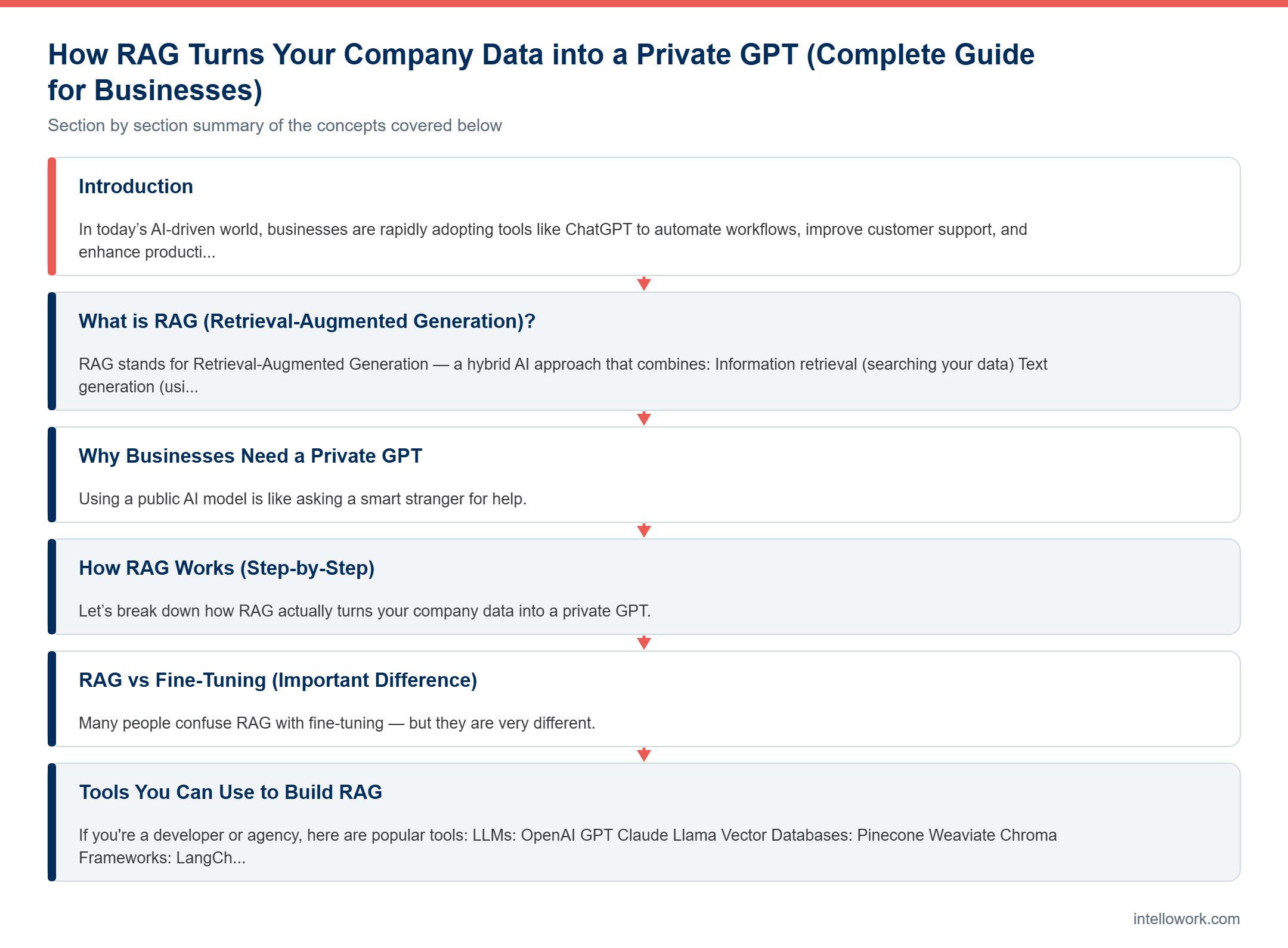
What is RAG (Retrieval-Augmented Generation)?
RAG stands for Retrieval-Augmented Generation — a hybrid AI approach that combines:
- Information retrieval (searching your data)
- Text generation (using LLMs like GPT)
Instead of relying only on pre-trained knowledge, RAG allows AI to:
- Search relevant information from your company data
- Feed that information into a language model
- Generate accurate, context-aware responses
Simple Example:
Without RAG:
GPT gives generic answers
With RAG:
GPT answers using your internal docs, PDFs, databases, or CRM
Why Businesses Need a Private GPT
Using a public AI model is like asking a smart stranger for help.
But a private GPT using RAG is like hiring an employee who:
- Knows your company policies
- Understands your products/services
- Can access internal documents
- Gives accurate, business-specific answers
Key Benefits:
- Data privacy (your data stays secure)
- Better accuracy
- Real-time knowledge updates
- Personalized responses
- Automation of internal processes
How RAG Works (Step-by-Step)
Let’s break down how RAG actually turns your company data into a private GPT.
1. Data Collection
You gather your internal data:
- PDFs
- Documents
- Notion / Google Docs
- CRM data
- Websites
- Knowledge base
2. Data Chunking
Large documents are split into smaller chunks for better retrieval.
3. Embedding Creation
Each chunk is converted into vector embeddings using AI models.
This helps machines understand meaning, not just keywords.
4. Vector Database Storage
Embeddings are stored in a vector database like:
- Pinecone
- Weaviate
- FAISS
5. Query Processing
When a user asks a question:
- The system converts the query into embeddings
- Finds the most relevant data chunks
6. Context Injection
Relevant data is sent to the LLM (like GPT-4)
7. Response Generation
The model generates a response using:
- Your data
- Its own intelligence
Real-World Use Cases of RAG
1. Internal Knowledge Assistant
Employees can ask:
“What is our refund policy?”
And get instant answers from company docs.
2. Customer Support Automation
RAG-powered chatbot can:
- Answer FAQs
- Handle support queries
- Reduce workload
3. Business Intelligence
Ask:
“What were our top-performing services last quarter?”
AI retrieves data and answers instantly.
4. Document Search Engine
Instead of manual search:
- Ask questions
- Get exact answers from documents
5. Training & Onboarding
New employees can learn faster using a private GPT assistant.
RAG vs Fine-Tuning (Important Difference)
Many people confuse RAG with fine-tuning — but they are very different.
| Feature | RAG | Fine-Tuning |
|---|---|---|
| Data Storage | External (vector DB) | Inside model |
| Updates | Easy | Difficult |
| Cost | Lower | Higher |
| Flexibility | High | Limited |
RAG is better for most businesses because it’s dynamic and scalable.
Tools You Can Use to Build RAG
If you’re a developer or agency, here are popular tools:
LLMs:
- OpenAI GPT
- Claude
- Llama
Vector Databases:
- Pinecone
- Weaviate
- Chroma
Frameworks:
- LangChain
- LlamaIndex
How RAG Creates a Private GPT Experience
RAG doesn’t just connect data — it transforms it into an interactive AI system.
Instead of:
- Searching documents manually
- Reading long PDFs
- Asking team members repeatedly
You get:
- Instant answers
- Context-aware responses
- Natural conversation
That’s what makes it feel like a Private GPT trained on your company data
SEO & Business Advantage of Using RAG
Implementing RAG is not just a tech upgrade — it’s a business advantage.
Benefits:
- Faster decision making
- Reduced operational costs
- Better customer experience
- Scalable support systems
Future of AI: Private GPTs Everywhere
The future is not just about using AI — it’s about owning your AI.
Businesses are moving towards:
- Custom AI assistants
- Private GPT systems
- Secure AI environments
RAG is the foundation of this transformation.:
- Portfolio & AI projects:
https://www.guptatarun.com - IT Services (AI Solutions):
https://www.exuverse.com - Tech + Design Integration (Optional Angle):
https://www.exuversespaces.com
Final Thoughts
RAG is one of the most powerful ways to leverage AI in your business.
Instead of relying on generic tools, you can:
- Build your own private GPT
- Use your company’s data securely
- Deliver smarter, faster, and more accurate solutions
If you’re serious about AI adoption, RAG is not optional — it’s essential.
What a private setup gives you that a public assistant does not
The appeal is straightforward, yet the differences are worth stating plainly, because they decide whether this approach suits your situation.
Control over the boundary comes first. Your documents stay in storage you choose, retrieval happens inside your permission model, and you can name the region where processing occurs. Consequently a security review has concrete answers rather than assurances.
Freshness comes second. Because knowledge lives in an index rather than in model weights, updating a policy means reindexing one document instead of retraining anything. Therefore corrections take minutes, and the system never confidently repeats a policy you retired last quarter.
Verifiability comes third. Since the answer is assembled from retrieved passages, each claim can carry a citation a reader can open. That single property changes how people treat the output, and I explained why in why grounded answers beat confident ones.
What it does not fix
It is worth being equally clear about the limits, since disappointment usually comes from expecting the wrong thing.
- Bad content stays bad. Contradictory or outdated documents produce contradictory or outdated answers, only faster.
- Retrieval can still miss. If chunking splits a procedure or reranking is absent, the right passage may never reach the model.
- It does not learn your tone by itself. Style and format come from prompting or light fine-tuning, not from retrieval.
- Permissions need designing. Access control has to be mapped onto sources deliberately, otherwise everyone sees everything.
- Someone must own it. Without a named owner for the corpus, accuracy decays quietly over a couple of quarters.
Given those limits, treat this as an engineering system rather than a product you switch on. The teams who succeed measure quality continuously and prune content deliberately.
Frequently asked questions
Is our data used to train the model?
It should not be. Retrieval passes passages to the model at query time rather than training on them, and any vendor involved should state that in writing.
Do we need to fine-tune as well?
Usually not at first. Fine-tuning teaches format and behaviour, while retrieval supplies facts. Most teams need the second one before the first. I compared them in RAG versus fine-tuning.
How do we keep it current?
Set an ingestion schedule, retire superseded documents deliberately and rerun a fixed question set after each change.
Can it run entirely inside our own environment?
Yes, with self-hosted models, or partly, by keeping storage and retrieval in your region while calling a model account you control.
What does it cost to run?
Embedding and generation costs scale with usage, while storage is modest. Content preparation and ongoing curation usually cost more than the compute in year one.
Related reading
- Company Internal Chatbot Solution: Complete Guide
- Data Protection Impact Assessment (DPIA): A Complete Guide for Indian Businesses
- AI Chatbot Data Residency and Security: What Indian Enterprises Must Get Right
Want to see this working on your documentation rather than a demo corpus? Intellowork handles ingestion, permission-aware retrieval, citations and multi-channel delivery from a single workspace.