Introduction
Most people think AI success comes from powerful models like GPT, Claude, or Llama.
But the truth is — the model is just the surface.
Behind every successful AI system, there is a secret layer that determines whether the system actually works in real-world scenarios or fails completely.
This hidden layer is what separates:
- Demo projects from production systems
- Generic AI tools from business-ready solutions
- Experiments from scalable products
In this blog, we will uncover what this secret layer is and why it matters more than the model itself.
If you’re building AI systems or exploring real-world implementations, this is something you cannot afford to ignore.
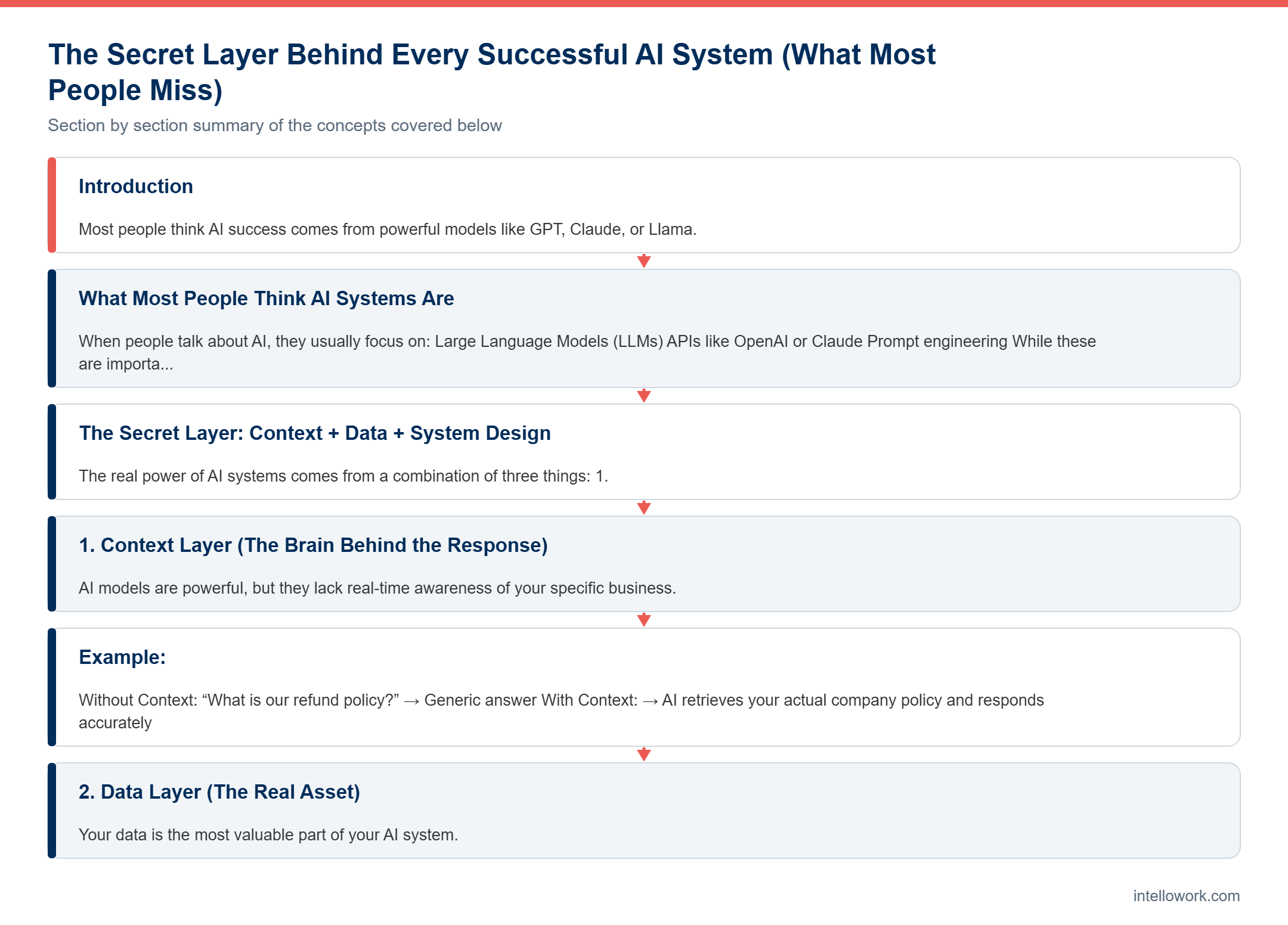
What Most People Think AI Systems Are
When people talk about AI, they usually focus on:
- Large Language Models (LLMs)
- APIs like OpenAI or Claude
- Prompt engineering
While these are important, they are only a small part of the system.
The Problem:
Relying only on models leads to:
- Generic responses
- Lack of business context
- Inconsistent performance
- Poor scalability
This is why many AI projects fail after initial hype.
The Secret Layer: Context + Data + System Design
The real power of AI systems comes from a combination of three things:
1. Context Layer
2. Data Layer
3. System Architecture
Together, they form the secret layer behind every successful AI system.
1. Context Layer (The Brain Behind the Response)
AI models are powerful, but they lack real-time awareness of your specific business.
The context layer solves this problem.
It provides:
- Relevant information
- Task-specific instructions
- Dynamic inputs
Why Context Matters
Without context:
AI gives generic answers
With context:
AI gives precise, relevant, and useful responses
Example:
Without Context:
“What is our refund policy?”
→ Generic answer
With Context:
→ AI retrieves your actual company policy and responds accurately
2. Data Layer (The Real Asset)
Your data is the most valuable part of your AI system.
This includes:
- Internal documents
- Customer data
- Knowledge bases
- Product information
Why Data is Critical
AI systems are only as good as the data they access.
High-quality data leads to:
- Better accuracy
- Better decision-making
- Better user experience
Structured vs Unstructured Data
Successful AI systems handle:
- PDFs
- Emails
- Databases
- APIs
This is where technologies like RAG (Retrieval-Augmented Generation) come into play.
3. System Architecture (The Execution Engine)
Even with great data and context, your AI system needs proper architecture.
This includes:
- APIs
- Retrieval systems
- Memory management
- Workflow automation
Key Components of a Strong AI Architecture
- Vector databases (for semantic search)
- LLM integration
- Orchestration frameworks
- Backend systems
Why Architecture Matters
Without proper architecture:
- Systems break under scale
- Responses become slow
- Accuracy drops
How RAG Connects Everything
RAG (Retrieval-Augmented Generation) is the bridge that connects:
- Data
- Context
- Models
It allows AI systems to:
- Retrieve relevant data
- Inject it into prompts
- Generate accurate responses
This is why RAG is considered a core part of modern AI systems.
Real-World Example of the Secret Layer
Let’s compare two AI systems:
Basic AI System:
- Uses GPT API
- Simple prompts
Result:
- Generic answers
- Limited usefulness
Advanced AI System (With Secret Layer):
- Uses RAG
- Has structured data pipelines
- Includes memory and workflows
Result:
- Accurate answers
- Business-specific insights
- Scalable performance
Why Most AI Projects Fail
Most failures happen because people ignore the secret layer.
They focus only on:
- Models
- UI
- Quick demos
Common Mistakes:
- No proper data pipeline
- No context management
- Poor architecture
- No scalability planning
How to Build a Successful AI System
If you want to build a real AI system, focus on:
1. Start with Data
- Organize your data
- Clean and structure it
2. Build Context Pipelines
- Use RAG
- Create dynamic prompts
3. Design Scalable Architecture
- Choose the right tools
- Plan for growth
4. Test in Real Scenarios
- Not just demos
- Real users and workflows
The Future of AI Systems
The future is not about better models alone.
It is about:
- Better systems
- Better integration
- Better data usage
Companies that understand this will:
- Build stronger AI products
- Gain competitive advantage
- Scale faster
Final Thoughts
The biggest misconception in AI today is that models are everything.
They are not.
The real magic happens in the secret layer behind the system — where data, context, and architecture come together.
If you focus on this layer, you won’t just build AI projects.
You will build AI systems that actually work.
Why the retrieval layer decides the outcome
Attention naturally goes to the model, since that is the part with a name and a version number. However, the layer between your data and the model does most of the work that users actually notice.
Consider what happens when an answer is wrong. Occasionally the model reasoned poorly. Far more often the right passage never reached it, because chunking split the answer, retrieval ranked it fourth, or a superseded document matched the wording better. In each of those cases a larger model changes nothing.
This is why teams who invest in chunking strategy, hybrid retrieval and reranking usually outperform teams who upgrade models. I set out the practical version of that argument in lessons from running retrieval in production.
Meanwhile the same layer carries your security model. Permissions applied during retrieval keep restricted content out of the context entirely, whereas filtering afterwards allows it to shape an answer invisibly. So the retrieval layer is where both accuracy and safety are genuinely decided.
What good looks like
- Chunks that preserve meaning. Split on structure rather than character count, so tables and procedures stay whole.
- Hybrid retrieval. Keyword matching catches codes and identifiers, vector search catches paraphrases, and each covers the other weakness.
- A reranking pass. A cross-encoder reorders candidates so the passage that answers the question reaches the top of the context.
- A refusal threshold. Below a confidence floor the system declines rather than improvising.
- A regression suite. A fixed question set, rerun after every content change, turns quality from opinion into measurement.
Notably, none of those five require a different model. They require engineering attention on the part of the system that rarely gets a headline.
Frequently asked questions
Is the model really less important?
Less important than most assume, once the model is reasonably capable. Retrieval quality sets the ceiling, and the model can only work with what it receives.
What is reranking?
A second scoring pass that compares the question directly against each candidate passage, then reorders them. It is slower than initial retrieval, so it runs on a small candidate set.
How do we know retrieval is the problem?
Inspect the passages sent to the model for a failed answer. If the correct passage is absent, retrieval failed. If it is present and the answer is still wrong, look at the model or the prompt.
Does better chunking really matter that much?
Yes. Splitting mid-table or mid-procedure guarantees incomplete answers, and no downstream step can restore information the chunk never contained.
Where should a team start improving?
Build a regression suite first. Without measurement, every subsequent change is a guess.
Related reading
- AI Powered Internal Search System: Complete Guide
- AI Powered Internal Search System for Enterprises: Complete Guide
- AI Based Document Search System: Complete Guide
The practical version of everything above is Intellowork: one knowledge base, cited answers, action agents that call your own APIs, and a named region for data residency.