Enterprise AI adoption is growing rapidly as organizations aim to leverage artificial intelligence for better decision-making, automation, and efficiency. However, despite the growing interest, many companies struggle to successfully implement AI solutions.
While AI promises significant benefits, the journey from experimentation to full-scale deployment is not easy. Organizations face multiple technical, operational, and strategic challenges that slow down adoption.
In this guide, we will explore the biggest challenges in enterprise AI adoption and how businesses can overcome them effectively.
Quick Answer
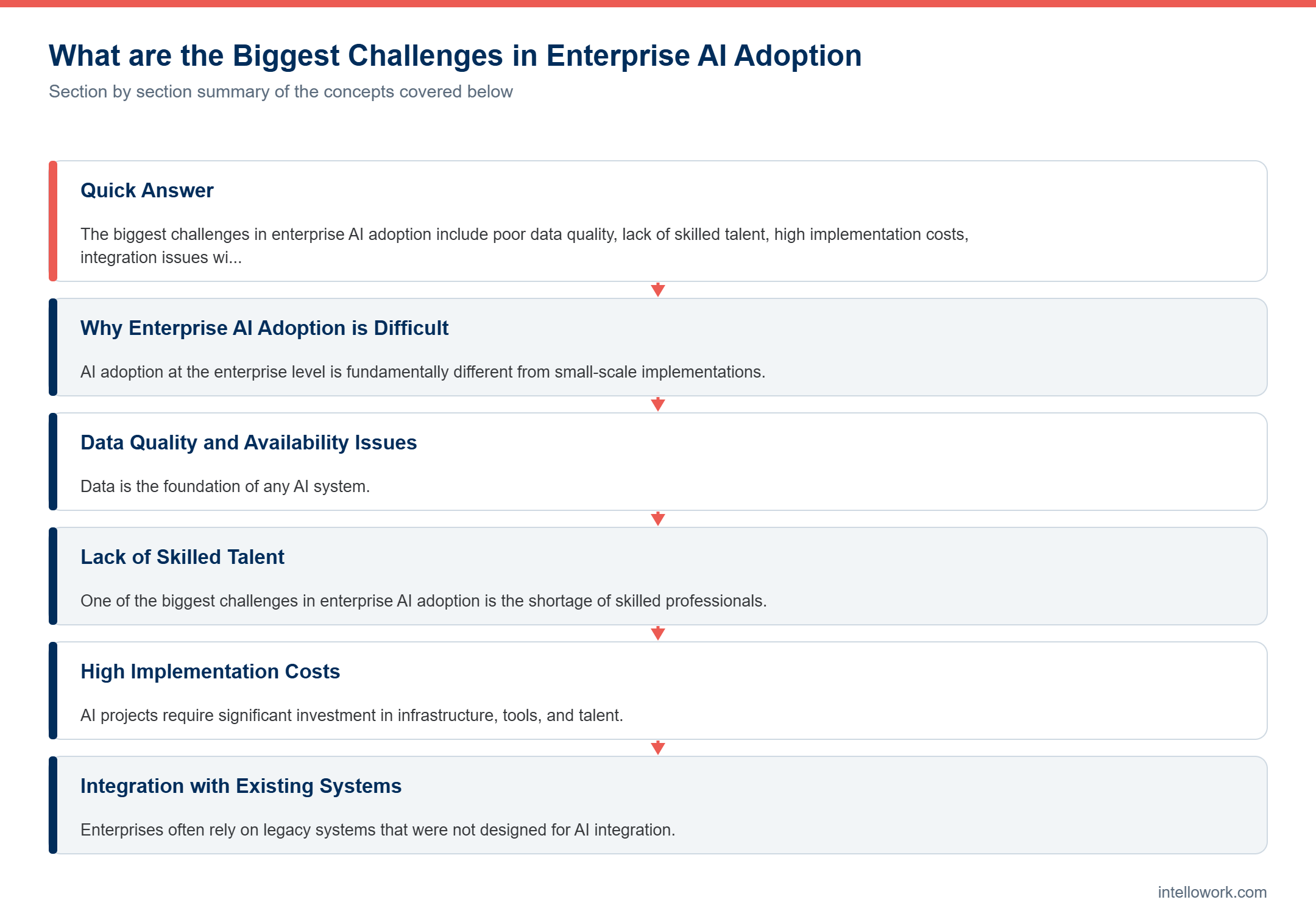
The biggest challenges in enterprise AI adoption include poor data quality, lack of skilled talent, high implementation costs, integration issues with existing systems, and concerns around security and governance.
Why Enterprise AI Adoption is Difficult
AI adoption at the enterprise level is fundamentally different from small-scale implementations. Large organizations deal with complex systems, massive datasets, and strict compliance requirements.
Unlike startups, enterprises cannot experiment freely without considering risks. Every decision impacts multiple departments, making implementation slower and more challenging.
Additionally, AI projects often require collaboration between data scientists, engineers, and business teams. Misalignment between these groups creates further complications.
Data Quality and Availability Issues
Data is the foundation of any AI system. However, most organizations struggle with poor data quality.
Enterprise data is often scattered across multiple systems. It may be incomplete, outdated, or inconsistent. This makes it difficult to train accurate AI models.
Another issue is data labeling. Many AI systems require labeled data, which is time-consuming and expensive to create.
Without high-quality data, even the most advanced AI models fail to deliver meaningful results.
Lack of Skilled Talent
One of the biggest challenges in enterprise AI adoption is the shortage of skilled professionals.
AI development requires expertise in machine learning, data engineering, and domain knowledge. Finding professionals with all these skills is difficult.
Even when companies hire talent, retaining them becomes a challenge due to high competition in the market.
Organizations must invest in training and upskilling their existing workforce to overcome this issue.
High Implementation Costs
AI projects require significant investment in infrastructure, tools, and talent.
Costs include:
Data storage and processing
Cloud services
Model development
Maintenance and updates
For many organizations, these costs become a barrier to adoption. Without a clear return on investment, companies hesitate to invest in AI initiatives.
Integration with Existing Systems
Enterprises often rely on legacy systems that were not designed for AI integration.
Integrating AI solutions with existing infrastructure is complex and time-consuming. It requires careful planning and customization.
Compatibility issues may arise, leading to delays and increased costs.
Successful AI adoption requires a well-defined integration strategy.
Data Security and Privacy Concerns
Enterprise data often includes sensitive information such as customer details and financial records.
Using this data in AI systems raises concerns about security and privacy. Organizations must comply with regulations and ensure data protection.
Failure to address these concerns can lead to legal issues and loss of trust.
Implementing strong security measures is essential for safe AI adoption.
Lack of Clear Strategy
Many organizations adopt AI without a clear strategy.
They invest in technology without defining specific goals or use cases. This leads to failed projects and wasted resources.
A successful AI strategy should align with business objectives. It should focus on solving real problems rather than experimenting without direction.
Change Management and Resistance
AI adoption often requires changes in workflows and processes.
Employees may resist these changes due to fear of job loss or lack of understanding. This resistance slows down implementation.
Organizations must focus on change management and educate employees about the benefits of AI.
Building trust is crucial for successful adoption.
Scalability Challenges
Many AI projects start as small experiments but fail to scale.
Scaling AI systems requires robust infrastructure and efficient processes. It also involves handling large volumes of data and ensuring consistent performance.
Without proper planning, scaling becomes a major challenge.
Ethical and Bias Issues
AI systems can sometimes produce biased or unfair results.
This happens when training data contains biases. In enterprise environments, this can lead to serious consequences.
Organizations must ensure fairness and transparency in AI systems. Regular audits and monitoring can help identify and address biases.
How to Overcome Enterprise AI Challenges
Despite these challenges, organizations can successfully adopt AI with the right approach.
Start with clear goals and identify high-impact use cases. Focus on data quality and invest in data management systems.
Build a strong team with the right skills. Consider partnerships with external experts if needed.
Adopt scalable infrastructure and use cloud-based solutions. Implement strong security measures to protect data.
Most importantly, create a culture that supports innovation and continuous learning.
Real World Applications of Enterprise AI
Many organizations are already using AI successfully.
In finance, AI is used for fraud detection and risk analysis. In healthcare, it helps in diagnosis and patient care.
Retail companies use AI for personalized recommendations. Manufacturing industries use it for predictive maintenance.
These examples show that AI adoption is possible with the right strategy.
Future of Enterprise AI Adoption
The future of enterprise AI looks promising.
Advancements in technology are making AI more accessible and affordable. Tools and platforms are becoming easier to use.
Automation will continue to grow, and AI will play a central role in business operations.
Organizations that overcome current challenges will gain a significant competitive advantage.
Conclusion
Enterprise AI adoption offers immense opportunities, but it comes with significant challenges.
From data issues and talent shortages to integration and security concerns, organizations must address multiple obstacles.
With a clear strategy, strong data foundation, and skilled workforce, businesses can successfully implement AI solutions.
The key is to focus on long-term value and continuous improvement.
FAQ
What are the biggest challenges in enterprise AI adoption
The main challenges include data quality, lack of talent, high costs, integration issues, and security concerns
Why do AI projects fail in enterprises
They fail due to poor planning, lack of data, and unclear business goals
How can companies overcome AI challenges
By focusing on strategy, data quality, and skilled teams
Is AI adoption expensive
Yes, but costs can be managed with proper planning and cloud solutions
What is the future of enterprise AI
AI will become a core part of business operations and decision-making
Related reading
- Who Is Tarun Gupta? The AI Architect Building India’s Next Generation of Enterprise AI Solutions
- AI Infrastructure: The Foundation of Modern Enterprise Intelligence
- Enterprise AI Automation Services in India: Complete Guide
Building something similar? Intellowork turns your existing documentation, websites and APIs into cited answers across a web widget, WhatsApp, Slack and a direct API, with permission-aware retrieval and data residency in your chosen region.