Security reviews for assistants usually stall on the same sentence. The vendor says data is hosted in India, the security lead asks whether the model runs there too, and the room goes quiet. That gap is exactly what AI chatbot data residency means in practice, and it is where most deployments run into trouble.
The timing matters as well. India Digital Personal Data Protection Rules were notified on 14 November 2025, and the legacy data revalidation deadline falls on 13 November 2026. Soft enforcement ends around the same point. Consequently teams deploying an assistant this quarter are building something that must satisfy a regulator very soon.
This guide covers AI chatbot data residency end to end: where your data travels during a single answer, the seven control layers a security review will ask about, how the Act applies to conversational systems, and the questions that separate a serious vendor from an optimistic one.
Where your data actually goes
Start with the path rather than the policy, because AI chatbot data residency is decided hop by hop. One question produces six distinct hops, and each hop is a separate residency decision.
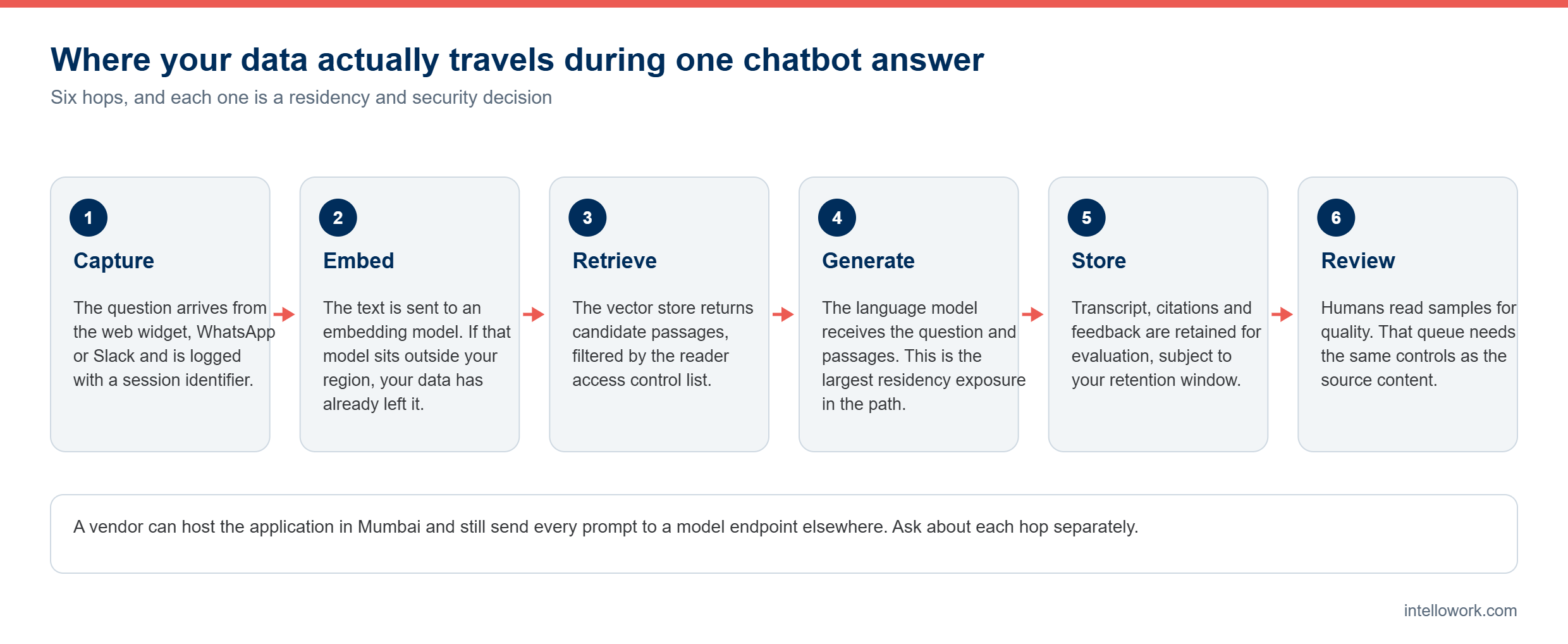
Notice hop two and hop four in particular. Embedding turns your text into vectors, and generation sends both the question and the retrieved passages to a language model. So if either endpoint lives outside your chosen region, your content has crossed a border regardless of where the database sits.
Meanwhile hop six catches people out. Quality review queues contain real conversations, which means whoever reads them needs the same access controls as the underlying documents. Many teams tighten retrieval carefully and then leave the review console open to the whole support organisation.
Three AI chatbot data residency options, and what each one buys
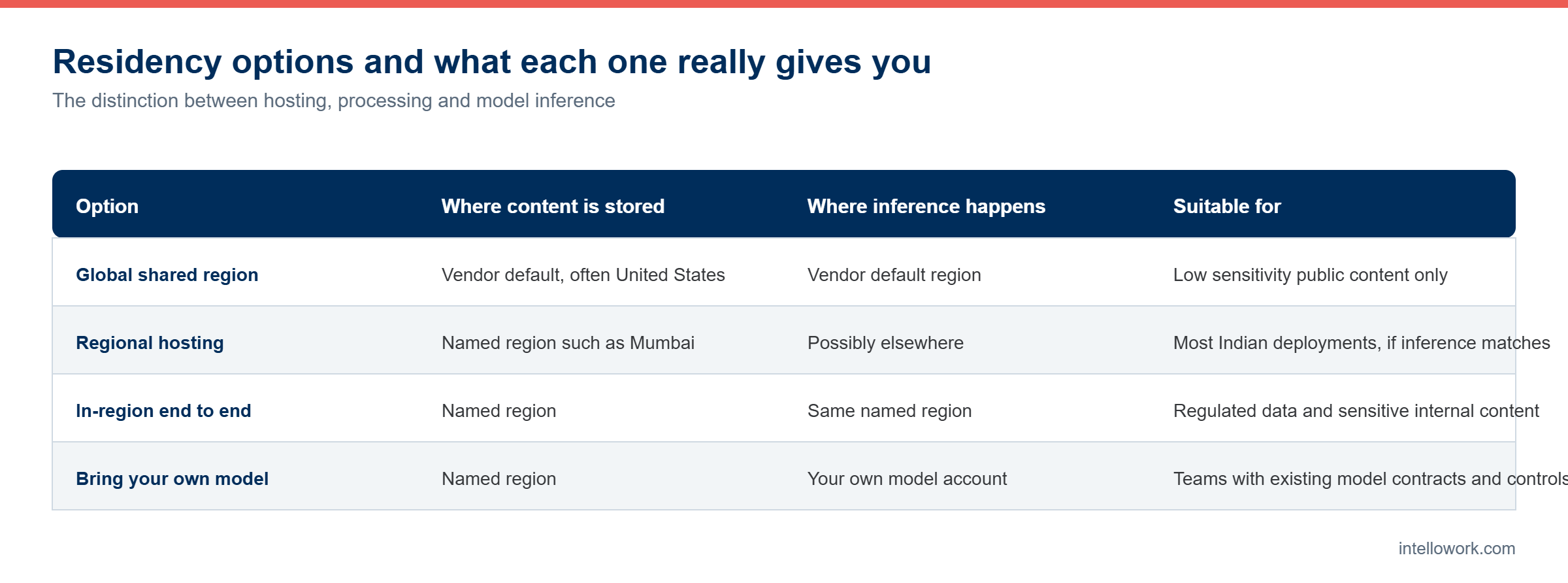
Regional hosting alone is the option most vendors describe when they claim AI chatbot data residency. It puts your documents and transcripts in a named region such as Mumbai, which is meaningful. However, inference may still happen elsewhere, so the sensitive part of the path stays outside your boundary.
End-to-end in-region processing closes that gap. Both storage and inference stay inside the named region, which is what a regulated buyer generally needs. Bring your own model achieves something similar by different means, since prompts go to a model account you already control and govern.
Therefore the useful question is never simply whether a vendor supports Indian residency. Ask which of these three shapes they are offering, and ask them to name the region for storage and for inference separately.
Seven AI chatbot data residency and security control layers
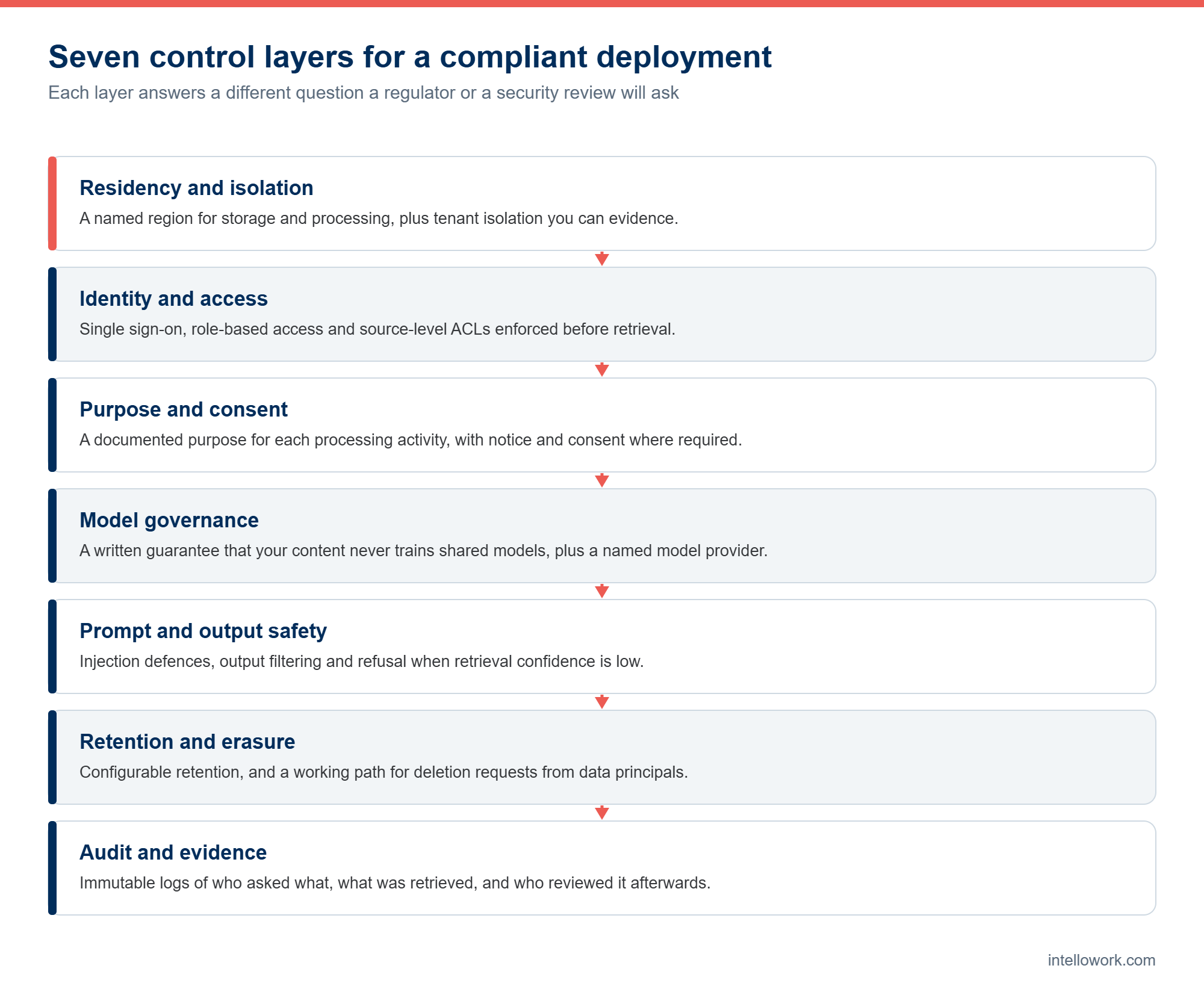
Residency and isolation
Beyond the region itself, ask how tenants are separated. Shared indexes with a filter applied at query time behave very differently from isolated workspaces. Ask for evidence rather than assurance.
Identity and permission-aware retrieval
Single sign-on through your existing provider is table stakes. The harder requirement is that source-level access control lists apply before retrieval, not after generation. Otherwise restricted content still shapes the answer even when it never appears verbatim.
Purpose, notice and consent
Under the Act you need a documented purpose for each processing activity, along with notice and consent where the lawful basis requires it. Conversational logs count, since they contain personal data supplied by the person asking. My DPDP compliance checklist works through this in more detail.
Model governance
Get a written statement that your content never trains shared models. Additionally, ask which providers sit behind the assistant, because a vendor who cannot name their model provider cannot make promises about it either.
Prompt and output safety
Retrieved content is untrusted input. As a result, an attacker who can place text in a document you index may attempt to redirect the assistant. I covered the mechanics in how prompt injection works, and the defence combines input handling, output filtering and refusal thresholds.
Retention and erasure
Data principals can ask for erasure, so your assistant needs a working deletion path that reaches transcripts, embeddings and review queues. Configurable retention windows matter here, since indefinite storage is difficult to justify.
Audit and evidence
Finally, keep immutable logs of who asked what, which passages were retrieved and who reviewed the exchange later. Auditors ask for evidence rather than architecture diagrams, and this is the layer that produces it.
How the DPDP framework applies to assistants
The Act treats your organisation as a data fiduciary and your users as data principals. So the obligations you already carry for forms and databases extend naturally to conversations. Nevertheless three points deserve specific attention.
First, the significant data fiduciary thresholds include handling sensitive data with automated decision-making. Because assistants increasingly take actions rather than only answering, teams that thought the threshold did not apply should re-examine that assumption.
Second, the legacy data revalidation deadline on 13 November 2026 covers historical personal data. Old chat transcripts and support archives frequently become training or retrieval corpora, so they fall squarely inside that requirement.
Third, significant data fiduciaries face an audit cycle beginning in the first quarter of 2027, including an India-based data protection officer, independent audits and impact assessments. Consequently a AI chatbot data residency decision taken now will be examined by an auditor within about eighteen months.
The vendor questionnaire that saves a quarter
Send this before the technical deep dive. Written answers reveal far more than a demonstration, and the differences between vendors emerge quickly.
- Name the region where our documents, embeddings and transcripts are stored.
- Name the region where embedding and generation happen, and confirm whether those are the same region.
- Which model providers process our prompts, and can we bring our own model account instead?
- Is our content ever used to train shared models, and will you state that in the contract?
- Where in the pipeline are source-level access control lists applied?
- How is our workspace isolated from other customers at the index level?
- What retention windows are configurable, and how does a deletion request propagate?
- Who inside your organisation can read our conversation transcripts, and how is that logged?
- What defences exist against instructions embedded in indexed documents?
- Which certifications and audit reports can you share under a non-disclosure agreement?
Question two settles most arguments. A vendor who answers it precisely understands AI chatbot data residency. Meanwhile a vendor who returns to talking about hosting has told you something useful too.
A practical rollout sequence
You do not need every AI chatbot data residency control on day one. Still, the order matters, because retrofitting identity and residency is far harder than adding them at the start.
- Weeks one and two. Fix the region for storage and inference, and confirm the no-training commitment in writing.
- Weeks three and four. Wire single sign-on and map source-level permissions onto your content before you index anything sensitive.
- Weeks five and six. Set retention windows, build the deletion path and lock down the review console.
- Weeks seven and eight. Run adversarial testing, including injection attempts through indexed documents and permission probes from a low-privilege account.
- Ongoing. Rerun that test suite whenever the corpus changes, since new content introduces new exposure.
Notably, step four often surfaces the most uncomfortable findings. Teams discover that a shared drive nobody remembered indexing contains material that should never have reached retrieval.
Common mistakes
- Treating hosting as residency. The application region and the inference region are different questions, and only the second protects the prompt.
- Indexing first and permissioning later. Once restricted content enters an index, removing its influence is messy and rarely complete.
- Forgetting the transcripts. Conversations contain personal data, so retention, access and erasure apply to them as much as to your documents.
- Ignoring the review queue. Human quality review is a legitimate purpose, yet it needs its own access controls and logging.
- Assuming a certificate settles it. A compliance badge describes the vendor organisation, not your specific configuration.
Each of these appears repeatedly in AI chatbot data residency reviews, and each is straightforward to avoid when raised early. For the broader threat picture around these systems, my post on enterprise AI security covers the surrounding risks.
How Intellowork handles this
For transparency, this is the category I build in. Intellowork defaults to the Mumbai region for data residency, with European and United States options available, and it isolates each customer workspace rather than sharing an index.
Retrieval respects source-level access control lists, so a reader only ever influences an answer with content they could open themselves. Single sign-on works through Keycloak, Google, Azure Active Directory, Okta or any OpenID Connect provider, and audit logging records both queries and retrieved passages. Teams who prefer to keep inference under their own contract can bring their own model from OpenAI, Bedrock or Anthropic.
That architecture exists because AI chatbot data residency questions arrive in almost every enterprise conversation now, and answering them after the build is considerably more expensive than designing for them first.
What changes once the assistant takes actions
Answering is one risk profile. Acting is another. Once an assistant can look up an order, raise a ticket or book a slot, it reaches into systems that hold far more than the documents you indexed. Consequently the AI chatbot data residency question widens to cover those systems too.
Three controls handle most of this. First, scope every integration credential narrowly, so the assistant can read an order status without reading the whole customer record. Second, require an explicit confirmation step before any write action. Third, log the action alongside the conversation that triggered it, because an auditor will want to trace both together.
Additionally, decide where the action payloads travel. If a lookup passes customer details to a model for formatting, that is another crossing. Keeping formatting logic in your own code rather than in the prompt avoids the issue entirely.
Multilingual deployments and residency
Indian deployments rarely stay in one language. Users switch between English, Hindi and Hinglish freely, sometimes inside a single sentence. Therefore your retrieval stack needs multilingual embeddings and a reranking step that treats languages fairly.
This intersects with residency more than teams expect. Multilingual models are sometimes available only in specific regions, so a vendor may quietly route those requests elsewhere. So add one line to your questionnaire: does the multilingual path use the same region as the default path? A vendor serious about AI chatbot data residency will answer without hesitating.
Meanwhile transliterated content creates a second issue. Hinglish written in Latin script often fails to match Devanagari source documents, which pushes teams toward machine translation as a workaround. Translation adds another external call, and therefore another residency question.
Building the evidence pack
Security reviews go faster when you arrive with evidence rather than intentions. Assemble this pack once, then reuse it for every internal approval and every customer questionnaire.
- Architecture note. One page naming the region for storage, embedding, generation and review, plus the model providers involved.
- Data inventory. Which sources are indexed, who owns each one and what personal data each may contain.
- Permission map. How source access control lists translate into retrieval filters, with a worked example for two roles.
- Retention schedule. Windows for transcripts, embeddings, feedback and review records, plus the deletion path for each.
- Test results. Outcomes from permission probes, injection attempts and refusal testing, dated and repeatable.
- Contract extracts. The no-training clause, the residency commitment and the breach notification terms.
That pack answers roughly eighty percent of what reviewers ask. Furthermore it turns AI chatbot data residency from a debate into a document, which shortens approval cycles considerably.
Who owns this internally
One last practical point. Assistants tend to be procured by support or operations, secured by an infrastructure team and audited by legal, and none of those three groups owns the corpus. As a result, content quietly drifts and nobody notices until an answer embarrasses someone.
Name a single owner for the knowledge base at kickoff. Give that person authority to retire outdated documents, and put quarterly permission reviews in their calendar. This costs very little, yet it prevents the slow decay that turns a well-governed deployment into a liability. Teams who skip it usually revisit their AI chatbot data residency controls after an incident rather than before one.
Frequently asked questions
Does hosting in India satisfy DPDP requirements for an assistant?
Not on its own. Storage location is one control among several, and inference location, access control, retention and audit evidence all matter. Ask about each separately.
Does the DPDP Act require data localisation?
The Act permits cross-border transfer except to countries the government restricts, so it is not a blanket localisation mandate. However, many enterprises adopt in-region processing anyway to simplify audits and contractual assurances.
What happens on 13 November 2026?
That is the legacy data revalidation deadline, after which historical personal data should rest on valid notice and consent. Soft enforcement ends around the same period, so supervision becomes active.
Are chat transcripts personal data?
Usually yes, because people include names, order numbers and contact details while asking questions. Therefore transcripts need the same retention, access and erasure handling as your other records.
Can we use a general assistant for internal documents instead?
It is risky, since uploads flatten permissions and residency guarantees vary by plan. A platform with permission-aware retrieval and a named region gives you evidence you can show an auditor.
The short version
Map the six hops. Ask separately about storage and inference. Then work through the seven control layers, put permissions in before you index, and keep evidence rather than assurances. Handled that way, AI chatbot data residency becomes a design decision rather than a late surprise in a security review.
If you want to see a permission-aware, in-region deployment running on your own documentation, Intellowork is a practical starting point.