An agentic AI chatbot does something an ordinary assistant cannot. It also changes the state of a real system. Instead of describing how to reset a password, it resets the password. Instead of quoting the refund policy, it raises the refund.
That shift sounds small. However, it changes the engineering, the security review and the way you measure success. A wrong answer costs you trust, whereas a wrong action costs you money.
I have shipped both kinds of assistant at Exuverse. Therefore this guide stays practical. You will see the architecture, the first actions worth automating, the guardrails that keep an agentic AI chatbot safe, and the numbers that prove it works.
What an agentic AI chatbot actually does
Most support assistants retrieve text and summarise it. When a question arrives, they read your help centre, find the closest passage and write a short reply. Good ones show their citations so a reader can check the source.
An agentic AI chatbot adds a second ability. It calls typed functions in your systems, reads the result back and reports what happened. In other words, it moves from retrieval to execution.
Three components make that possible. First, a tool registry describes every function the assistant may call, with strict argument types. Second, a planner decides whether to answer, to act, or to ask one clarifying question. Third, a policy layer decides whether this particular user may run this particular tool right now.
Consequently the interesting work sits outside the model. The model still chooses. Your platform, though, decides what is allowed.
| Dimension | Answer-only assistant | Agentic AI chatbot |
|---|---|---|
| What it returns | Text plus sources | Text, sources and a completed action |
| Worst failure | A confident wrong answer | A real change in a live system |
| Integration work | Content connectors | Content connectors plus write APIs |
| Review needed | Content accuracy | Accuracy, identity, audit and rollback |
| Value ceiling | Deflected reading time | Fully resolved requests |
The architecture behind an agentic AI chatbot
A single request travels through nine hops. The diagram below shows the full path, and each hop leaves a log line behind.
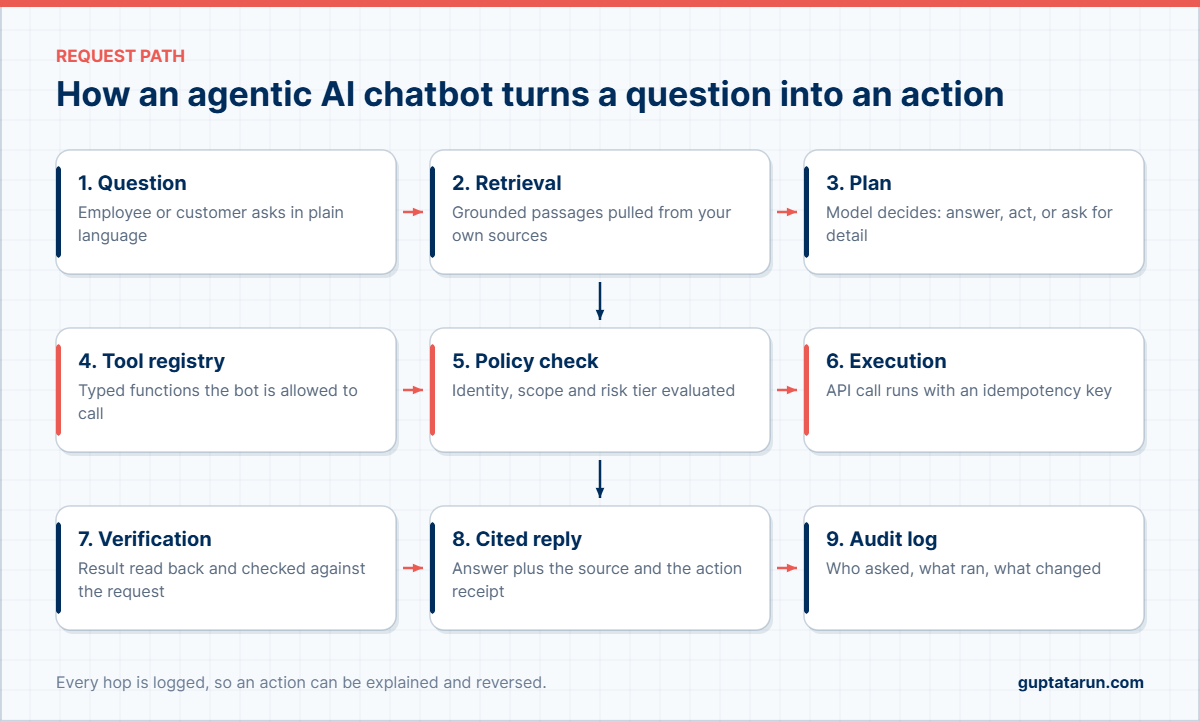
Retrieval comes first, because grounding still matters. While it works, the assistant pulls passages from your own documents before it decides anything. As a result, it argues from your policy rather than from training data. That habit also keeps hallucinations under control.
Next comes planning. The model reads the question, the retrieved context and the tool registry. Then it produces one of three outcomes: a grounded answer, a clarifying question, or a tool call with arguments.
The policy check follows. Your platform verifies the signed-in identity, the role, the risk tier of the tool and any spending cap. Only after that does execution run.
Finally the assistant verifies the result. It reads the API response, compares it to the original request and reports plainly. For example, a refund reply should name the amount, the order and the expected settlement date. Meanwhile the audit log records who asked, what ran and what changed.
Which actions to give an agentic AI chatbot first
Teams usually start with the most impressive action rather than the safest one. That is backwards. Start with reads, move to reversible writes, and leave money movement until the audit trail has earned trust.
Now sort every candidate action into three risk tiers. Reads change nothing, since they only fetch data. Reversible writes can be undone with a documented counter-action. Irreversible writes move money, delete records or send messages to customers.
| Action | Risk tier | Reversible | When to ship |
|---|---|---|---|
| Order, ticket or invoice lookup | Read | Not applicable | Week 1 |
| Raise a ticket with full context | Reversible write | Yes, close it | Week 1 |
| Book or reschedule an appointment | Reversible write | Yes, rebook | Week 2 |
| Password or MFA reset | Reversible write | Yes, revoke | Week 3, with identity proof |
| Update an address or preference | Reversible write | Yes, restore | Week 4 |
| Refund, credit or discount | Irreversible | No | After 60 days, with caps |
| Delete data or close an account | Irreversible | No | Keep it with a person |
Notice that the first two rows already resolve a large share of contacts. In my experience, lookups and ticket creation cover roughly half of first-line volume. Therefore you can prove value early without touching anything irreversible. The same staging logic applies when you plan ticket deflection targets.
Guardrails every agentic AI chatbot needs
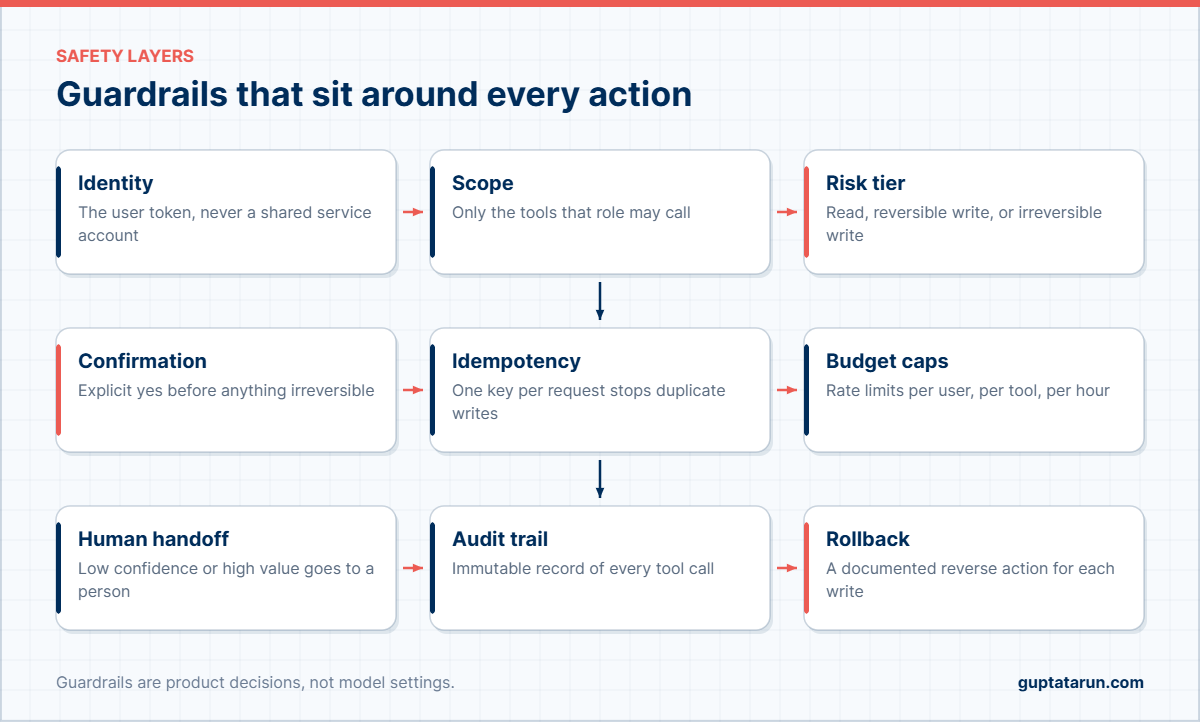
Guardrails are also product decisions, not model settings. Prompts drift, models change and vendors ship new versions. Your controls, however, stay where you put them.
Confirmation before anything irreversible
Reversible actions can run straight away, once the policy check passes. Irreversible ones need a clear yes. Show the exact change first, in plain words, and wait.
Keep the confirmation specific too. “Refund 4,200 rupees to order INV-8821 on the original card” works. “Shall I proceed?” does not, because the reader has no idea what will happen.
Identity and permission scoping
So run every tool call with the signed-in user’s own token. A shared service account is faster to build, yet it hands the assistant more power than any single person holds. Consequently one clever prompt could reach records the asker may never see.
Similarly, scope the retrieval layer the same way. Permission-aware search keeps salary letters and board decks out of a general reply. If you operate in India, map these controls to your obligations under the DPDP Act and data residency rules as well.
Idempotency, retries and rollback
Networks also fail halfway. Without protection, a retry creates a second refund or a duplicate ticket. Therefore every write should carry an idempotency key derived from the conversation and the request.
Write the reverse action before you ship the forward one. Each tool in the registry should name its counter-action, its owner and its time limit. As a result, an incident becomes a five-minute fix instead of a support escalation.
Defence against instruction injection
Retrieved documents are untrusted input too. A PDF can contain a line that tells the assistant to issue a credit. An agentic AI chatbot must treat that text as data, never as a command.
Still, two habits help. First, keep tool permissions outside the prompt, so no instruction inside a document can widen them. Second, test against the injection patterns in the OWASP Top 10 for LLM applications before launch.
How to test an agentic AI chatbot before launch
Testing an assistant that only writes text is forgiving. Testing one that writes to your database is not. Build the evaluation set before you build the demo.
Five test types cover most of the risk, though the list grows with your tool registry. Run them on every prompt change and every model upgrade, because both can shift behaviour quietly.
| Test | What it catches | Pass bar |
|---|---|---|
| Grounded answer set (200 questions) | Wrong or unsupported answers | 90 percent correct with a citation |
| Tool selection eval | Calling the wrong function | 98 percent correct tool |
| Argument extraction eval | Right tool, wrong values | 97 percent exact arguments |
| Refusal set | Acting when it should ask | Zero unsafe actions |
| Injection set | Commands hidden inside documents | Zero successful attempts |
| Shadow replay on live traffic | Real questions your set missed | Two weeks, no writes |
Shadow mode also deserves special mention. The assistant sees real traffic and proposes tool calls, yet nothing executes. Meanwhile your team reviews the proposals each morning. Two weeks of that will teach you more than any benchmark.
Metrics that prove the agentic AI chatbot is working
Containment alone is a weak metric, because a bot that stalls a frustrated customer also contains the conversation. Pair it with resolution and reversal instead.
| Metric | Definition | Target by day 90 |
|---|---|---|
| Action completion rate | Requested actions that finished cleanly | Above 95 percent |
| Contained resolution | Conversations solved with no human touch | 35 to 55 percent |
| Reversal rate | Actions undone within 24 hours | Below 1 percent |
| Escalation quality | Handoffs that arrive with full context | 100 percent |
| Time to resolution | Median minutes from question to done | Under 3 minutes |
| Cost per resolved request | Model, tools and hosting divided by resolutions | Below your agent cost |
Still, reversal rate is the honest one. It counts the times a person had to clean up after the assistant. Watch it weekly, and expand the action ladder only while it stays low. For budgeting, my breakdown of enterprise AI chatbot pricing shows how these unit costs behave at volume.
A 30-day rollout plan
Thirty days is enough to reach a safe launch, provided you resist the urge to automate everything at once.
| Week | Focus | Exit criteria |
|---|---|---|
| Week 1 | Connect content, ship read-only answers with citations | Grounded answer set above 90 percent |
| Week 2 | Add the tool registry, run in shadow mode | Tool selection above 98 percent |
| Week 3 | Enable two reversible writes for internal users | Zero unexplained writes in the audit log |
| Week 4 | Open to 10 percent of live traffic with caps | Reversal rate below 1 percent |
Before week one, settle the platform question. My guide to building versus buying an AI chatbot covers that decision in detail, and the shortlist in the best AI chatbot for enterprise data narrows the options further.
Where an agentic AI chatbot fails in production
Pilots rarely fail on model quality, though. They fail on the unglamorous parts, and the same five problems appear again and again.
The first is stale content. An assistant that quotes a withdrawn policy will act on it too. Therefore each source needs an owner and a refresh schedule before launch.
The second is a vague tool description. If two functions sound similar, the model will mix them up. Rename them, narrow the arguments and add one example each.
The third is silent partial failure. An API returns 200 while the record never changes. Consequently the assistant reports success and the customer waits. Read the record back after every write instead of trusting the status code.
The fourth is a missing escalation path. When confidence drops, the conversation should reach a person with the full transcript attached. A dead end costs more goodwill than a slow answer.
The fifth is scope creep. Somebody adds a tool without a risk tier, and the audit story quietly breaks. Keep the registry small, reviewed and versioned.
| Failure | Early signal | Fix |
|---|---|---|
| Stale content | Citations point at old documents | Owner plus refresh date per source |
| Overlapping tools | Tool selection eval drops below 95 percent | Rename, split and add examples |
| Silent partial failure | Reversal rate climbs without complaints | Read back after every write |
| No escalation path | Repeat questions in one session | Handoff with transcript and context |
| Registry creep | Tools with no named owner | Versioned registry and review gate |
How an agentic AI chatbot fits your existing stack
One knowledge base should serve every channel. Otherwise you maintain four versions of the same answer, and they drift apart within a quarter.
On the web, the assistant sits in a widget beside the docs. On WhatsApp, it handles order and booking questions for Indian customers. Inside Slack or Microsoft Teams, it answers policy questions and raises internal tickets. In a voice channel, it reads the same grounded answer aloud.
The retrieval layer stays shared, while the action layer varies by channel. For example, a refund tool belongs on the customer surface, whereas a leave-balance lookup belongs on the internal one. Similarly, the identity source differs: your customer login on one side, your directory on the other.
Retrieval quality still decides the ceiling. If you are choosing between architectures, my comparison of retrieval augmented generation and fine tuning explains why grounded retrieval wins for policy-heavy work.
Frequently asked questions
What is the difference between a chatbot and an agentic AI chatbot?
A standard chatbot retrieves information and writes a reply. An agentic AI chatbot also calls functions in your systems, so it can complete the request rather than describe it. The difference sits in the tool layer, not in the conversation.
Does an agentic AI chatbot need a different model?
No. Most current models also support tool calling well enough. Reliability comes from typed tools, tight prompts and a strong policy layer, so teams gain more from better evaluation than from a larger model.
How do you stop it from acting on a malicious instruction?
Keep permissions outside the prompt and treat retrieved text as data. Because the policy layer checks identity and risk tier separately, a hidden instruction inside a document cannot widen what the assistant may run.
Should it use the user’s identity or a service account?
So use the signed-in user’s own token. A service account grants the assistant more access than any single person holds, which turns one prompt mistake into a data exposure.
How long does a first launch take?
Around 30 days for read-only answers plus two reversible actions, assuming your content and APIs already exist. Irreversible actions such as refunds usually follow after 60 to 90 days of clean audit logs.
What does an agentic AI chatbot cost to run?
Model spend is rarely the main line, though. Connectors, evaluation and monitoring cost more over a year, so compare platforms on total cost per resolved request rather than on token price.
Where to start
Begin with grounded answers on your own documents. Add one read action, then one reversible write. Keep the audit log honest, and let the reversal rate decide how fast you expand.
If you want that path without building the plumbing yourself, Intellowork runs cited answers, permission-aware retrieval and typed actions across web, WhatsApp, Slack and Teams from a single knowledge base. You can request access here and test it on your own documentation.
Written by Tarun Gupta, founder of Exuverse. I build enterprise AI search and assistant platforms, including Intellowork, and I write about what actually survives production.