Ask five vendors what an assistant will cost and you will get five numbers that cannot be compared. One quotes per seat. Another quotes per resolution. A third quotes per employee across your whole company. Consequently enterprise AI chatbot pricing looks deliberately confusing, and to be fair, sometimes it is.
However, the structure underneath is simple once you separate the billing model from the rate. This guide walks through the four models in use during 2026, the publicly listed figures, the costs that never appear on a quote, and a worksheet for building a twelve-month number you can defend in a budget meeting.
Above all, remember one thing before you read the price list. In enterprise AI chatbot pricing, the licence is usually the smallest part of what you will spend.
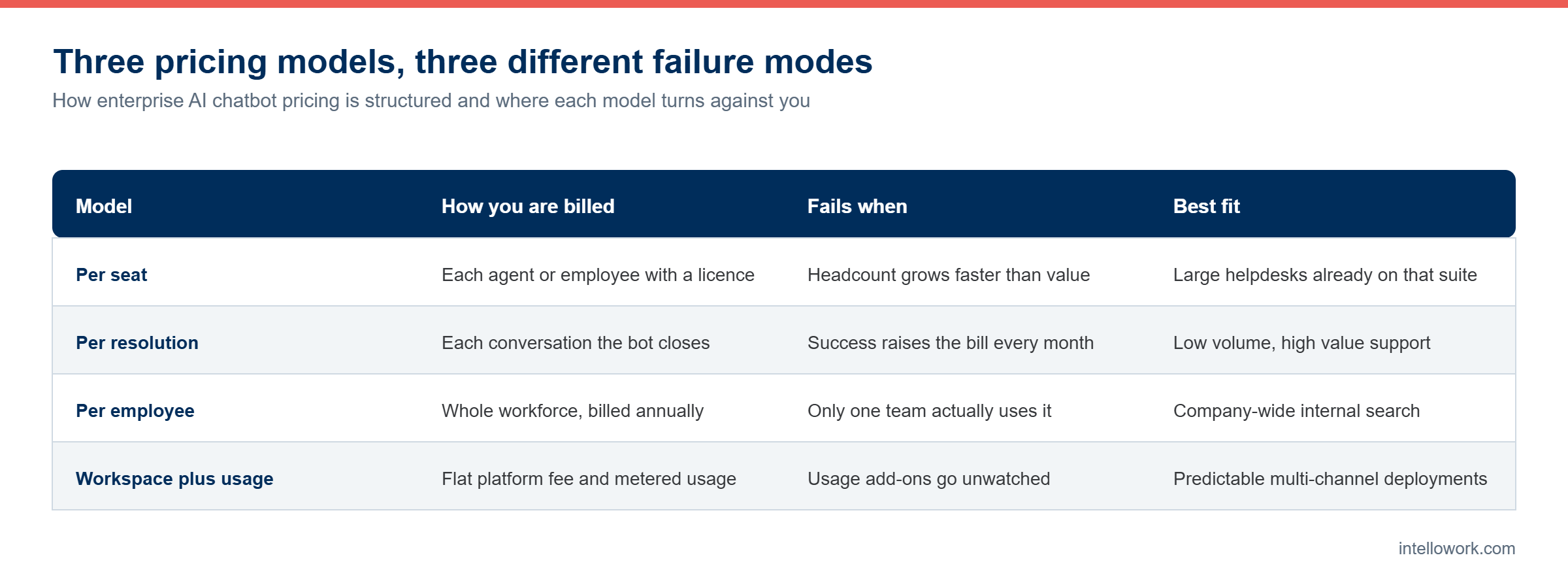
The four pricing models behind every quote
Per seat
Support suites bill for each agent holding a licence. Because of this, cost tracks headcount rather than value. So a growing support team pays more even when the assistant carries a larger share of the work. Per-seat enterprise AI chatbot pricing therefore suits teams whose headcount is stable and whose agents already live in that suite.
Per resolution
Here you pay whenever the bot closes a conversation without a human. It sounds fair, and in a low-volume setting it genuinely is. Yet the incentive inverts at scale: the better your assistant performs, the larger your invoice becomes. Meanwhile the definition of a resolution belongs to the vendor, so read that clause closely.
Per employee
Enterprise search copilots often price across the whole workforce, billed annually. That model works when everyone genuinely searches. On the other hand, if only two departments adopt the tool, effective cost per active user climbs quickly and renewal conversations get uncomfortable.
Workspace plus usage
A flat platform fee covers the workspace, then metered usage covers volume. This is the most forecastable shape, since you can model both halves. Still, watch the add-ons. Extra channels, extra content sources and higher retention windows all attach to that meter.
What the market actually charges in 2026
Published enterprise AI chatbot pricing moves constantly, so treat the figures below as shape rather than quote. Nevertheless they anchor the conversation usefully.
- Intercom Fin lists roughly one United States dollar per resolution, with seats priced separately from about twenty-nine dollars each month.
- Gorgias lists about one dollar per AI resolution, on top of plans that run from roughly ten to three hundred and sixty dollars monthly.
- Zendesk suite tiers run from about fifty-five to one hundred and sixty-nine dollars per agent each month, with AI add-ons adding roughly fifty dollars per agent.
- Tidio Lyro starts near thirty-two dollars monthly for fifty AI conversations, then charges around fifty-eight cents for each extra conversation.
- Freshchat starts near nineteen dollars per seat monthly, with AI session overages around forty-nine dollars per hundred sessions.
- Chatfuel scales from about twenty-four dollars for a thousand conversations to roughly two hundred and sixteen dollars for ten thousand.
Notice the pattern. Entry pricing looks approachable everywhere, and then volume decides everything. As a result, enterprise AI chatbot pricing comparisons only become meaningful once you plug in your own monthly question count.
The costs that never appear on the quote
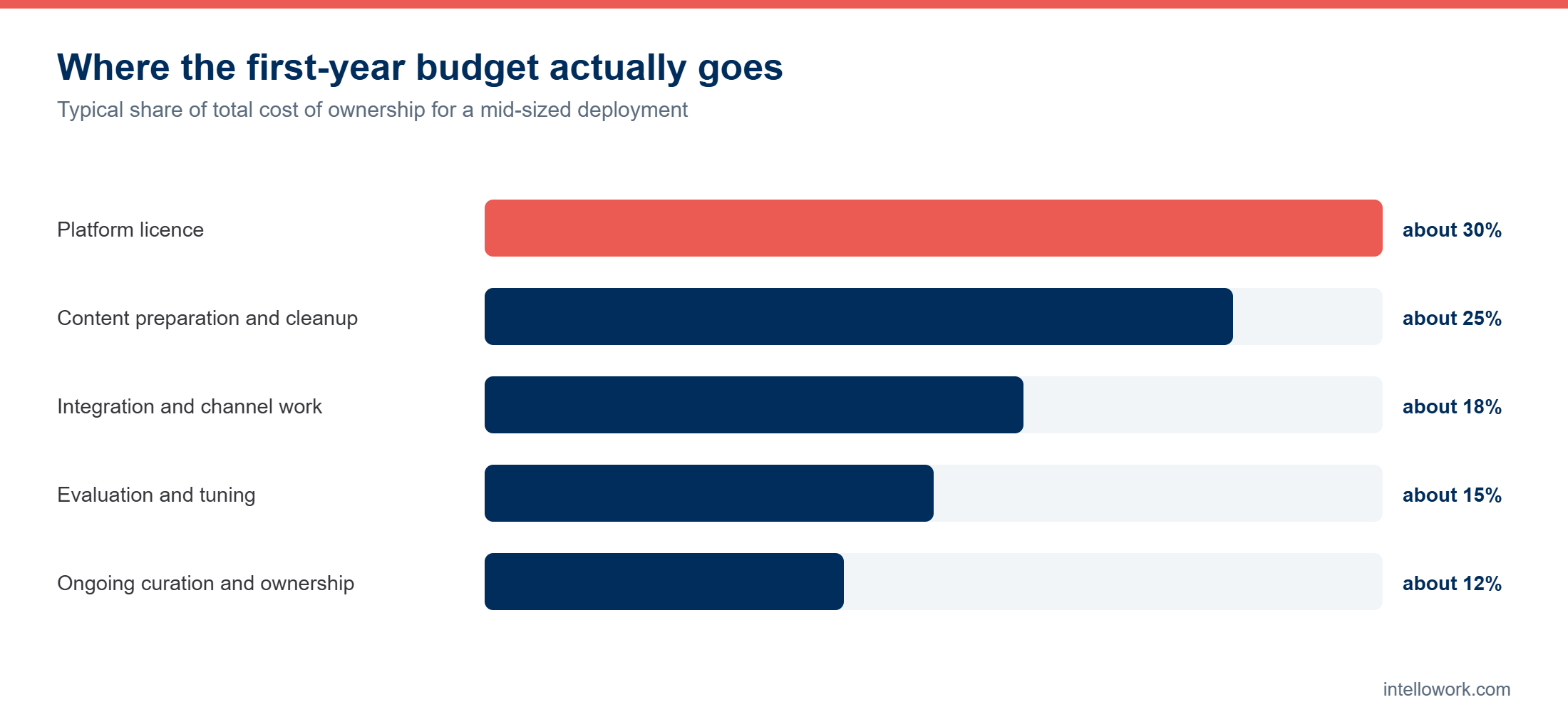
This chart surprises people, because most enterprise AI chatbot pricing discussions never reach these lines. So let me break down each one.
Content preparation
Your documentation was written for humans who skim. Retrieval needs something different: consistent structure, clear headings, resolved contradictions and retired old versions. Consequently teams spend weeks here, and skipping the work simply moves the cost into poor answers later. My guide to turning documentation into an AI chatbot covers this stage properly.
Integration and channels
Every channel adds work. A web widget is straightforward, while WhatsApp needs business verification and Slack or Microsoft Teams needs app approval inside your tenant. Similarly, action agents that call your own systems need authentication, validation and a confirmation step.
Evaluation and tuning
Without a regression suite you cannot tell whether last week change helped. Therefore build a question set early, score answers against it, and rerun it after every knowledge base update. I set out a practical method in how to evaluate retrieval system performance.
Ongoing ownership
Someone has to own the corpus. When nobody does, accuracy decays quietly over about two quarters, and the renewal discussion turns into a cancellation. Budget a named owner rather than a heroic volunteer.
Building a twelve-month estimate you can defend
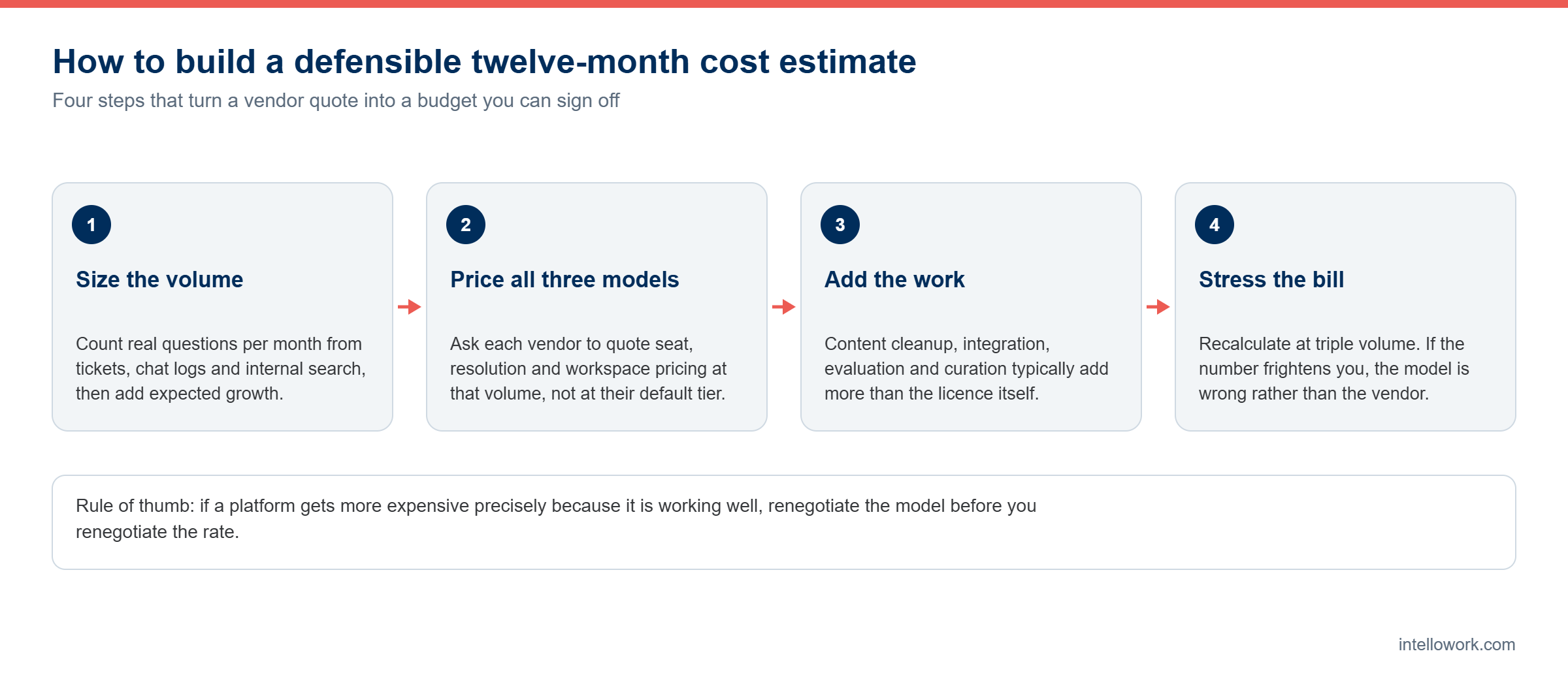
- Size the volume honestly. Count questions per month from tickets, chat transcripts and internal search logs. Then add realistic growth rather than optimistic growth.
- Force a like-for-like quote. Ask each vendor to price your actual volume under their model, and ask what the number becomes at double and triple that volume.
- Add the work. Estimate content cleanup, integration, evaluation and curation in days, then price those days at your loaded internal rate.
- Compare against the alternative. Weigh the total against the cost of the tickets, delays and repeated questions you are absorbing today.
Once you complete step four, enterprise AI chatbot pricing stops being a vendor negotiation and becomes an ordinary investment decision. Incidentally, this is the same exercise that settles the build versus buy question, because in-house builds carry every line except the licence.
Which model should you push for?
Given a choice, push for the model that matches your growth curve. If your volume is small and steady, per resolution keeps enterprise AI chatbot pricing simple. If your volume is large or growing, workspace plus usage protects you from being penalised for success. Meanwhile per-seat pricing only makes sense when the assistant genuinely lives inside an existing helpdesk workflow.
In negotiations, three clauses matter more than the headline rate. First, how a resolution is defined. Second, what happens when you exceed a tier mid-year. Third, whether the price holds at renewal or resets to list. Vendors expect these questions, so ask them plainly.
A worked example
Abstract models only get you so far, so here is enterprise AI chatbot pricing applied to a concrete case. Take a company handling six thousand support conversations each month, with four hundred employees and two languages. Suppose the assistant resolves forty percent of those conversations without a human.
- At one dollar per resolution, that is roughly two thousand four hundred dollars monthly, or about twenty-nine thousand across the year.
- At sixty dollars per agent monthly across twelve agents, seats alone reach about eight thousand six hundred annually, before any AI add-on.
- A workspace plus usage plan at that volume commonly lands somewhere between those two, with the advantage that the number barely moves when deflection improves.
Then add first-year work. Content cleanup at twenty days, integration at ten days and evaluation at eight days will typically exceed the licence in every one of those three scenarios. That is the point of the chart above, and it is why enterprise AI chatbot pricing conversations that focus only on the rate tend to produce disappointing outcomes.
Where Intellowork sits
For transparency, I build in this category. Intellowork uses workspace plus usage billing, with per-workspace monthly pricing, usage-based add-ons and custom contracts for larger deployments. Because one knowledge base powers the web widget, WhatsApp, Instagram, Messenger, Slack and the direct API, you do not pay again for each channel.
That structure exists for a specific reason. When a customer improves their assistant and deflects more conversations, their bill should stay flat rather than climb. So the incentives point the same way for both sides, which is the property I would look for in any vendor, mine included.
What Indian buyers should expect
Most published price lists assume a North American buyer, so Indian teams often find the numbers jarring at first. However, three local factors change the maths meaningfully, and all three work in your favour if you plan for them.
First, conversation volumes in India frequently run higher while average ticket value runs lower. Consequently per-resolution billing bites much earlier here than it does in a comparable American deployment. Second, multilingual support is rarely optional, since users switch between English, Hindi and Hinglish inside a single sentence. Third, data residency requirements under the Digital Personal Data Protection Act push you toward vendors with a named Indian region, which narrows the field.
Because of those three factors, enterprise AI chatbot pricing for an Indian deployment usually favours workspace plus usage over per resolution. Ask specifically whether multilingual retrieval carries an extra charge, since some vendors treat each additional language as a paid module. My notes on the DPDP compliance checklist cover the residency side in more depth.
Five levers that actually move the number
Discount requests rarely achieve much on their own. These five levers move more.
- Term length. A two-year commitment usually buys a better rate than a one-year deal, provided you negotiate an exit for material failure.
- Volume banding. Ask for a band rather than a tier, so modest overage does not push you into the next price step immediately.
- Channel bundling. If you plan to add WhatsApp or Microsoft Teams later, price them now while you still have leverage.
- Onboarding scope. Vendors will often absorb content preparation days instead of cutting the licence, and those days are worth more.
- Renewal caps. Fix the maximum renewal increase in the original contract. This single clause protects more budget than any first-year discount.
Notably, the last lever is the one buyers most often forget. A generous first-year discount followed by an uncapped reset to list price leaves you worse off than a flat rate would have.
Red flags on a pricing page
Some signals reliably predict trouble later. Watch for these while you compare enterprise AI chatbot pricing across vendors.
- No definition of a billable event. If the page never explains what counts as a conversation or a resolution, the definition will favour the vendor.
- Unlimited claims with a fair use footnote. Unlimited means metered, and the meter is simply hidden until you hit it.
- Per-language charges. Treating a second language as an upsell suggests retrieval was never designed to be multilingual.
- Channel by channel licensing. One knowledge base should serve every channel. Paying again per channel signals separate products stitched together.
- Contact us for every tier. Complete opacity usually means pricing is set by how much the vendor thinks you can pay.
Conversely, a vendor who publishes their model, defines their billable events and explains their overage behaviour is telling you something useful about how they will behave in year two.
Modelling the return, not only the cost
Finally, a budget conversation goes far better with a return figure beside the cost figure. Fortunately the calculation is simple, provided you use resolution rather than containment.
Take your monthly conversation volume, multiply by the share the assistant genuinely resolves, then multiply by your fully loaded cost per handled contact. That gives gross monthly saving. Subtract the platform cost and the amortised first-year work, and you have net return. Meanwhile a second benefit rarely gets counted: faster answers reduce repeat contacts, which shrinks volume over time.
Be careful with the deflection percentage you plug in, though. Vendor numbers usually describe containment rather than resolution, and the gap between those two is where most disappointing business cases originate. I explained the distinction in what forty to sixty percent deflection actually means, and using the honest number keeps your enterprise AI chatbot pricing business case credible when finance reviews it.
One more discipline helps. Rerun the model at month six with real data instead of assumptions. Teams who do this keep their programmes funded, while teams who present a single optimistic spreadsheet at kickoff tend to lose the budget at renewal.
Frequently asked questions
How much does an enterprise AI chatbot cost per month?
Small deployments commonly run from a few hundred dollars monthly. Mid-sized deployments with several channels and moderate volume usually land in the low thousands. Large programmes with heavy volume and custom integrations move into five figures monthly.
Why does per-resolution pricing get criticised?
Because it charges you more precisely when the product works better. That is tolerable at low volume, yet it becomes a strong disincentive to improve your knowledge base once conversation counts grow.
What share of the budget is the licence?
In a typical first year the licence is around thirty percent. Content preparation, integration, evaluation and ongoing ownership account for the remainder.
Can we reduce cost by building in-house?
Occasionally, though rarely by as much as expected. You remove the licence and take on evaluation, guardrails, channel adapters and maintenance permanently. The trade-off is discussed in lessons from running retrieval in production.
How do we avoid surprise bills?
Agree a written definition of a billable event, set alerts at seventy percent of each tier, and ask for renewal pricing in the original contract rather than later.
The short version
Separate the model from the rate. Then size your real volume, force like-for-like quotes, add the work nobody quotes, and stress the number at triple volume. Approach it that way and enterprise AI chatbot pricing becomes predictable rather than mysterious.
If you would like a workspace-based quote against your own documentation and channels, Intellowork is a straightforward place to start.