Every vendor in this space quotes a deflection number. Forty percent. Sixty. Occasionally eighty, which should make you suspicious. Having now watched several of these deployments from the inside, I want to unpack what AI chatbot ticket deflection actually measures, why the honest range is narrower than the marketing range, and what determines where a given team lands.
The number is not fake. It is just doing a lot of definitional work that nobody spells out.
Three different things get called deflection
Before comparing any two numbers, find out which one is being counted.
- Containment. The conversation ended in the bot without a handoff. Easy to measure, easy to inflate — a user who gives up and closes the tab counts as contained.
- Resolution. The user got a correct answer and did not come back about it within some window. Harder to measure, much more honest.
- Volume reduction. Total human tickets this month versus a comparable month before launch. The only number your finance team cares about, and the noisiest, because seasonality and product changes move it too.
Most published figures are containment. Resolution typically runs ten to fifteen points below it. When someone quotes 60%, a reasonable translation is “about half of those conversations genuinely ended well.”
My advice is to track containment weekly because it is cheap and moves fast, but report resolution monthly because it is the one that tells the truth. And instrument the abandonment case explicitly — a session with no handoff, no thumbs-up and no follow-up question is not a win, and if you do not separate it out it will silently pad your headline number.
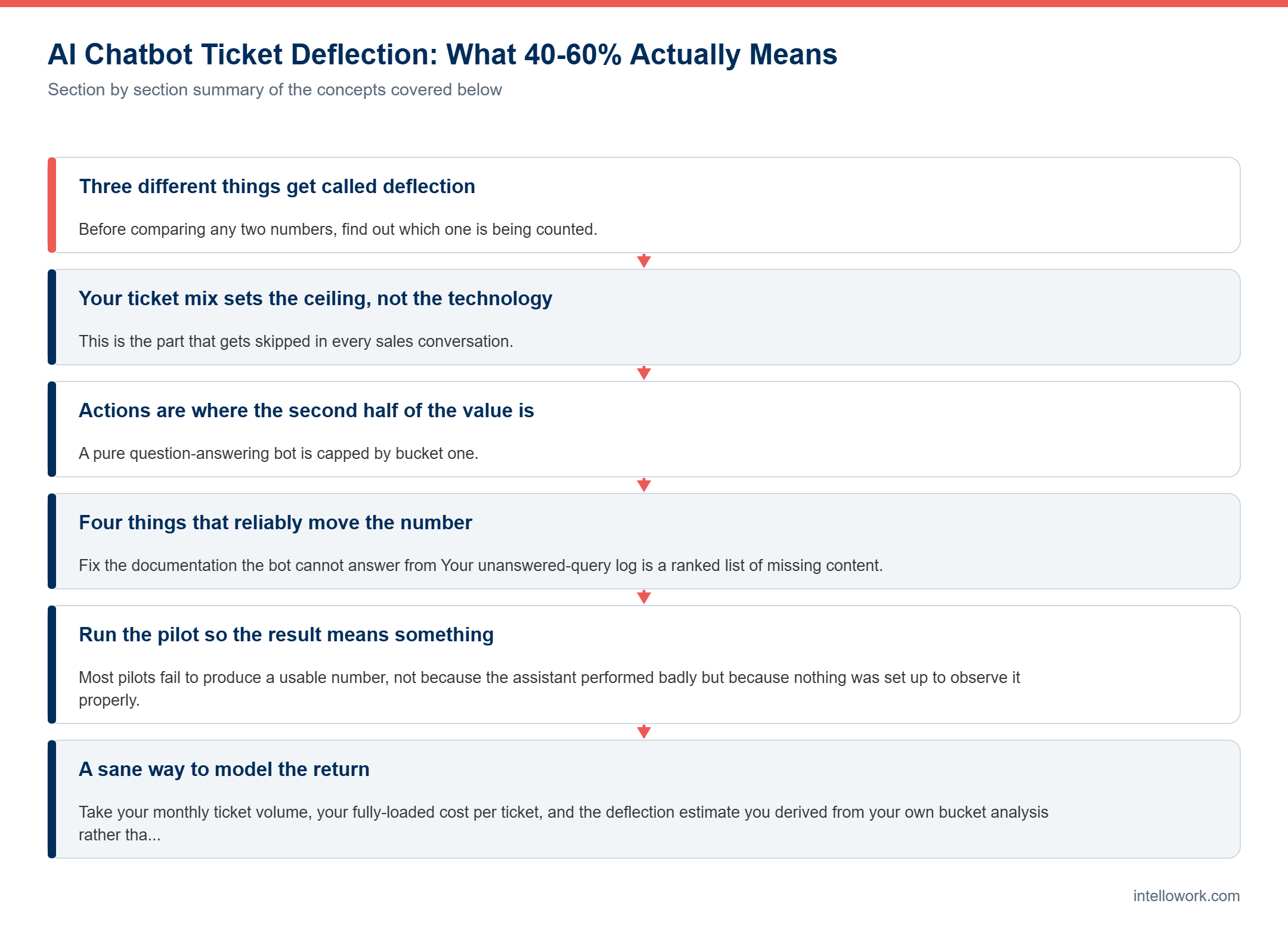
Your ticket mix sets the ceiling, not the technology
This is the part that gets skipped in every sales conversation. Pull a hundred recent tickets and sort them into four buckets:
- Documented and factual — “what is your refund window”, “how do I rotate an API key”. A retrieval system handles these well. Realistically 80-90% deflectable.
- Account-specific — “where is my order”, “why was I charged twice”. These need a lookup against your systems, not a document. Deflectable only if the bot can take actions, and then quite reliably.
- Diagnostic — “it is not working”. Needs back-and-forth, context, sometimes a screenshot. Partially deflectable at best; the useful outcome is a well-triaged ticket rather than no ticket.
- Emotional or commercial — complaints, cancellations, negotiations. Not a deflection target. Trying to deflect these is how you get a viral screenshot.
Now weight them. A developer tools company where 70% of tickets are documented and factual will hit a high number almost regardless of implementation quality. A consumer marketplace where most contacts are order-specific and emotional will not, and no amount of model tuning changes that arithmetic.
Do this exercise before you sign anything. It takes an afternoon and it converts a vendor’s generic 40-60% claim into a defensible forecast for your own queue.
Actions are where the second half of the value is
A pure question-answering bot is capped by bucket one. The step change comes when the assistant can look something up or do something — check order status, resend an invoice, reset a password, book a slot, open a ticket with the right fields already filled.
That moves a chunk of bucket two into scope, and bucket two is usually the largest bucket in any business with transactions. It also raises the stakes: a wrong answer is embarrassing, a wrong action is a refund issued to the wrong account. Which means read-only actions first, write actions behind confirmation, and an audit log on everything.
Four things that reliably move the number
Fix the documentation the bot cannot answer from
Your unanswered-query log is a ranked list of missing content. Teams that review it weekly and write two articles a week see deflection climb steadily for months. Teams that do not review it plateau in week three and conclude the technology underperformed.
Put it where the questions are asked
A widget buried in the help centre only intercepts people who were already self-serving. Placing the assistant in the contact form flow, on the pricing page, and on WhatsApp if that is where your customers live is often worth more than any accuracy improvement — you are intercepting contacts that were otherwise going straight to a human.
Make the handoff good
Counter-intuitively, an easy escape hatch increases deflection. When users know a human is one click away they are willing to try the bot; when they suspect they are trapped they hunt for the contact link immediately and never engage. Pass the full transcript to the agent so nobody has to repeat themselves.
Ground answers and cite them
Trust compounds. Users who verify an answer and find it correct stop verifying and start relying, which shows up as repeat usage and therefore as deflection. Users burned once route around the bot permanently. This is the practical business case for an AI chatbot with citations — it is a retention mechanism, not just a trust badge.
Run the pilot so the result means something
Most pilots fail to produce a usable number, not because the assistant performed badly but because nothing was set up to observe it properly. Three habits fix that.
Take a baseline first. Two to four weeks of ticket volume by category before launch, so you have something to compare against that is not a memory. Then hold the deployment surface constant for the pilot window — if you add WhatsApp in week three, volume moves for reasons that have nothing to do with answer quality, and you can no longer attribute anything.
Finally, read transcripts. Fifty conversations a week, by a human, out loud if necessary. Dashboards tell you that containment is 47%; transcripts tell you that eleven of those conversations were people asking about a feature you shipped last month and never documented. Every meaningful improvement I have seen in these systems started with somebody reading the actual conversations rather than the summary of them.
A sane way to model the return
Take your monthly ticket volume, your fully-loaded cost per ticket, and the deflection estimate you derived from your own bucket analysis rather than a vendor deck. Then discount it: assume the first quarter delivers roughly half your steady-state number, because content gaps and tuning take a real amount of calendar time.
Two effects the spreadsheet usually misses, both pointing the same way. Deflection is disproportionately concentrated in simple tickets, so the tickets that remain are harder on average — plan for agent time per ticket to rise even as volume falls. And the biggest wins often are not headcount at all: first-response time on the remaining queue drops sharply, and after-hours coverage stops being a staffing problem. Those show up in customer satisfaction long before they show up in cost.
The honest summary
For a team with decent documentation and a mostly informational queue, 40-60% containment is achievable and 30-45% genuine resolution is a fair expectation. Above that generally means either action-taking on account-specific requests, or a definition doing some quiet work. Below it usually means a documentation problem rather than a model problem — which is good news, because that one you can fix.
If you are working out where to start, turning your documentation into an AI chatbot walks through the build sequence, and build versus buy covers the decision before it. IntelloWork is the version I built for teams who would rather skip the six-week build: grounded answers with citations, action agents for the account-specific bucket, and deployment across web, WhatsApp and Slack from one knowledge base.
Whichever route you take, measure resolution rather than containment, and judge AI chatbot ticket deflection against your own ticket mix instead of somebody else’s case study.
Related reading
- Enterprise AI Chatbot Pricing in 2026: What It Actually Costs
- Best AI Chatbot for Enterprise Data in 2026: How to Actually Choose One
- AI Chatbot Data Residency and Security: What Indian Enterprises Must Get Right
- Agentic AI Chatbot: When Answers Are Not Enough
- Internal Helpdesk Chatbot for Slack and Microsoft Teams