Build vs Buy an AI Chatbot: Honest Answers From a Founder Who Sells Both
Every article on this question is written by someone with a thumb on the scale. Chatbot platforms tell you building is a maintenance nightmare — buy. Development agencies tell you platforms are rigid toys — build. Both are describing their invoice, not your situation.
I’m in an unusual position to answer this honestly: my company, Exuverse, does custom AI development for enterprises, and we also built our own chatbot product, IntelloWork. I get paid either way. So here’s the framework I actually use when a client asks — including the times I’ve told build-budget clients to buy, and product prospects to go build.
The short answer: buy when your chatbot’s job is answering questions from content you already have. Build when the chatbot must do things — execute transactions, run proprietary workflows, act inside your systems. Most enterprises discover they need a hybrid: a platform for the knowledge layer, custom engineering around it. Now the long answer, with the costs.
What “Build” Actually Costs
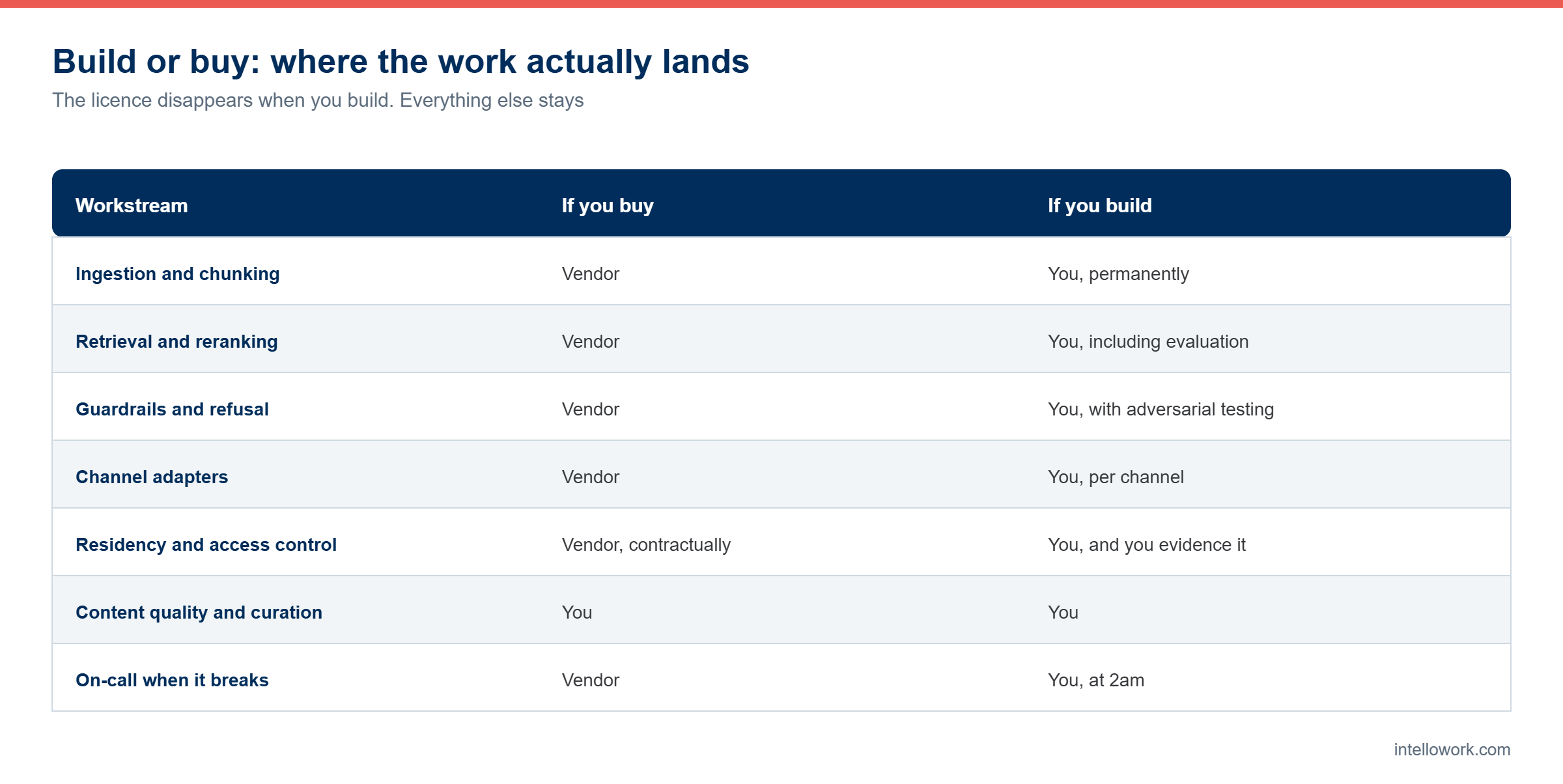
Having shipped IntelloWork to production, I can tell you what the “build a RAG chatbot in a weekend” tutorials leave out. The weekend version — an LLM plus a vector database plus a chat UI — genuinely takes a weekend. It’s also unusable in an enterprise, because the real product is everything around that core.
Permission-aware retrieval, so a guest can’t extract confidential content with a cleverly phrased question. Hybrid search with reranking and confidence thresholds, so the bot says “I’m not sure” instead of improvising. Citations on every answer. SSO, audit logs, and a retrieval-trace debugger for when answers go wrong — and they will go wrong. Multi-channel delivery if your users live in WhatsApp or Slack rather than a web widget. And then the part nobody budgets: permanent maintenance, because content drifts, source schemas change, and model providers reshuffle pricing every quarter.
Realistic numbers for a genuine enterprise-grade build: a senior team spanning data engineering, search relevance, backend and DevOps, four to six months to production quality, landing in the $50,000–150,000+ range — followed by an ongoing engineering commitment forever. I’ve laid out the full architecture in my team’s guide to enterprise AI chatbot development if you want the technical detail.
That price isn’t an argument against building. It’s an argument against building the wrong thing.
When Building Is Genuinely Right
I tell clients to build custom in three situations.
The chatbot is your product or core differentiator. If conversational AI is what your company sells, or the interface your competitive advantage lives in, you need to own the stack. Renting your core product from a vendor is strategic malpractice.
The bot must act, not just answer. Executing refunds against your payment system, running approval workflows, making decisions against internal APIs — agentic behaviour deep inside proprietary systems is real custom engineering. No off-the-shelf platform knows your systems.
Regulation forces your hand. Fully self-hosted requirements, air-gapped environments, or sector rules that no vendor’s compliance package covers.
If you’re in one of these three, hire for it properly — I’ve written before about how to choose an enterprise AI partner without ending up with a demo shop.
When Buying Is Right (Which Is More Often Than My Services Business Would Like)
If your problem statement sounds like “our customers and employees keep asking questions that our documents already answer” — support deflection, documentation search, internal helpdesk — then building custom means spending six figures to reinvent retrieval infrastructure that already exists, minus the years of production hardening.
This is the conversation where I’ve talked clients out of custom builds. A good platform gets you grounded, cited, permission-aware answers on your own content in days. With IntelloWork, you connect your sources, bring your own LLM keys if you want, and the first working bot is a days-long project, not a two-quarter programme. For the knowledge use case, buying isn’t settling — a hardened platform is simply better than a first-attempt custom build, because it has already survived the failure modes your build hasn’t met yet.
The honest caveat on buying: make sure the platform passes the enterprise bar — permissions enforced inside retrieval, citations on every answer, audit logs, and your own model keys. Plenty of chatbot builders fail that check, and a cheap platform that leaks an HR document is the most expensive software you’ll ever buy.
The Hybrid Most Enterprises Actually Need
After enough of these projects, a pattern is obvious: the knowledge layer is a commodity you should buy; the action layer is proprietary and worth building. A support bot that answers from your docs (platform) but also triggers a refund workflow (custom integration). An internal helpdesk that cites HR policy (platform) and files the ticket when it can’t help (custom).
Buy the retrieval, build the actions. You get days-to-launch on the eighty percent, and focused engineering spend on the twenty percent that’s actually yours. This is the architecture we deploy most often at Exuverse — IntelloWork as the grounded Q&A layer, with our custom software development team building the connectors and workflows around it — and it typically costs a third of a full custom build.
The 90-Day Test
If you’re still torn, run this: deploy a platform on your real content for ninety days with defined metrics — deflection rate, answer accuracy, wrong-answer traces. There are two outcomes, and both are wins. Either the platform covers your need and you just saved six figures, or you now have a precise, evidence-based spec of exactly what the platform can’t do — which is the only honest starting point for a custom build. Companies that skip this test write custom-build requirements from imagination, and imagination is how six-month projects become twelve-month projects.
You can start the test this week — request IntelloWork access and you’ll have a workspace within a day. And if your ninety days surface the custom twenty percent, that’s the conversation my team is built for. Either way, you’ll be deciding from evidence instead of vendor blog posts — including this one.
Related reading
- AI Chatbot Data Residency and Security: What Indian Enterprises Must Get Right
- Enterprise AI Chatbot Pricing in 2026: What It Actually Costs
- Best AI Chatbot for Enterprise Data in 2026: How to Actually Choose One
- Agentic AI Chatbot: When Answers Are Not Enough
- Internal Helpdesk Chatbot for Slack and Microsoft Teams