Businesses in India are rapidly adopting artificial intelligence to automate operations, reduce costs, and improve efficiency. From customer support to internal workflows, AI is transforming how enterprises function.
Enterprise AI automation services help organizations implement AI-driven systems that automate repetitive tasks, improve decision-making, and enhance productivity.
As competition increases, companies that adopt AI automation early gain a significant advantage in speed, scalability, and innovation.
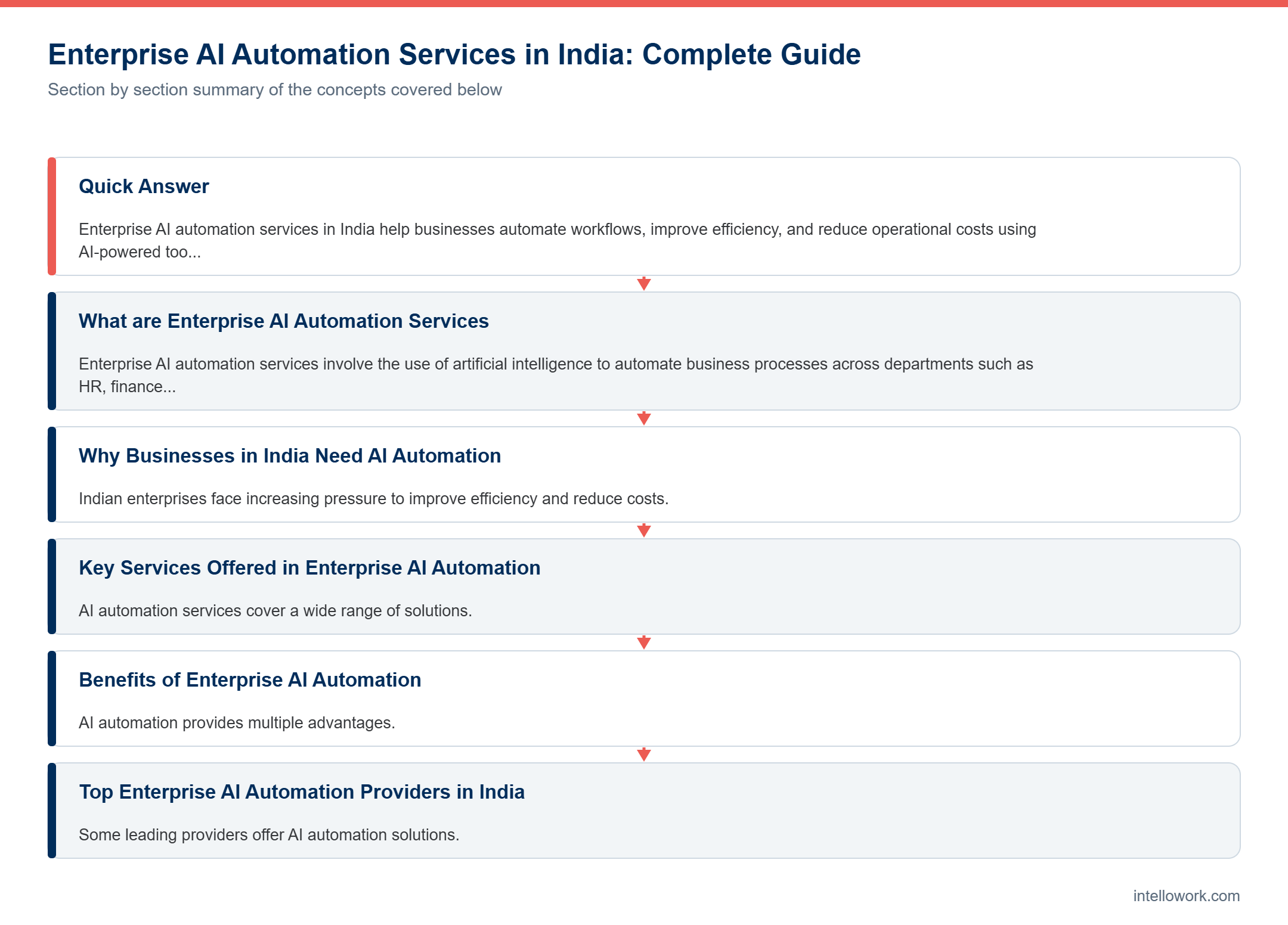
Quick Answer
Enterprise AI automation services in India help businesses automate workflows, improve efficiency, and reduce operational costs using AI-powered tools and systems.
What are Enterprise AI Automation Services
Enterprise AI automation services involve the use of artificial intelligence to automate business processes across departments such as HR, finance, customer support, and operations.
These services include AI chatbots, workflow automation, document processing, predictive analytics, and enterprise search systems.
Unlike traditional automation, AI automation can learn from data and improve over time, making it more powerful and adaptable.
Why Businesses in India Need AI Automation
Indian enterprises face increasing pressure to improve efficiency and reduce costs.
Common Challenges
Manual processes slow down operations
High operational costs
Human errors in repetitive tasks
Difficulty scaling processes
How AI Automation Solves These Problems
Automates repetitive tasks
Reduces errors
Improves speed and efficiency
Enables scalability
Key Services Offered in Enterprise AI Automation
AI automation services cover a wide range of solutions.
AI Chatbots and Virtual Assistants
Automate customer and employee interactions
Workflow Automation
Streamline business processes
Document Processing
Extract and process data from documents
Predictive Analytics
Use data to make better decisions
Enterprise Search Systems
Enable fast access to information
Benefits of Enterprise AI Automation
AI automation provides multiple advantages.
Increased Productivity
Employees focus on high-value tasks
Cost Reduction
Less dependency on manual work
Faster Operations
Processes are completed quickly
Better Decision Making
Data-driven insights improve outcomes
Improved Customer Experience
Faster and more accurate responses
Top Enterprise AI Automation Providers in India
Some leading providers offer AI automation solutions.
- Tata Consultancy Services
- Infosys
- Wipro
- HCLTech
- Kore.ai
Many startups also provide custom AI automation solutions tailored to business needs.
How Enterprise AI Automation Works
AI automation systems follow a structured workflow.
Step-by-Step Process
Identify business processes to automate
Collect and analyze data
Build AI models or integrate APIs
Deploy automation workflows
Monitor and optimize performance
This ensures efficiency and scalability.
Real World Use Cases
AI automation is widely used across industries.
Banking and Finance
Automate fraud detection and customer support
Healthcare
Streamline patient data and operations
Retail
Personalize customer experience
Manufacturing
Optimize production processes
Challenges in AI Automation
Despite its benefits, there are challenges.
High Initial Cost
Implementation can be expensive
Integration Complexity
Connecting with existing systems is difficult
Data Privacy Concerns
Sensitive data must be protected
Skill Gap
Requires expertise in AI and automation
How to Choose the Right AI Automation Service in India
Selecting the right provider is critical.
Steps to Follow
Define business goals
Evaluate experience and expertise
Check technology stack
Ensure security and compliance
Review case studies and results
Future of AI Automation in India
AI automation is growing rapidly in India.
Businesses will adopt AI agents for complex tasks
Automation will become more intelligent
Cloud-based AI solutions will increase
Data-driven decision-making will improve
India is becoming a global hub for AI innovation.
Conclusion
Enterprise AI automation services in India are transforming how businesses operate.
By automating processes and improving efficiency, companies can reduce costs and scale faster.
Organizations that invest in AI automation today will gain a strong competitive advantage in the future.
FAQ
What are enterprise AI automation services
They help automate business processes using AI
Why are they important
They improve efficiency and reduce costs
Which companies provide AI automation in India
TCS, Infosys, Wipro, HCLTech, and others
Is AI automation expensive
It depends on scale and complexity
What is the future of AI automation
More intelligent and scalable systems
How to choose an enterprise AI partner in India
The services market has expanded quickly, so the difficulty is no longer finding a vendor. It is telling capable teams apart. Four checks do most of the work.
Begin with delivered outcomes rather than logos. Ask for a system currently running in production, then ask what broke during the first month and how the team responded. Vendors who answer that comfortably have genuinely operated something. Meanwhile vendors who describe only successful launches usually have not.
Next, examine the evaluation practice. Any serious team will describe how they measure accuracy, what their regression suite contains and how they detect quality drift. Without that, you are buying a demonstration rather than a system.
Then check ownership of the outcome. Ask who is accountable when quality falls three months after launch, and whether that is written into the agreement. Finally, ask about data handling: region, retention, access control and whether your content ever trains shared models.
Where these projects usually go wrong
- Scope written as technology. A statement of work describing models rather than business outcomes cannot be judged as successful or otherwise.
- No baseline. Without measuring the current process first, improvement becomes a matter of opinion.
- Content treated as someone else problem. Vendors cannot fix contradictory or outdated documentation for you, and it drives most quality complaints.
- Handover without capability transfer. If nobody internal can retrain, reindex or evaluate, you have bought a dependency.
- Compliance considered last. Residency and access control are architectural, so retrofitting them is far more expensive than designing for them.
Above all, insist on a small paid pilot with a defined success measure before any long engagement. Good partners welcome that, since it shortens their sales cycle too.
Frequently asked questions
What does a typical engagement look like?
Commonly a discovery phase of two to three weeks, a pilot of six to eight weeks with a measurable target, then a phased rollout. Anything that skips the pilot deserves scrutiny.
Should we hire or outsource?
Outsource to learn quickly, then bring evaluation and content ownership in house. Those two capabilities determine long-term quality, so they belong with you.
How do we compare quotes fairly?
Ask every vendor to price the same scope with the same success measure, and require the cost of content preparation to appear as its own line.
What about data residency?
Ask for the region used for storage and for model inference separately. Those are different questions, and only the second protects the prompt.
How soon should we expect results?
A well-scoped pilot should show a measurable result within two months. Broader transformation takes longer, mostly because of process and content work.
Related reading
- Who Is Tarun Gupta? The AI Architect Building India’s Next Generation of Enterprise AI Solutions
- AI Infrastructure: The Foundation of Modern Enterprise Intelligence
- AI Agents: The Future of Intelligent Business Automation
If you would rather test this on your own content than build it, Intellowork grounds every answer in your documentation, cites the passage behind each claim and keeps retrieval inside your permission model.