Artificial Intelligence is transforming how businesses operate.
From AI chatbots and automation systems to predictive analytics and enterprise search platforms, organizations are rapidly adopting AI technologies.
But behind every successful AI system lies one critical component:
AI infrastructure.
Without strong infrastructure, even the most advanced AI models fail to deliver reliable performance.
Modern enterprises need scalable, secure, and intelligent infrastructure to support AI workloads efficiently.
In this article, we will explore what AI infrastructure is, why it matters, and how businesses can build enterprise-ready AI systems.
What Is AI Infrastructure?
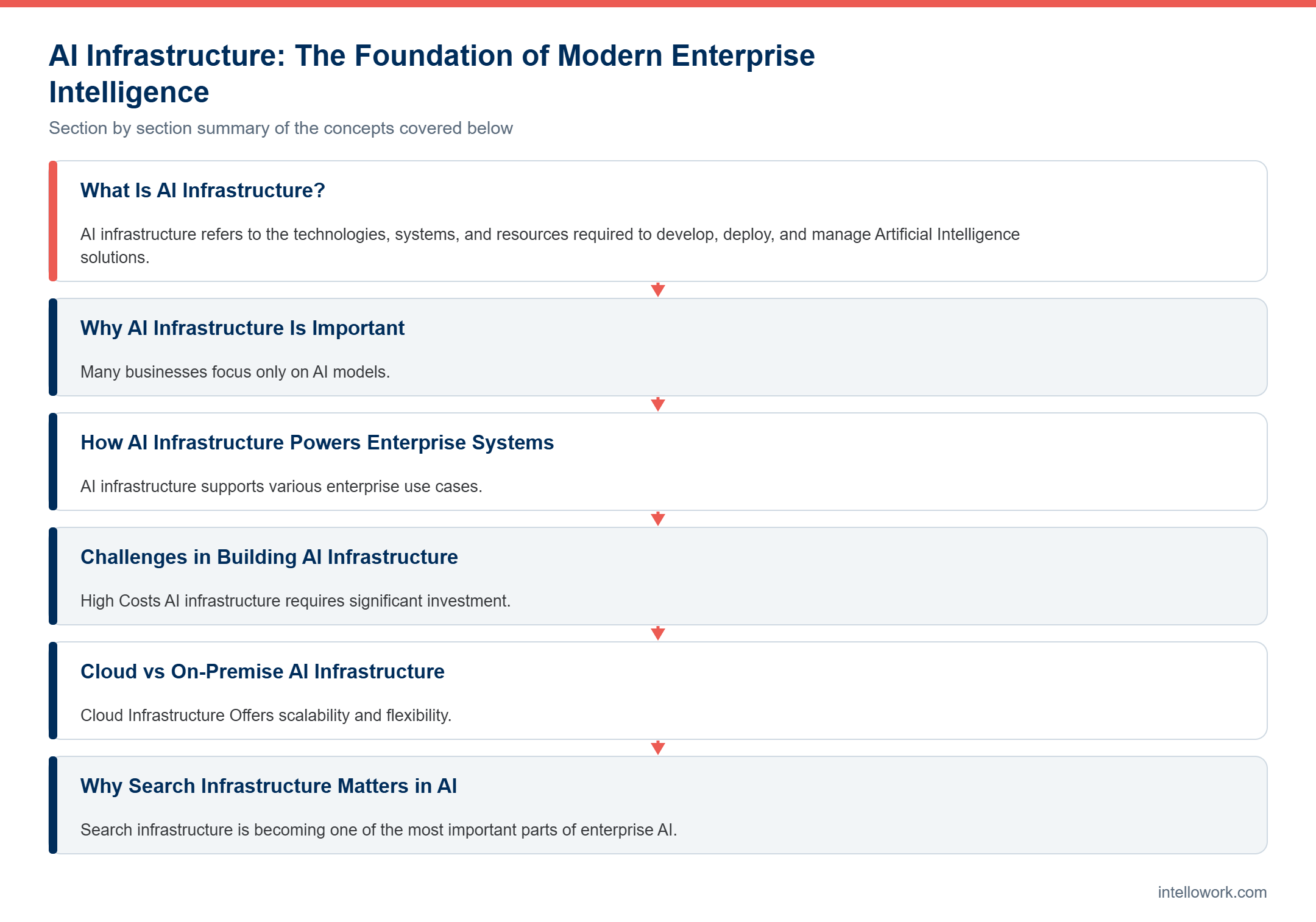
AI infrastructure refers to the technologies, systems, and resources required to develop, deploy, and manage Artificial Intelligence solutions.
It includes:
- Computing resources
- Data storage systems
- Search infrastructure
- AI models
- Cloud platforms
- Networking systems
AI infrastructure acts as the foundation that powers AI applications.
Why AI Infrastructure Is Important
Many businesses focus only on AI models.
However, AI models alone are not enough.
Without proper infrastructure, organizations face problems such as:
- Slow performance
- Inaccurate outputs
- Scalability issues
- High operational costs
Strong AI infrastructure ensures that AI systems operate efficiently and reliably.
Core Components of AI Infrastructure
1. Data Infrastructure
AI systems depend on data.
Businesses need systems that can:
- Collect data
- Store data
- Process data
- Retrieve data efficiently
High-quality data infrastructure is essential for AI success.
2. Computing Infrastructure
AI workloads require powerful computing systems.
This includes:
- GPUs
- High-performance servers
- Cloud computing platforms
These systems process large amounts of data quickly.
3. Search Infrastructure
Modern AI systems rely heavily on enterprise search.
Search infrastructure helps AI retrieve relevant information in real time.
This is especially important for:
- AI chatbots
- RAG systems
- Knowledge assistants
4. Storage Systems
AI applications generate and process massive amounts of data.
Scalable storage systems are required to manage this data efficiently.
5. Networking Infrastructure
AI systems require fast and secure communication between systems.
Reliable networking ensures smooth performance.
6. Security and Access Control
Enterprise AI systems handle sensitive business data.
Infrastructure must include:
- Data encryption
- Role-based access control
- AI guardrails
- Compliance frameworks
Security is a critical part of AI infrastructure.
How AI Infrastructure Powers Enterprise Systems
AI infrastructure supports various enterprise use cases.
AI Chatbots
Provide conversational support using enterprise data.
Enterprise Search Systems
Enable intelligent access to internal knowledge.
Workflow Automation
Automate repetitive business processes.
Predictive Analytics
Analyze large datasets and forecast trends.
AI Agents
Autonomous systems that execute tasks intelligently.
Challenges in Building AI Infrastructure
High Costs
AI infrastructure requires significant investment.
Data Silos
Enterprise data is often spread across systems.
Scalability Issues
Infrastructure must handle increasing workloads.
Security Risks
Sensitive data must be protected.
Integration Complexity
Connecting legacy systems can be difficult.
Cloud vs On-Premise AI Infrastructure
Cloud Infrastructure
Offers scalability and flexibility.
Benefits include:
- Lower upfront costs
- Faster deployment
- Easy scaling
On-Premise Infrastructure
Provides more control and security.
Suitable for industries with strict compliance requirements.
Why Search Infrastructure Matters in AI
Search infrastructure is becoming one of the most important parts of enterprise AI.
AI systems need access to real-time and relevant data.
Without search systems, AI may generate inaccurate or outdated responses.
This is why technologies like:
- Vector search
- Hybrid search
- Retrieval-Augmented Generation (RAG)
are becoming critical.
Best Practices for Building Enterprise AI Infrastructure
Use scalable cloud platforms.
Implement secure data pipelines.
Use hybrid search systems.
Ensure strong access control.
Continuously monitor system performance.
Invest in high-quality data management.
Industry Insights and Trends
Experts believe AI infrastructure will become one of the most valuable enterprise investments in the coming years.
Organizations with strong AI infrastructure report:
- Faster AI deployment
- Better performance
- Improved scalability
- Higher ROI
Businesses are moving towards AI-first infrastructure strategies.
The Future of AI Infrastructure
AI infrastructure will continue to evolve rapidly.
Future systems will include:
- Autonomous AI operations
- Real-time AI processing
- Intelligent data pipelines
- Advanced enterprise search systems
Infrastructure will become the backbone of every AI-driven organization.
Why Businesses Must Invest in AI Infrastructure
Companies that fail to build proper AI infrastructure will struggle to scale AI initiatives.
Businesses that invest early will gain advantages such as:
- Faster innovation
- Better automation
- Improved decision-making
- Competitive growth
AI infrastructure is no longer optional.
It is essential for future-ready businesses.
Conclusion
AI infrastructure is the foundation of modern enterprise AI systems.
It powers automation, search, analytics, and intelligent workflows.
Organizations that build scalable and secure AI infrastructure will unlock the full potential of Artificial Intelligence.
The future of business is AI-driven, and strong infrastructure will decide the winners.
Frequently Asked Questions (FAQ)
What is AI infrastructure?
AI infrastructure includes the systems and technologies required to build and manage AI applications.
Why is AI infrastructure important?
It ensures scalability, performance, security, and efficient AI operations.
What are the components of AI infrastructure?
Data systems, computing resources, search infrastructure, storage, and networking.
Is cloud infrastructure better for AI?
Cloud infrastructure offers scalability and flexibility for most businesses.
What role does search infrastructure play in AI?
It helps AI systems retrieve accurate and real-time information.
Related reading
- Who Is Tarun Gupta? The AI Architect Building India’s Next Generation of Enterprise AI Solutions
- Enterprise AI Automation Services in India: Complete Guide
- Best Enterprise Search Software in India
If you would rather test this on your own content than build it, Intellowork grounds every answer in your documentation, cites the passage behind each claim and keeps retrieval inside your permission model.