Your Company Already Has the Answers. Employees Just Cannot Find Them Fast Enough.
Every growing organization creates a large amount of knowledge.
Policies are stored in shared drives.
Project documents are saved in folders.
HR information is available in employee portals.
Technical documentation exists in knowledge bases.
Important discussions are buried in emails and collaboration tools.
Sales teams maintain customer information across multiple platforms.
Over time, company knowledge becomes distributed across dozens of locations.
The information exists.
However, finding the right information becomes difficult.
An employee may spend several minutes searching through folders. They may open multiple documents, ask colleagues for help, or send a message to another department.
The same questions are then answered repeatedly.
Where is the latest policy?
Which document contains the approved process?
What is the current onboarding procedure?
Who owns this project?
What are the latest product details?
This is not only a search problem.
It is a productivity problem.
Modern organizations need a faster way to access internal knowledge. This is where Enterprise Search Software becomes valuable.
An AI-powered enterprise search platform helps employees discover relevant information across approved company knowledge sources using natural-language questions.
Instead of searching through hundreds of files, employees can ask:
“What is our employee leave policy?”
“Show the latest product onboarding process.”
“What are the steps for handling a customer escalation?”
The system can retrieve relevant information from connected company knowledge and provide a useful response.
Intellowork helps organizations transform scattered business knowledge into an accessible AI-powered workplace experience. It combines enterprise search, intelligent knowledge discovery, and an AI workplace assistant to help employees find information faster.
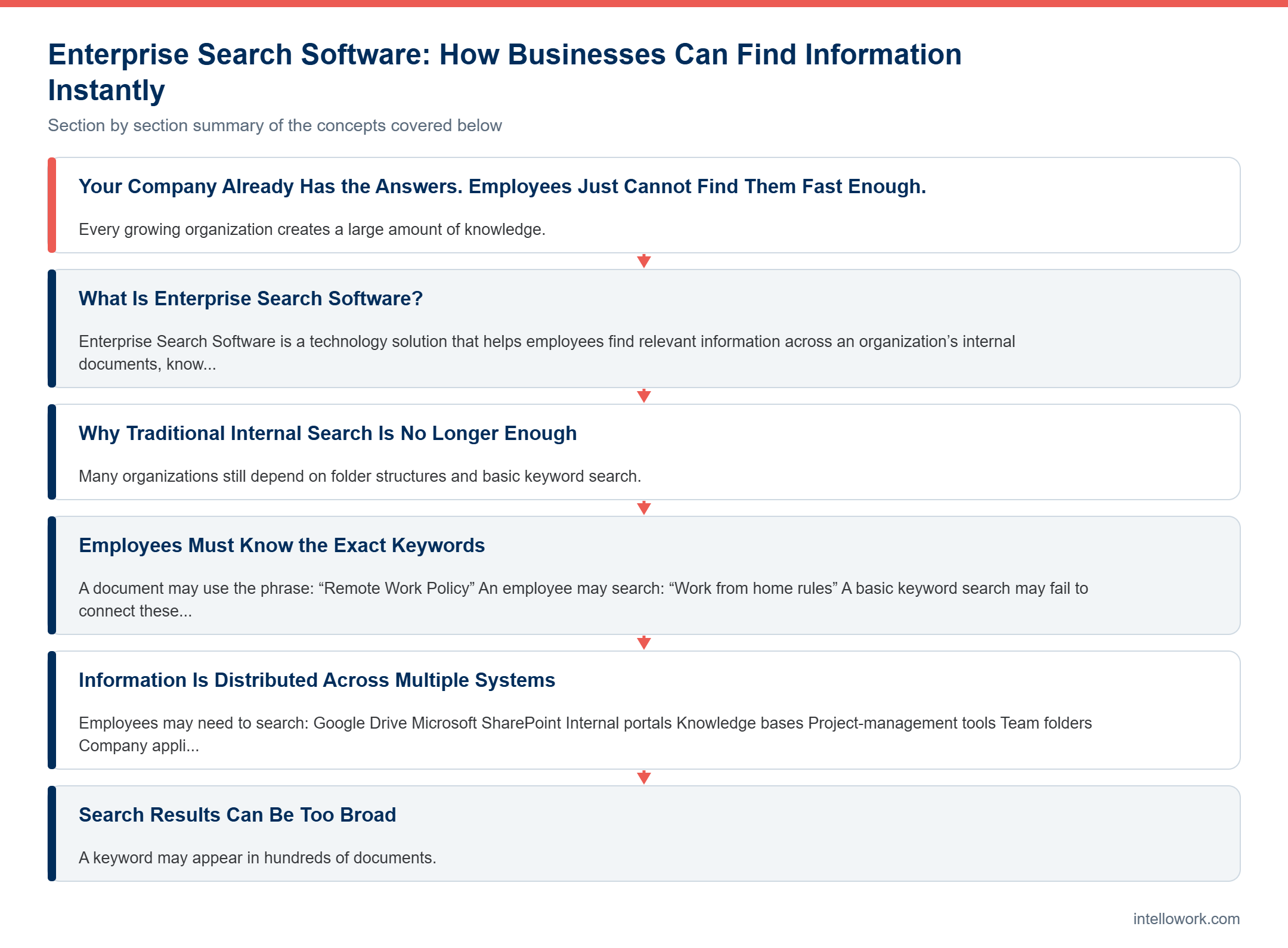
What Is Enterprise Search Software?
Enterprise Search Software is a technology solution that helps employees find relevant information across an organization’s internal documents, knowledge repositories, applications, and approved data sources.
Traditional search often depends on exact keywords.
Enterprise search is designed to understand business context, improve relevance, and make organizational knowledge easier to discover.
Depending on the platform and connected systems, enterprise search may help employees access information from:
- Company documents
- PDFs
- Policies
- Employee handbooks
- Standard operating procedures
- Knowledge bases
- Project documentation
- Internal portals
- Product documentation
- Training material
- Shared drives
- Approved business applications
The goal is simple:
Help employees find the right information without wasting time searching across multiple systems.
Modern AI Enterprise Search Software can also understand natural-language questions.
For example, an employee may ask:
“How do I request work-from-home approval?”
The employee does not need to know the exact file name or folder location.
The system can identify relevant information from connected knowledge sources and present a useful response.
Why Traditional Internal Search Is No Longer Enough
Many organizations still depend on folder structures and basic keyword search.
These systems can work when the number of documents is small.
However, they become less effective as the organization grows.
Traditional search often creates several problems.
Employees Must Know the Exact Keywords
A document may use the phrase:
“Remote Work Policy”
An employee may search:
“Work from home rules”
A basic keyword search may fail to connect these phrases effectively.
AI-powered search can better understand the intent behind the question.
Information Is Distributed Across Multiple Systems
Employees may need to search:
- Google Drive
- Microsoft SharePoint
- Internal portals
- Knowledge bases
- Project-management tools
- Team folders
- Company applications
Switching between platforms increases the time required to find information.
Search Results Can Be Too Broad
A keyword may appear in hundreds of documents.
Employees then need to open multiple files and manually identify the relevant section.
This creates unnecessary effort.
Important Knowledge Remains Hidden
Organizations often have valuable information that employees rarely use because they do not know where it is stored.
This creates knowledge silos.
Employees Depend on Other Employees
When search fails, employees ask colleagues.
This creates repeated interruptions.
Senior employees may spend a significant amount of time answering questions that already have documented answers.
What Are Knowledge Silos?
A knowledge silo occurs when useful information remains isolated within a department, team, system, or individual.
For example:
- HR knowledge remains inside HR tools.
- Technical knowledge remains with engineering teams.
- Sales information remains in separate systems.
- Project knowledge remains inside individual folders.
- Operational knowledge exists only in employee experience.
Knowledge silos create several business problems.
Employees may:
- Duplicate existing work
- Use outdated information
- Make slower decisions
- Depend heavily on subject-matter experts
- Spend too much time searching
- Miss important company knowledge
Enterprise Search Software helps connect knowledge across approved sources and makes it easier to discover.
How AI-Powered Enterprise Search Works
Modern enterprise search uses artificial intelligence to improve how employees interact with organizational knowledge.
Although each platform works differently, the process often includes the following stages.
1. Connect Approved Knowledge Sources
The organization connects relevant documents, knowledge repositories, and approved business systems.
The goal is not to make every piece of information available to everyone.
The platform should respect organizational permissions and access requirements.
2. Process and Organize Knowledge
The system processes available content so that it can understand:
- Topics
- Context
- Document relationships
- Relevant sections
- Business terminology
This creates a more useful knowledge layer than simple file-name search.
3. Understand Natural-Language Questions
Employees can ask questions using everyday language.
For example:
“What is the process for onboarding a new employee?”
The system analyzes the meaning and intent of the question.
4. Retrieve Relevant Information
The platform searches connected knowledge sources and identifies information that is relevant to the employee’s query.
5. Generate a Useful Response
An AI-powered system can summarize relevant information and present it in a conversational format.
This reduces the need to open multiple documents.
6. Support Verification Through Sources
For business use, employees should be able to review the source information where available.
Source visibility helps users:
- Verify answers
- Understand context
- Review the original information
- Build confidence in the response
Enterprise Search vs Traditional Search
| Feature | Traditional Internal Search | AI-Powered Enterprise Search |
|---|---|---|
| Search method | Exact keywords | Natural-language questions |
| Context understanding | Limited | Context-aware |
| Information discovery | File and keyword focused | Meaning and relevance focused |
| Employee experience | Search through results | Ask and receive a useful response |
| Knowledge access | Often system-specific | Can connect approved knowledge sources |
| Productivity | More manual effort | Faster information discovery |
| Knowledge silos | Often remain | Can be reduced |
| Workplace support | Search tool | Search plus AI assistance |
AI Enterprise Search does not simply help employees find files.
It helps them discover relevant organizational knowledge.
Key Features to Look for in Enterprise Search Software
Not every enterprise search platform provides the same capabilities.
Businesses should evaluate the following features before choosing a solution.
1. Natural-Language Search
Employees should be able to ask questions naturally.
The platform should understand intent rather than relying only on exact keyword matches.
2. AI-Powered Answers
The platform should help users understand information instead of only displaying a list of files.
Useful answers can reduce the time required to review multiple documents.
3. Source References
Employees should be able to review the supporting source information.
This improves transparency and allows users to verify important responses.
4. Permission-Aware Access
Enterprise knowledge is not public.
The platform should support access controls and respect existing permissions where applicable.
Employees should only access information they are authorized to view.
5. Secure Enterprise Deployment
Businesses should evaluate:
- Data security
- Authentication
- Access controls
- Deployment options
- Data-handling practices
- Administrative controls
Security requirements may differ across organizations and industries.
6. Relevant Search Results
The system should prioritize useful and contextually relevant information.
A search platform that produces too many unrelated results may reduce employee adoption.
7. Easy Knowledge Management
Administrators should be able to manage connected knowledge sources without creating unnecessary technical complexity.
8. Analytics and Insights
Search analytics can help organizations understand:
- What employees search for
- Which questions remain unanswered
- Which knowledge areas require improvement
- Where documentation may be missing
These insights can improve both knowledge management and employee experience.
9. Scalability
The platform should support organizational growth.
It should remain useful as:
- Documents increase
- Teams expand
- New departments are added
- More knowledge sources are connected
How Intellowork Transforms Enterprise Knowledge Search
Intellowork is designed to help organizations make internal knowledge easier to access through AI-powered enterprise search and workplace assistance.
Instead of asking employees to remember:
- Which folder contains a document
- Which department owns the information
- What the exact document title is
- Which system contains the latest version
Intellowork enables users to ask questions naturally and discover relevant information from connected organizational knowledge.
The platform helps businesses move from:
Scattered knowledge → Connected knowledge
Manual searching → AI-powered discovery
Repeated questions → Self-service information access
Knowledge silos → More accessible organizational intelligence
Key Intellowork Capabilities
AI-Powered Enterprise Search
Employees can search company knowledge using natural language.
This makes internal information easier to discover without depending on exact keywords.
Enterprise Knowledge Chatbot
Intellowork can act as an intelligent knowledge assistant that helps employees ask questions and access relevant company information.
Workplace AI Assistant
Employees can receive faster support for common workplace questions.
This can reduce repetitive requests to HR, IT, operations, and subject-matter experts.
Internal Knowledge Discovery
Intellowork helps organizations make valuable internal information more accessible.
Employees can spend less time searching and more time completing meaningful work.
Context-Aware Information Access
AI-powered search can understand the meaning behind employee questions and retrieve information based on relevance.
Centralized Knowledge Experience
Instead of moving between multiple systems, employees can access organizational knowledge through a more unified experience.
How Enterprise Search Software Benefits Different Departments
Enterprise Search is not only an IT solution.
It can support teams across the organization.
Human Resources
HR teams manage:
- Employee policies
- Leave information
- Benefits
- Onboarding documents
- Workplace guidelines
- Training material
Employees can use Intellowork to find relevant HR information without sending repeated requests.
This may reduce routine administrative workload.
Information Technology
IT teams frequently receive questions about:
- Password policies
- Software access
- Device setup
- Security requirements
- Technical procedures
- Troubleshooting guides
An AI workplace assistant can help employees discover approved documentation before raising a support request.
Sales Teams
Sales representatives often need quick access to:
- Product information
- Pricing guidance
- Sales enablement documents
- Customer case studies
- Proposal templates
- Competitive information
Faster knowledge access can improve sales readiness.
Customer Support
Support teams need accurate and current information.
Enterprise Search Software can help them discover relevant procedures and knowledge faster.
Operations
Operations teams often manage:
- Standard operating procedures
- Process documents
- Compliance instructions
- Vendor processes
- Quality guidelines
AI-powered search can make these resources easier to access.
Leadership Teams
Leadership can benefit from better knowledge visibility across the organization.
Search insights may also reveal:
- Knowledge gaps
- Frequently searched topics
- Documentation issues
- Areas where employees need additional support
Business Benefits of Enterprise Search Software
Improve Employee Productivity
Employees spend less time searching and more time completing valuable work.
Reduce Repetitive Questions
Common questions can be answered through self-service knowledge access.
Improve Knowledge Reuse
Existing documents and expertise become easier to discover.
Support Faster Decisions
Employees can access relevant information without waiting for responses from multiple teams.
Reduce Knowledge Dependency
Important knowledge becomes less dependent on a small number of experienced employees.
Improve Employee Experience
Employees receive faster access to the information they need.
Preserve Organizational Knowledge
Documented knowledge remains accessible even when employees change roles or leave the organization.
Improve Knowledge Governance
Centralized knowledge access can encourage organizations to maintain better documentation and ownership.
Enterprise Search and Knowledge Management
Enterprise Search Software and knowledge management work together.
Knowledge management focuses on:
- Creating knowledge
- Organizing information
- Maintaining documentation
- Defining ownership
- Keeping content current
Enterprise search focuses on:
- Discovering knowledge
- Retrieving relevant information
- Making knowledge easier to access
A company may have excellent documentation but still struggle if employees cannot find it.
Intellowork helps bridge the gap between stored knowledge and usable knowledge.
How to Choose the Right Enterprise Search Platform
Before selecting a platform, businesses should ask:
Can employees search using natural language?
A modern solution should support conversational questions.
Does the platform provide source visibility?
Users should be able to verify important answers.
How does the platform manage access and permissions?
Enterprise security requires controlled information access.
Can the platform connect to relevant company knowledge?
The solution should support the organization’s knowledge environment.
Is the platform easy for employees to use?
Adoption is critical.
A powerful platform that employees avoid will provide limited value.
Can it scale with the business?
The solution should support growing documents, teams, and knowledge sources.
Does it provide useful search insights?
Analytics can help organizations improve documentation and knowledge management.
Does the platform support enterprise security requirements?
Businesses should evaluate security, access controls, deployment requirements, and governance based on their needs.
Common Mistakes Businesses Make
Buying a Basic Search Tool
A basic search bar may not understand context or answer employee questions.
Ignoring Knowledge Quality
AI search works best when company knowledge is accurate, organized, and regularly maintained.
Connecting Everything Without Governance
More data does not always create better search.
Organizations should define:
- Knowledge ownership
- Content quality standards
- Access rules
- Update schedules
Ignoring Permissions
Enterprise knowledge must be protected.
Access controls should remain a priority.
Launching Without Employee Training
Employees should understand:
- What the platform can do
- Which questions to ask
- How to verify responses
- How to provide feedback
The Future of Enterprise Search
Enterprise search is evolving from a document-retrieval tool into an intelligent workplace experience.
Future enterprise search platforms will increasingly support:
- Conversational knowledge access
- AI workplace assistants
- Context-aware search
- Personalized information discovery
- Knowledge analytics
- Automated knowledge recommendations
- Intelligent workflow support
The future workplace will not require employees to remember where information is stored.
Employees will be able to ask for what they need.
The right information will become easier to access.
Why Intellowork Is the Smarter Choice for Enterprise Knowledge
Organizations do not need more documents.
They need better access to the knowledge they already have.
Intellowork helps businesses transform internal knowledge into a more accessible and intelligent workplace resource.
With AI-powered enterprise search, enterprise knowledge chatbot capabilities, and workplace assistance, Intellowork can help organizations:
- Find information faster
- Reduce knowledge silos
- Improve employee productivity
- Support self-service knowledge access
- Reduce repetitive internal questions
- Improve knowledge discovery
- Build a more connected workplace
Instead of allowing valuable information to remain hidden across disconnected systems, businesses can make knowledge easier to discover and use.
Conclusion
Every organization has valuable knowledge.
The challenge is making that knowledge accessible at the moment employees need it.
Traditional search requires employees to know:
- Where information is stored
- Which keywords to use
- Which document contains the answer
AI-powered Enterprise Search Software changes this experience.
Employees can ask questions naturally and discover relevant information from connected company knowledge.
This can improve productivity, reduce knowledge silos, support faster decisions, and create a better employee experience.
Intellowork helps organizations turn scattered information into an intelligent, accessible knowledge experience.
The future of work is not about storing more information.
It is about making existing knowledge easier to find, understand, and use.
Frequently Asked Questions
What is Enterprise Search Software?
Enterprise Search Software helps employees find relevant information across company documents, knowledge bases, internal systems, and approved business data sources.
How is AI Enterprise Search different from traditional search?
Traditional search mainly depends on keywords. AI Enterprise Search can understand natural-language questions, interpret context, retrieve relevant information, and provide useful responses.
Can Enterprise Search Software reduce knowledge silos?
Yes. By connecting approved organizational knowledge sources, enterprise search can make information easier to discover across teams and departments.
How does Intellowork help employees?
Intellowork helps employees ask questions naturally and access relevant information from connected company knowledge. This can reduce manual searching and repetitive internal requests.
Is Enterprise Search useful for small businesses?
Yes. Small businesses can use enterprise search to organize knowledge early and reduce dependency on individual employees as they grow.
Which teams can use Intellowork?
HR, IT, sales, customer support, operations, leadership, and other teams can use Intellowork to improve access to internal knowledge.
Is Enterprise Search Software secure?
Security depends on the platform, deployment model, access controls, connected systems, and organizational requirements. Businesses should evaluate security capabilities before implementation.
Related reading
- Best Chatbot for Enterprise Data: Why Modern Businesses Are Choosing AI-Powered Enterprise Search
- Enterprise Search Chatbot: The Smartest Way for Businesses to Access Enterprise Knowledge
- Enterprise Knowledge Chatbot: The Smarter Way for Businesses to Access Information
Want to see this working on your documentation rather than a demo corpus? Intellowork handles ingestion, permission-aware retrieval, citations and multi-channel delivery from a single workspace.