Ask a support leader what worries them about deploying a chatbot and almost nobody says “accuracy” in the abstract. They say some version of: what happens the day it tells a customer something wrong, confidently, in writing. That is the fear an AI chatbot with citations is designed to remove — not by making the model smarter, but by making every claim checkable in about two seconds.
I think citations are the most underrated design decision in this whole category. Teams spend weeks comparing models and minutes deciding how answers are attributed, when the second choice does more for adoption than the first.
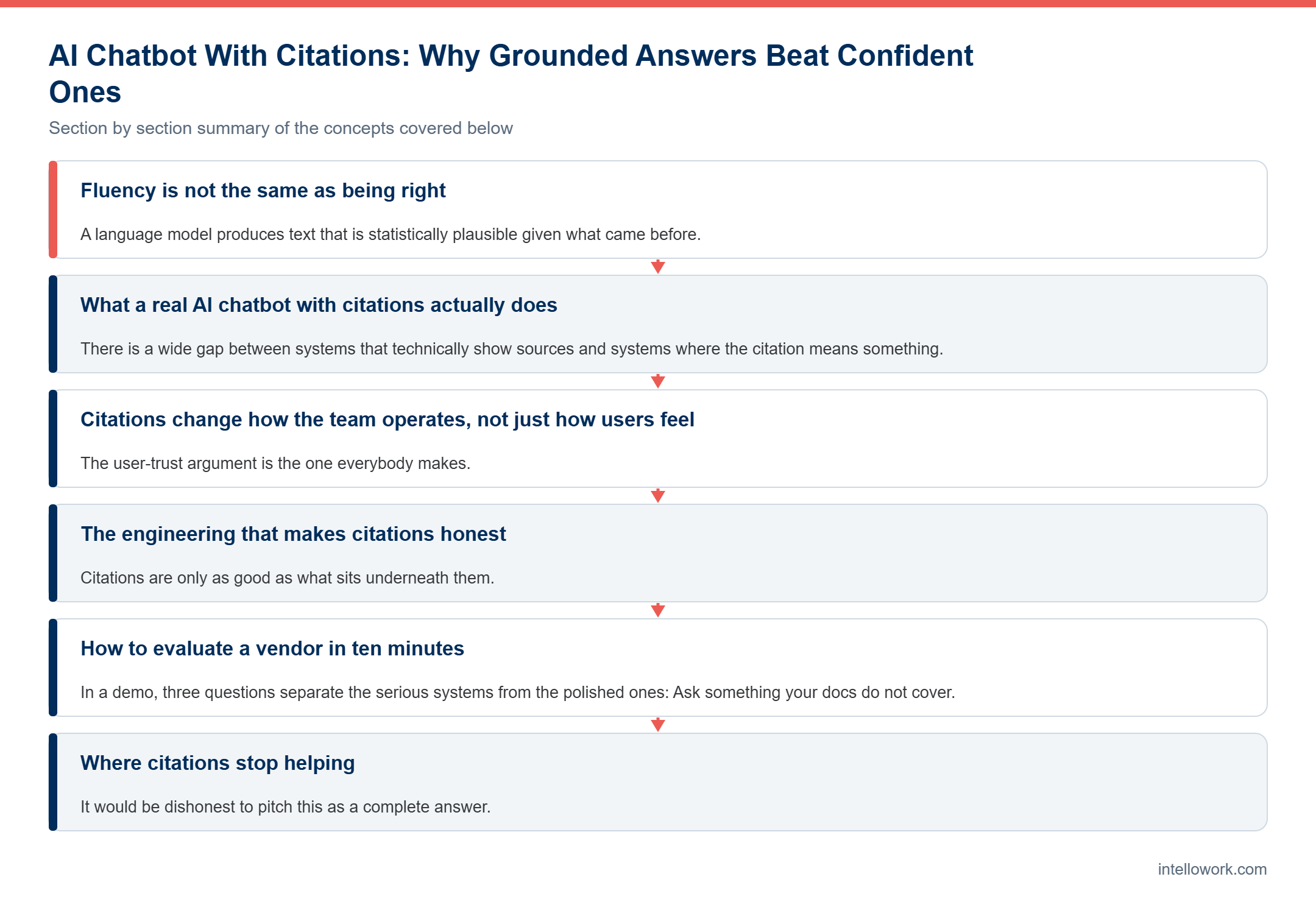
Fluency is not the same as being right
A language model produces text that is statistically plausible given what came before. When it has good retrieved context, plausible and correct usually coincide. When retrieval misses — the query was ambiguous, the doc does not exist, the chunk was truncated mid-table — the model does not go quiet. It produces something equally fluent and quietly wrong.
This is the part people underestimate. There is no tonal difference between a grounded answer and an invented one. The confidence is identical. So the reader has no signal to work with, and “read it carefully and use your judgement” is not a workable instruction for a customer who came looking for an answer in the first place.
Prompting helps at the margins — I covered what actually moved the needle in reducing chatbot hallucinations in production, and it was mostly retrieval work, not prompt work. But no instruction reliably makes a model refuse. Citations sidestep the problem instead of trying to solve it: if every sentence points at a source, a wrong answer becomes visibly wrong.
What a real AI chatbot with citations actually does
There is a wide gap between systems that technically show sources and systems where the citation means something. The tell is granularity.
- Page-level citation — “See: Billing Guide.” Better than nothing. Still leaves the reader scanning 4,000 words to verify one sentence, which means they will not verify it.
- Section-level — links to the right heading. Usable.
- Paragraph-level — links to the specific passage the claim came from. This is the level where verification becomes a glance rather than a task.
The second tell is whether citations are generated or recorded. If you ask the model to append sources, it will invent them — plausible titles, plausible URLs, occasionally real ones. The citation has to come from the retrieval layer, attached to the chunk before generation ever happens. The model composes prose around retrieved passages; the system, not the model, decides what gets cited.
The third tell is what happens when retrieval comes back empty. A system built around citations has an obvious fallback: no sources above threshold, no answer. It says it does not know and offers the human path. A system built around fluency has no such circuit breaker.
Citations change how the team operates, not just how users feel
The user-trust argument is the one everybody makes. The operational argument is the one that convinced me.
Debugging becomes finite. An uncited wrong answer is a mystery — bad retrieval, bad chunking, bad prompt, model drift, who knows. A cited wrong answer tells you immediately which of two things happened: retrieval fetched the wrong passage, or it fetched the right passage and the model misread it. Those have completely different fixes, and knowing which one you have turns a week of guesswork into an afternoon.
Bad documentation gets exposed. Half the wrong answers I have investigated were the system faithfully reporting a document that was itself out of date or contradicted another document. Without citations that reads as “the AI is unreliable”. With citations it reads as “page 14 of the refunds policy contradicts the help centre”, which is a ticket somebody can close.
Compliance gets a straight answer. In regulated contexts, “where did this come from and who could see it” is not optional. Citations plus permission-aware retrieval plus audit logs turn an uncomfortable conversation into a demo.
The engineering that makes citations honest
Citations are only as good as what sits underneath them. Three things carry most of the weight.
Chunk boundaries that respect meaning
If your chunker cuts a table in half, the citation points at a fragment that does not support the claim even when the claim is correct. Split on structure — headings, list boundaries, table integrity — and carry the heading path into the chunk so the passage is self-describing.
Hybrid retrieval
Vector search understands paraphrase and fails on exact tokens like error codes and part numbers. Keyword search is the reverse. Run both, fuse the rankings, and the passage you cite is far more likely to be the one that answers the question. This matters more for citation quality than model choice does.
Permissions applied at retrieval
If access control happens after generation, you have already leaked — the answer was composed from content the user cannot see, and redacting the citation does not un-leak the sentence. Filtering has to happen while candidates are selected, using the source system’s own access rules.
How to evaluate a vendor in ten minutes
In a demo, three questions separate the serious systems from the polished ones:
- Ask something your docs do not cover. Watch whether it declines or improvises. This single test tells you most of what you need to know.
- Click a citation. Does it land on the exact passage, or dump you at the top of a long page?
- Ask about something restricted. Confirm the filtering happened during retrieval, not as a post-hoc redaction.
None of this requires you to understand embeddings. It just requires you to try to break it, which is the one thing scripted demos never do. If you are earlier in the process, my write-up on turning documentation into an AI chatbot covers the same ground from the build side, and this piece on ticket deflection covers what results to expect.
Where citations stop helping
It would be dishonest to pitch this as a complete answer. Citations fix attribution; they do not fix everything.
They do not help with synthesis questions. If someone asks “should we use the standard or enterprise plan for a 40-person team”, the answer necessarily combines several passages and adds judgement. You can cite the inputs, but the reasoning that joins them is the model’s, and that is exactly where subtle errors live. For questions like that, treat the answer as a starting point and keep a human in the loop.
They also do not fix a stale index. A citation to a page that was updated last week but indexed last quarter is confidently pointing at content that no longer says what the system claims it says. Surface the last-indexed date in the citation and you turn an invisible failure into a visible one.
And they do not stop a determined user from taking the first sentence and ignoring the link. Citations raise the ceiling on trust and give your team a debugging trail; they are not a substitute for measuring thumbs-down rates and reading the transcripts. Some of the most useful hours I have spent on these systems were just reading conversations that went badly, which is also the theme of seven lessons from running RAG in production.
Grounded beats clever
The chatbots that survive contact with real users are not the eloquent ones. They are the ones people stop double-checking after two weeks, because every time they did check, the source was right there and it held up.
That is the whole design philosophy behind IntelloWork — hybrid retrieval over your existing content, paragraph-level citations on every answer, permission-aware filtering at the retrieval layer, and a refusal path when nothing relevant comes back. An AI chatbot with citations is not a feature you add at the end. It is the constraint you design the system around, and everything else gets better because of it.