
Large Language Models are powering modern AI applications, from chatbots to enterprise automation systems. While these models offer powerful capabilities, running them at scale comes with significant costs.
Organizations often underestimate the expenses involved in deploying and maintaining LLM-based systems. Beyond just model access, costs include infrastructure, compute resources, data processing, and ongoing optimization.
In this guide, you will understand the real cost of running LLMs at scale and how businesses can optimize their spending.
Quick Answer
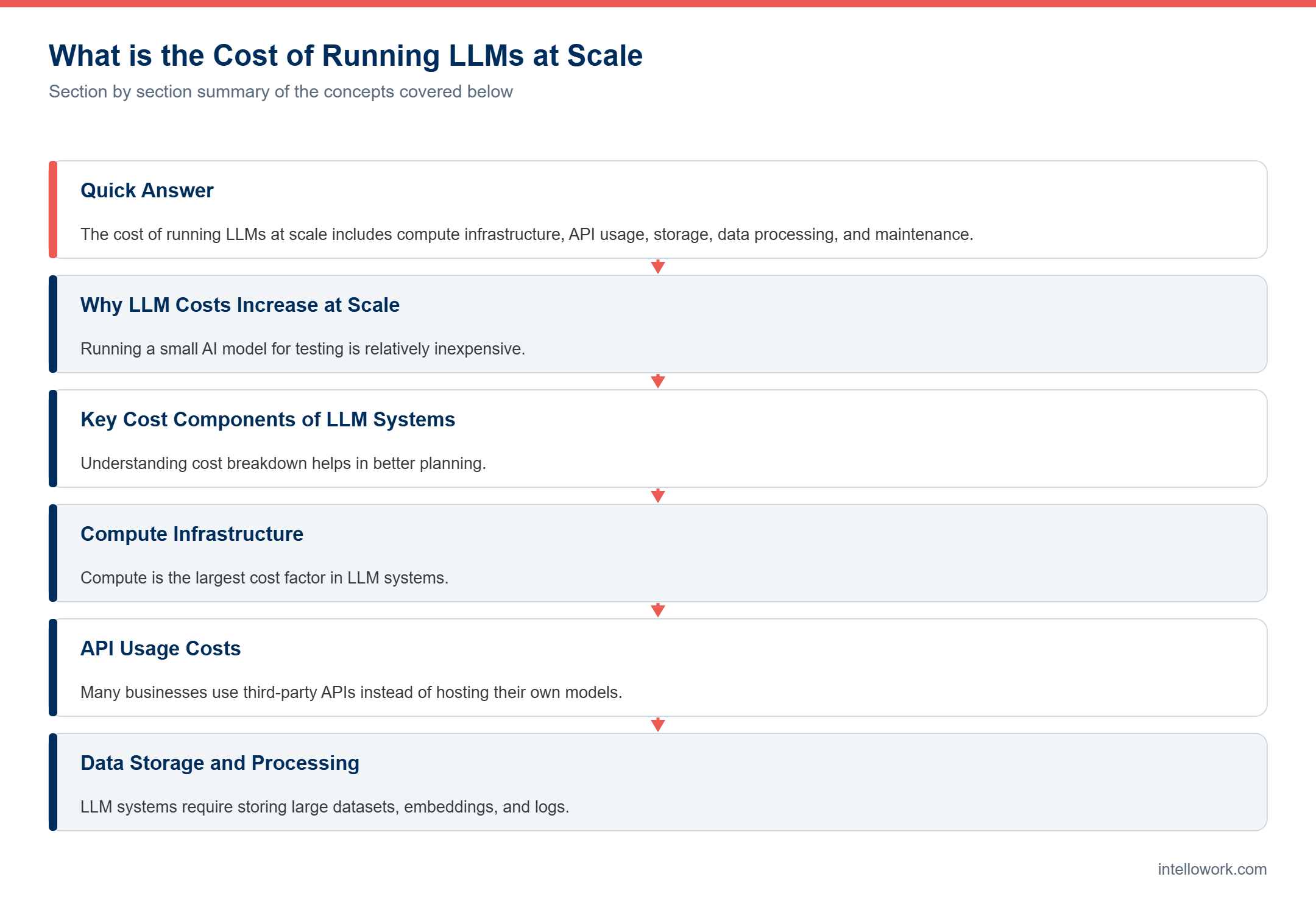
The cost of running LLMs at scale includes compute infrastructure, API usage, storage, data processing, and maintenance. These costs can range from hundreds to millions of dollars depending on usage and architecture.
Why LLM Costs Increase at Scale
Running a small AI model for testing is relatively inexpensive. However, when deployed to serve thousands or millions of users, costs increase rapidly.
The primary reason is compute demand. LLMs require powerful hardware such as GPUs or specialized accelerators. As usage grows, the number of requests increases, leading to higher processing costs.
Another factor is latency requirements. Enterprises need fast responses, which often requires more resources and optimized infrastructure.
Scaling also involves redundancy, monitoring, and reliability systems, all of which add to the cost.
Key Cost Components of LLM Systems
Understanding cost breakdown helps in better planning.
Compute Infrastructure
Compute is the largest cost factor in LLM systems.
Running models requires GPUs or cloud-based compute instances. High-performance GPUs are expensive and consume significant power.
Cloud providers charge based on usage, which increases with traffic.
API Usage Costs
Many businesses use third-party APIs instead of hosting their own models.
These APIs charge based on tokens or requests. As the number of users grows, API costs can become substantial.
For high-traffic applications, API usage alone can cost thousands of dollars per month.
Data Storage and Processing
LLM systems require storing large datasets, embeddings, and logs.
Data processing pipelines also add to the cost. Cleaning, transforming, and indexing data requires compute resources.
Vector databases used for semantic search also contribute to expenses.
Model Training and Fine Tuning
Training large models from scratch is extremely expensive.
Even fine-tuning requires significant compute resources and time.
Organizations must balance between customization and cost.
Maintenance and Monitoring
LLM systems require continuous monitoring to ensure performance.
Logging, debugging, and updating models add to operational costs.
Security and compliance systems also increase expenses.
Hidden Costs of Running LLMs
Many organizations overlook hidden costs.
Latency optimization requires caching and distributed systems.
Scaling infrastructure requires load balancing and redundancy.
Engineering costs are also significant. Skilled professionals are needed to build and maintain these systems.
Energy consumption is another factor, especially for on-premise deployments.
Cost Comparison: API vs Self Hosting
Businesses often choose between API-based models and self-hosted solutions.
API-based models are easier to implement and require less infrastructure. However, they become expensive at scale.
Self-hosting requires upfront investment in hardware and expertise. But it can reduce long-term costs for high usage.
The right choice depends on the scale and requirements of the application.
How to Reduce LLM Costs
Organizations can adopt several strategies to optimize costs.
Use Smaller Models
Not every application requires large models. Smaller models can perform well for specific tasks and reduce costs significantly.
Implement Caching
Caching frequently used responses reduces repeated computation.
This improves performance and lowers cost.
Use Retrieval Based Systems
Retrieval-based systems reduce the need for large model inference.
By fetching relevant data, they minimize computation and improve accuracy.
Optimize Prompts
Efficient prompts reduce token usage.
Short and precise prompts lower API costs.
Batch Processing
Processing multiple requests together improves efficiency and reduces compute cost.
Use Hybrid Architecture
Combining LLMs with traditional systems reduces dependency on expensive inference.
This approach balances cost and performance.
Real World Cost Examples
In real-world scenarios, costs vary based on usage.
A small startup may spend a few hundred dollars per month on API usage.
Mid-scale applications can cost thousands of dollars monthly.
Large enterprises handling millions of requests may spend hundreds of thousands or more.
These examples highlight the importance of cost optimization.
Future of LLM Cost Optimization
As technology evolves, costs are expected to decrease.
New hardware innovations will improve efficiency.
Open-source models will provide cost-effective alternatives.
Optimization techniques will become more advanced.
Cloud providers will offer better pricing models.
These trends will make LLMs more accessible to businesses.
Conclusion
Running LLMs at scale is powerful but expensive. Understanding cost components is essential for building sustainable AI systems.
By optimizing architecture, choosing the right models, and implementing cost-saving strategies, organizations can manage expenses effectively.
The key is to balance performance, scalability, and cost.
Businesses that master this balance will gain a competitive advantage in the AI-driven world.
FAQ
What is the biggest cost in LLM systems
Compute infrastructure is the largest cost
Is API cheaper than self hosting
It depends on scale; APIs are cheaper for small usage
How can LLM costs be reduced
Using smaller models, caching, and optimization techniques
Are LLMs expensive to run
Yes, especially at large scale
What is the future of LLM costs
Costs are expected to decrease with better technology
Related reading
- What is Hallucination in LLMs and How to Prevent It
- How Large Language Models Improve Search Engines (Complete Guide)
- RAG in Production: 7 Lessons From Actually Running One
The practical version of everything above is Intellowork: one knowledge base, cited answers, action agents that call your own APIs, and a named region for data residency.