Businesses in India are generating massive amounts of internal knowledge across documents, tools, and communication platforms. Managing and accessing this information efficiently has become a major challenge.
An enterprise knowledge chatbot solves this problem by allowing employees to access company information instantly through a conversational interface. Instead of searching across multiple systems, users can simply ask questions and get accurate answers.
As organizations move toward AI-driven operations, knowledge chatbots are becoming an essential part of enterprise infrastructure.
Quick Answer
An enterprise knowledge chatbot in India is an AI-powered system that allows employees to access internal company information instantly using natural language queries.
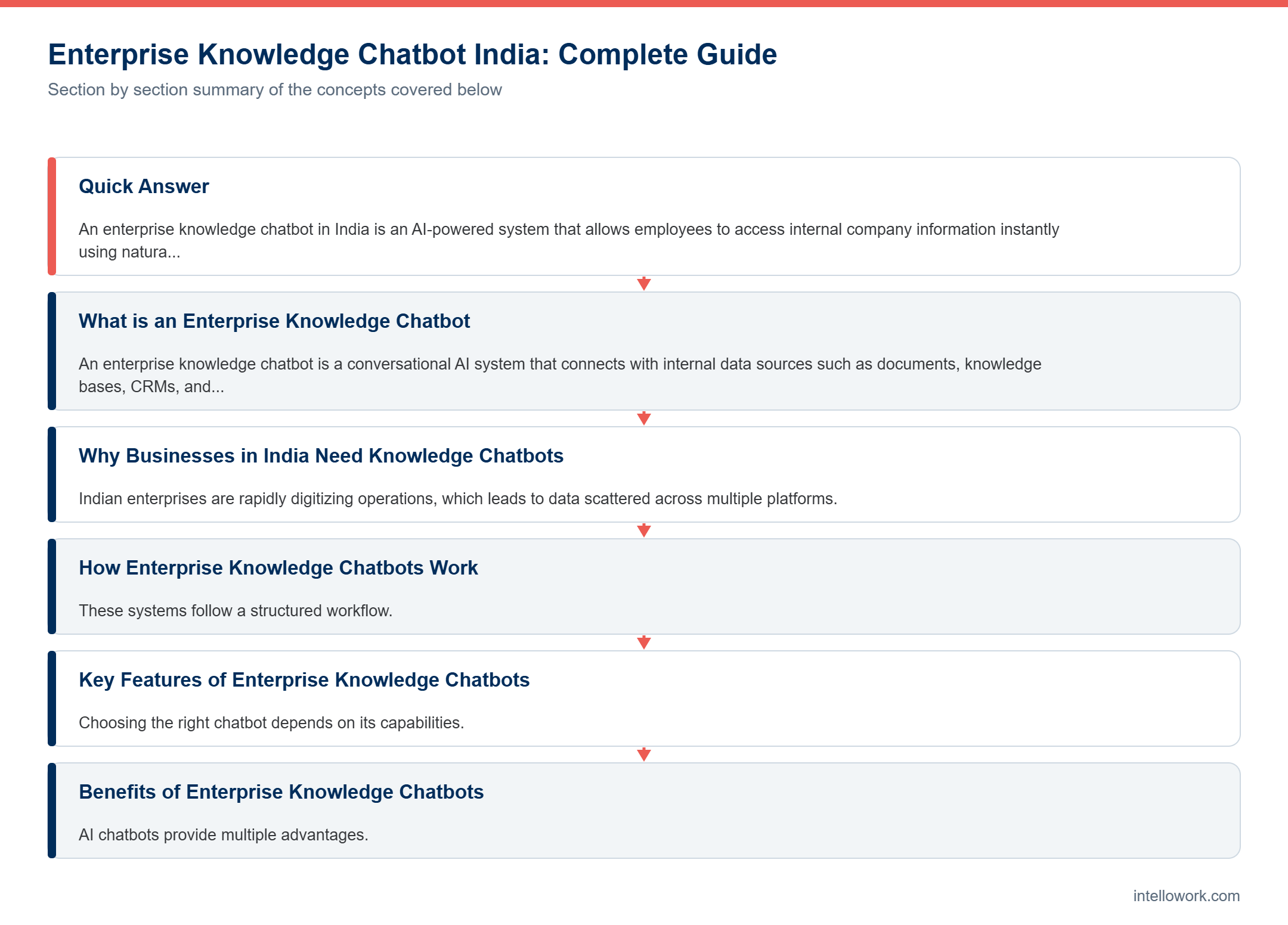
What is an Enterprise Knowledge Chatbot
An enterprise knowledge chatbot is a conversational AI system that connects with internal data sources such as documents, knowledge bases, CRMs, and communication tools.
It uses natural language processing and AI models to understand queries and deliver relevant responses.
Unlike traditional search systems, it provides direct answers instead of showing multiple links.
Why Businesses in India Need Knowledge Chatbots
Indian enterprises are rapidly digitizing operations, which leads to data scattered across multiple platforms.
Common Problems
Employees spend hours searching for information
Data is stored in silos
Support teams handle repetitive queries
Onboarding new employees takes time
How Chatbots Solve These Problems
Provide instant answers
Centralize access to knowledge
Reduce support workload
Improve onboarding efficiency
How Enterprise Knowledge Chatbots Work
These systems follow a structured workflow.
Step-by-Step Process
Data is collected from internal systems
Information is processed and indexed
User queries are analyzed using AI
Relevant data is retrieved
The chatbot generates a response
Modern chatbots also use retrieval-based architectures to improve accuracy and reduce incorrect answers.
Key Features of Enterprise Knowledge Chatbots
Choosing the right chatbot depends on its capabilities.
Natural Language Understanding
Understands user intent and context
Integration with Enterprise Tools
Connects with Slack, Teams, CRM, and HR systems
Role-Based Access
Ensures secure access to data
Real-Time Responses
Provides instant answers
Analytics and Insights
Tracks usage and performance
Benefits of Enterprise Knowledge Chatbots
AI chatbots provide multiple advantages.
Increased Productivity
Employees get answers instantly
Cost Reduction
Less dependency on support teams
Faster Decision Making
Quick access to accurate data
Improved Employee Experience
Easy access to information
Better Knowledge Management
Centralized and organized data
Real World Use Cases
Enterprise knowledge chatbots are widely used.
HR Support
Answer questions about policies and benefits
IT Helpdesk
Resolve common technical issues
Sales Teams
Provide product and customer information
Operations
Assist in workflows and documentation
Top Enterprise Knowledge Chatbot Solutions in India
Several companies provide AI chatbot solutions.
- Kore.ai
- Microsoft
- OpenAI
Businesses can also build custom chatbot solutions based on their needs.
Challenges in Implementation
Despite the benefits, there are challenges.
Data Quality Issues
Poor data leads to inaccurate responses
Integration Complexity
Connecting multiple systems can be difficult
Security Risks
Sensitive data must be protected
User Adoption
Employees may take time to adapt
How to Choose the Right Chatbot in India
Selecting the right solution is critical.
Steps to Follow
Identify business use cases
Check integration capabilities
Evaluate security features
Test performance and accuracy
Ensure scalability
Future of Enterprise Knowledge Chatbots in India
The future of AI chatbots is rapidly evolving.
Chatbots will become more intelligent and autonomous
Integration with AI agents will increase
Voice-based interactions will grow
Personalization will improve user experience
India is becoming a major hub for AI innovation, making chatbot adoption even faster.
Conclusion
An enterprise knowledge chatbot in India is a powerful solution for managing internal knowledge and improving productivity.
By providing instant access to information and automating support tasks, it helps businesses operate more efficiently.
Organizations that adopt AI chatbots today will gain a strong competitive advantage in the future.
FAQ
What is an enterprise knowledge chatbot
It is an AI system that helps employees access company data
How does it improve productivity
By reducing time spent searching for information
Is it secure
Yes, with proper access control
Can it integrate with existing tools
Yes, most solutions support integration
Is it expensive
Cost depends on features and scale
What Indian deployments get wrong first
An enterprise knowledge chatbot behaves differently in India than the vendor demo suggests, mainly because of language and document habits. So it helps to plan for three local realities from the start.
First, users mix languages freely. A question may begin in English, switch to Hindi and end in transliterated Hinglish written in Latin script. Consequently retrieval needs multilingual embeddings and a reranking step that treats languages fairly, otherwise answers degrade the moment someone stops writing in formal English.
Second, internal documentation is often distributed across shared drives, email attachments and scanned PDFs. Therefore ingestion work usually exceeds the estimate, and scanned material needs optical character recognition before it becomes searchable at all.
Third, data protection expectations have tightened. Under the Digital Personal Data Protection Rules, conversational logs containing personal data fall inside your compliance programme. As a result, residency, retention and access control belong in the design rather than in a later phase. My guide to AI chatbot data residency and security covers that ground properly.
A realistic rollout sequence
Sequencing matters more than tooling. This order works reliably.
- Weeks one and two. Pick one department and one well-maintained corpus. Resist the temptation to index everything immediately.
- Weeks three and four. Map permissions onto the content, then enforce them at retrieval rather than after generation.
- Weeks five and six. Collect one hundred real questions, including twenty the documentation cannot answer, and measure how the assistant handles each group.
- Weeks seven and eight. Add the second language properly, then retest. Translation shortcuts tend to fail on internal terminology.
- Ongoing. Name an owner for the knowledge base and review retired content every quarter.
Notably, the twenty unanswerable questions matter most. A chatbot that admits uncertainty builds trust, while one that improvises loses it permanently after two or three bad answers.
Frequently asked questions
How much content do we need before starting?
Less than most teams assume. One well-structured corpus covering a single department is usually enough for a useful pilot, provided the content is current.
Can it handle Hindi and Hinglish?
Yes, when the retrieval stack uses multilingual embeddings and reranking. Test this on day one, because generation often looks fine while retrieval quietly fails across languages.
How do we stop it answering from the wrong document?
Retire superseded versions, add reranking so the best passage reaches the top, and require citations so readers can check the source themselves.
Does it replace the helpdesk?
No. It removes repetitive questions so people handle the cases that need judgement. Escalation quality matters as much as answer quality.
What does a first deployment usually cost?
Licence costs vary, yet content preparation and integration typically exceed them in year one. I broke the numbers down in enterprise AI chatbot pricing.
Related reading
- AI Chatbot for Employees Knowledge Base: Complete Guide
- Enterprise AI Chatbot Pricing in 2026: What It Actually Costs
- Best AI Chatbot for Enterprise Data in 2026: How to Actually Choose One
The practical version of everything above is Intellowork: one knowledge base, cited answers, action agents that call your own APIs, and a named region for data residency.