
Search engines have evolved from simple keyword-matching systems to highly intelligent platforms powered by artificial intelligence. One of the biggest breakthroughs in this transformation is the rise of Large Language Models (LLMs).
LLMs are revolutionizing how search engines understand queries, process data, and deliver results. Instead of relying solely on keywords, modern search systems use LLMs to interpret context, intent, and meaning behind user queries.
In this guide, we will explore how large language models improve search engines and why they are becoming a critical component in AI-powered search systems.
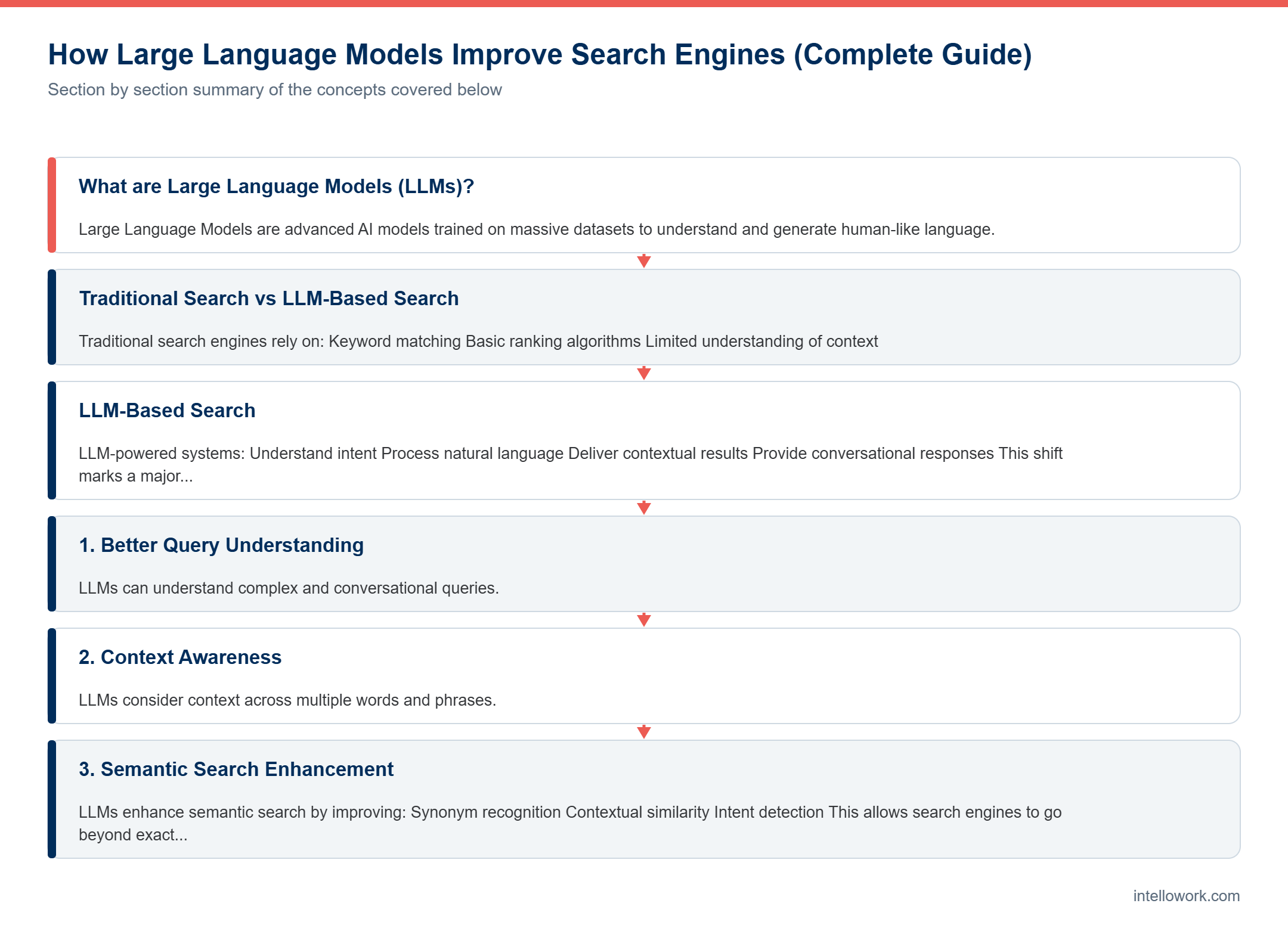
What are Large Language Models (LLMs)?
Large Language Models are advanced AI models trained on massive datasets to understand and generate human-like language.
These models can:
- Understand context
- Generate natural responses
- Analyze complex queries
- Perform semantic reasoning
Popular examples include:
- GPT models
- BERT
- LLaMA
LLMs are the backbone of modern AI applications, including intelligent search engines.
Traditional Search vs LLM-Based Search
Traditional search engines rely on:
- Keyword matching
- Basic ranking algorithms
- Limited understanding of context
LLM-Based Search
LLM-powered systems:
- Understand intent
- Process natural language
- Deliver contextual results
- Provide conversational responses
This shift marks a major evolution in search technology.
How LLMs Improve Search Engines
1. Better Query Understanding
LLMs can understand complex and conversational queries.
Example:
User Query
“Which laptop is best for coding under budget?”
LLMs understand:
- Budget constraint
- Use case (coding)
- Product category (laptop)
This leads to more accurate results.
2. Context Awareness
LLMs consider context across multiple words and phrases.
They can understand relationships between terms, making search results more relevant.
3. Semantic Search Enhancement
LLMs enhance semantic search by improving:
- Synonym recognition
- Contextual similarity
- Intent detection
This allows search engines to go beyond exact keyword matches.
4. Conversational Search Experience
Modern users prefer conversational interactions.
LLM-powered search engines allow users to:
- Ask follow-up questions
- Refine queries naturally
- Get direct answers
This creates a more interactive experience.
5. Improved Ranking Algorithms
LLMs help improve ranking by analyzing:
- Content quality
- Relevance
- Context
This ensures that the best results appear at the top.
6. Query Expansion
LLMs automatically expand queries by adding related terms and synonyms.
Example:
“AI tools”
Expanded to include:
- Machine learning tools
- Automation software
- AI platforms
This improves search coverage.
7. Summarization of Results
LLMs can summarize large amounts of information into concise answers.
Instead of showing multiple links, search engines can provide:
- Direct answers
- Key insights
- Summarized content
Architecture of LLM-Based Search Systems
A typical LLM-powered search system includes:
Data Layer
Stores structured and unstructured data.
Indexing Layer
Creates searchable indexes using:
- Keyword indexing
- Vector embeddings
LLM Processing Layer
Processes queries using large language models.
Retrieval Layer
Fetches relevant results using hybrid or semantic search.
Ranking Layer
Ranks results based on relevance and context.
Response Generation Layer
Generates final answers using LLMs.
Technologies Behind LLM Search
LLM-based search systems rely on several technologies.
Natural Language Processing (NLP)
Enables understanding of human language.
Transformer Models
Used in models like BERT and GPT.
Vector Databases
Store embeddings for semantic search.
Examples:
- FAISS
- Pinecone
Retrieval-Augmented Generation (RAG)
Combines search with LLMs to generate accurate responses.
Real World Applications
Google Search
Uses AI models like BERT to improve query understanding.
AI Chatbots
Provide conversational search experiences.
E-commerce Platforms
Improve product discovery.
Enterprise Search Systems
Help employees find internal data quickly.
Benefits of LLM-Based Search
High Accuracy
Better understanding of queries.
Improved User Experience
More relevant and faster results.
Conversational Interaction
Users can interact naturally.
Scalability
Handles large datasets efficiently.
Better Decision Making
Provides meaningful insights.
Challenges of Using LLMs in Search
High Computational Cost
LLMs require powerful hardware.
Latency Issues
Processing large models can slow down response time.
Data Privacy Concerns
Sensitive data must be handled carefully.
Model Bias
LLMs may produce biased results if not properly trained.
Future of LLM-Powered Search
The future of search engines will be heavily influenced by LLMs.
Upcoming trends include:
- Fully conversational search engines
- Voice-based AI assistants
- Multimodal search (text + image + voice)
- Personalized AI experiences
LLMs will continue to redefine how users interact with information.
Conclusion
Large Language Models are transforming search engines by making them more intelligent, contextual, and user-friendly.
By improving query understanding, enabling semantic search, and supporting conversational interactions, LLMs are setting a new standard for modern search systems.
As AI continues to evolve, LLM-powered search will become the foundation of next-generation digital experiences.
Developers and businesses that adopt this technology early will gain a significant competitive advantage.
FAQ
What are large language models?
Large language models are AI systems trained to understand and generate human language.
How do LLMs improve search engines?
They improve query understanding, semantic search, and result relevance.
What is RAG in search systems?
Retrieval-Augmented Generation combines search with LLMs to generate accurate responses.
Are LLMs better than traditional search methods?
Yes, because they understand context and intent.
Review
⭐ ⭐ ⭐ ⭐ ⭐
This guide provides a complete and practical understanding of how large language models improve search engines. Perfect for developers and AI enthusiasts.
Related reading
- AI Powered Internal Search System: Complete Guide
- AI Powered Internal Search System for Enterprises: Complete Guide
- AI Search Solution for Internal Data: Complete Guide
Building something similar? Intellowork turns your existing documentation, websites and APIs into cited answers across a web widget, WhatsApp, Slack and a direct API, with permission-aware retrieval and data residency in your chosen region.