Artificial intelligence systems are becoming essential for modern enterprises. From customer support automation to internal knowledge assistants, businesses are increasingly relying on AI to improve efficiency and decision-making.
However, one major challenge that organizations face is accuracy. AI systems often struggle to deliver precise and context-aware responses, especially when dealing with large and complex enterprise data.
This is where hybrid search plays a critical role.
Hybrid search combines traditional keyword-based search with modern semantic search techniques to improve how AI systems retrieve information. By integrating hybrid search into AI architectures, enterprises can significantly enhance the accuracy, relevance, and reliability of AI-generated responses.
In this article, we will explore how hybrid search works, why it is important for enterprise AI systems, and how it improves overall performance.
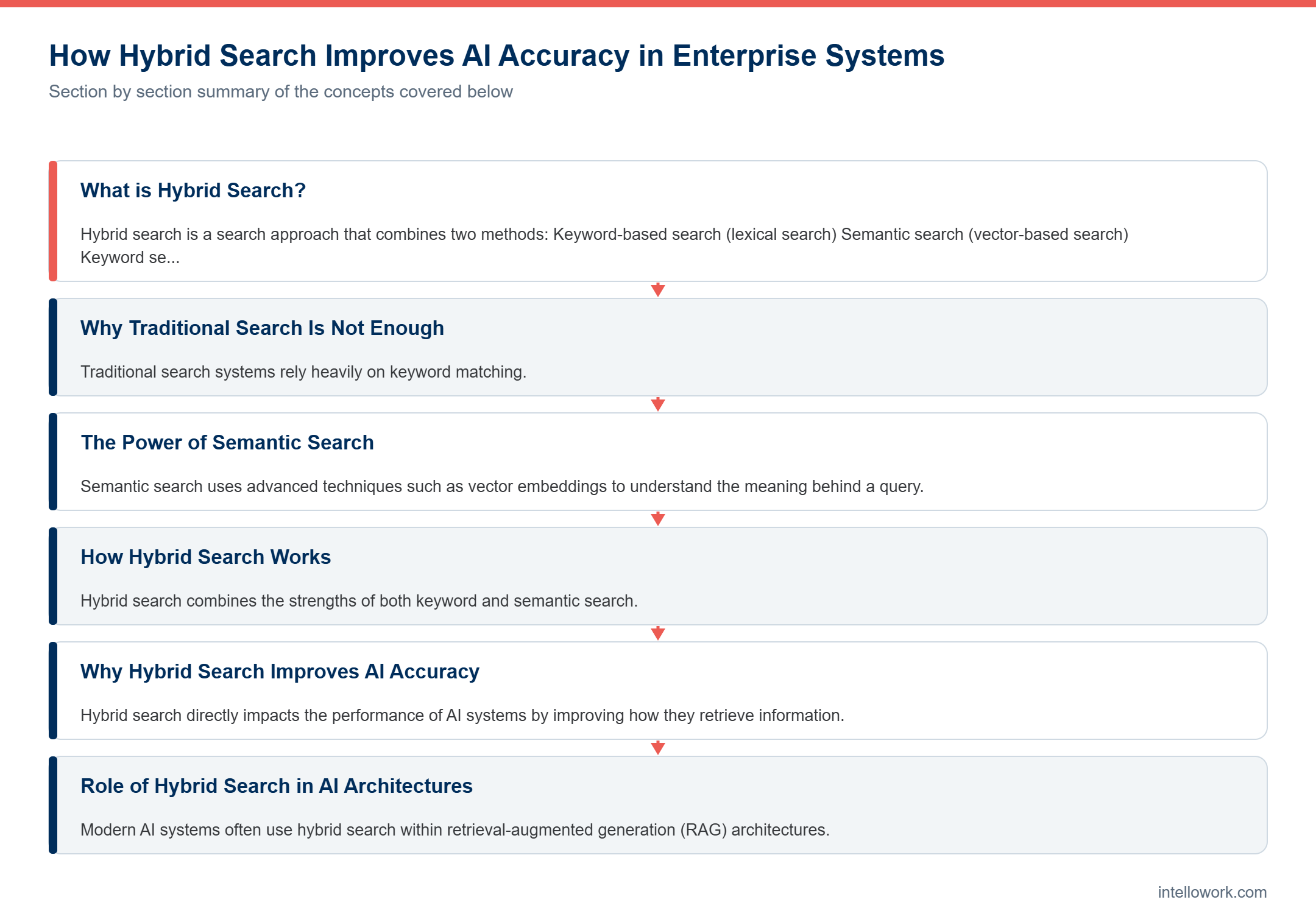
What is Hybrid Search?
Hybrid search is a search approach that combines two methods:
- Keyword-based search (lexical search)
- Semantic search (vector-based search)
Keyword search focuses on exact word matching, while semantic search understands the meaning and context of a query.
By combining both approaches, hybrid search delivers more accurate and relevant results.
Why Traditional Search Is Not Enough
Traditional search systems rely heavily on keyword matching.
While this approach works well for simple queries, it has limitations when dealing with complex or natural language queries.
For example, if a user searches for:
“Steps to integrate AI with enterprise systems”
A keyword-based search system may fail to retrieve relevant results if the exact keywords are not present in the documents.
This leads to incomplete or irrelevant search results.
The Power of Semantic Search
Semantic search uses advanced techniques such as vector embeddings to understand the meaning behind a query.
Instead of matching exact words, it finds content that is contextually similar.
This allows AI systems to:
- Understand user intent
- Retrieve relevant information even without exact keyword matches
- Improve search accuracy
However, semantic search alone may sometimes lack precision, especially when exact terms are important.
How Hybrid Search Works
Hybrid search combines the strengths of both keyword and semantic search.
Step 1: Query Processing
The system receives a user query and processes it using both keyword and semantic methods.
Step 2: Dual Retrieval
- Keyword search retrieves results based on exact matches
- Semantic search retrieves results based on meaning
Step 3: Result Merging
The system combines results from both methods.
Step 4: Ranking
Results are ranked based on relevance, ensuring the most accurate information appears at the top.
Why Hybrid Search Improves AI Accuracy
Hybrid search directly impacts the performance of AI systems by improving how they retrieve information.
Better Context Understanding
Semantic search ensures that the system understands user intent.
Higher Precision
Keyword search ensures that exact matches are not missed.
Reduced AI Hallucinations
When AI systems retrieve accurate data, they are less likely to generate incorrect responses.
Improved Response Quality
AI models can generate better responses when they are provided with relevant and high-quality data.
Role of Hybrid Search in AI Architectures
Modern AI systems often use hybrid search within retrieval-augmented generation (RAG) architectures.
In this setup:
- The user asks a question
- Hybrid search retrieves relevant documents
- The AI model uses these documents to generate a response
This ensures that AI responses are grounded in real enterprise data.
Key Technologies Behind Hybrid Search
Several technologies enable hybrid search systems.
Vector Databases
These databases store embeddings and enable semantic search.
Search Engines
Traditional search engines handle keyword-based retrieval.
Ranking Algorithms
Advanced ranking systems combine results and determine relevance.
Data Indexing
Efficient indexing ensures fast and accurate retrieval.
Benefits of Hybrid Search for Enterprises
Enterprises that implement hybrid search gain several advantages.
Improved Decision-Making
Accurate data retrieval leads to better business insights.
Faster Information Access
Employees can find relevant information quickly.
Enhanced Customer Support
Customer-facing AI systems provide more accurate responses.
Scalable AI Systems
Hybrid search supports large-scale enterprise data environments.
Real-World Use Cases
Hybrid search is widely used across industries.
Enterprise Knowledge Systems
Employees use AI assistants powered by hybrid search to access internal information.
Customer Support Chatbots
Chatbots retrieve accurate answers from knowledge bases.
E-Commerce Platforms
Customers can find products using natural language queries.
Research and Analytics
Organizations use hybrid search to explore large datasets.
Challenges in Implementing Hybrid Search
Despite its benefits, hybrid search comes with challenges.
Data Complexity
Enterprise data can be unstructured and difficult to manage.
Infrastructure Requirements
Hybrid search systems require scalable infrastructure.
Optimization
Balancing keyword and semantic search requires careful tuning.
Best Practices for Implementing Hybrid Search
Organizations should follow best practices to maximize effectiveness.
Use High-Quality Data
Clean and structured data improves search performance.
Combine Multiple Retrieval Methods
Hybrid systems should balance keyword and semantic search effectively.
Monitor Performance
Regular monitoring helps improve accuracy.
Integrate with AI Systems
Hybrid search should be part of the overall AI architecture.
Industry Insights and Reviews
Technology experts and enterprise teams widely recognize hybrid search as a key component of modern AI systems.
Organizations that implement hybrid search report improved accuracy in AI responses and better user experiences.
Customer support teams often highlight faster and more reliable responses when hybrid search is integrated into AI systems.
Experts believe that hybrid search will become a standard feature in enterprise AI platforms.
The Future of Hybrid Search in AI
As AI technology evolves, hybrid search systems will become more advanced.
Future developments may include:
- Improved semantic understanding
- Real-time data integration
- Context-aware search systems
- Automated knowledge discovery
These advancements will further enhance AI accuracy and usability.
Conclusion
Hybrid search plays a critical role in improving AI accuracy in enterprise systems.
By combining keyword and semantic search, organizations can ensure that AI systems retrieve relevant and accurate information.
This leads to better decision-making, improved customer experiences, and more reliable AI applications.
Enterprises that invest in hybrid search infrastructure will be better positioned to build scalable and effective AI systems.
Frequently Asked Questions
What is hybrid search?
Hybrid search combines keyword-based search and semantic search to improve result accuracy.
Why is hybrid search important for AI?
It helps AI systems retrieve relevant data, improving response accuracy.
Does hybrid search reduce AI hallucinations?
Yes. By providing accurate data, it reduces incorrect AI-generated responses.
Where is hybrid search used?
It is used in enterprise AI systems, chatbots, search platforms, and analytics tools.
What technologies support hybrid search?
Vector databases, search engines, indexing systems, and ranking algorithms support hybrid search.
Related reading
- How AI Improves Enterprise Search Systems (Complete Guide)
- Why Every Enterprise AI Strategy Starts with Search Infrastructure
- Semantic Search vs Keyword Search: The Future of Modern Search Engines
If you would rather test this on your own content than build it, Intellowork grounds every answer in your documentation, cites the passage behind each claim and keeps retrieval inside your permission model.