Every Business Is Becoming a Data Business
Whether you operate a startup, healthcare organization, financial institution, manufacturing company, SaaS business, educational institution, or e-commerce platform, one thing is common—you collect and process personal data.
customer registration.
Every employee onboarding.
online payment.
Every support ticket.
Every marketing campaign.
All these activities involve digital personal data.
With the implementation of India’s Digital Personal Data Protection (DPDP) Act, organizations are expected to manage this information responsibly while maintaining transparency, accountability, and strong privacy governance.
Many businesses believe they can manage compliance using spreadsheets, emails, and manual documentation.
That approach quickly becomes difficult as the organization grows.
Multiple departments.
Hundreds of employees.
Thousands of customers.
Several software applications.
Without a centralized compliance platform, maintaining consistency becomes a challenge.
This is why organizations are increasingly investing in DPDP Compliance Software that simplifies compliance, automates governance, and reduces operational risks.
Among the growing number of privacy platforms available in India, ProtectComply has emerged as a comprehensive AI-powered solution designed to help organizations simplify DPDP compliance from a single platform.
What Is DPDP Compliance Software?
DPDP Compliance Software is a centralized platform that helps organizations implement and manage the requirements of the Digital Personal Data Protection Act.
Instead of using multiple disconnected tools, businesses can manage their privacy program from one secure environment.
A modern DPDP Compliance Software solution typically includes:
- Consent Management
- Privacy Governance
- DPDP Gap Assessment
- Compliance Monitoring
- Audit Readiness
- Data Principal Request Management
- Privacy Documentation
- Compliance Reporting
- Risk Assessment
- Workflow Automation
Rather than reacting to compliance issues after they occur, organizations can proactively identify risks, improve governance, and strengthen accountability.
Why Businesses Need DPDP Compliance Software
Many organizations assume compliance simply means updating their privacy policy.
Unfortunately, that is only a small part of the process.
Real compliance involves managing the complete lifecycle of personal data.
Businesses must know:
- What personal data they collect
- Why they collect it
- Where it is stored
- Who can access it
- How consent is managed
- How long information is retained
- How requests from Data Principals are handled
Managing these activities manually becomes increasingly difficult as businesses expand.
Without structured software, organizations often experience:
- Missing compliance records
- Inconsistent consent management
- Delayed responses to customer requests
- Poor visibility into personal data
- Weak governance
- Increased operational costs
These issues can slow business growth and reduce customer confidence.
Signs Your Business Has Outgrown Manual Compliance
Many organizations continue to rely on manual processes because they worked when the business was smaller.
However, as operations expand, the limitations become obvious.
Your organization may need DPDP Compliance Software if:
- Compliance records are maintained in Excel sheets.
- Different departments follow different privacy processes.
- Consent records are difficult to locate.
- Compliance tasks depend on email approvals.
- There is no centralized privacy dashboard.
- Audit preparation takes several days or weeks.
- Teams struggle to identify compliance gaps quickly.
If any of these challenges sound familiar, it may be time to adopt a dedicated compliance platform.
Essential Features Every DPDP Compliance Software Should Include
Choosing software based only on price can become expensive in the long run.
Instead, organizations should evaluate whether the platform provides the capabilities needed to support long-term compliance.
Here are the most important features to look for.
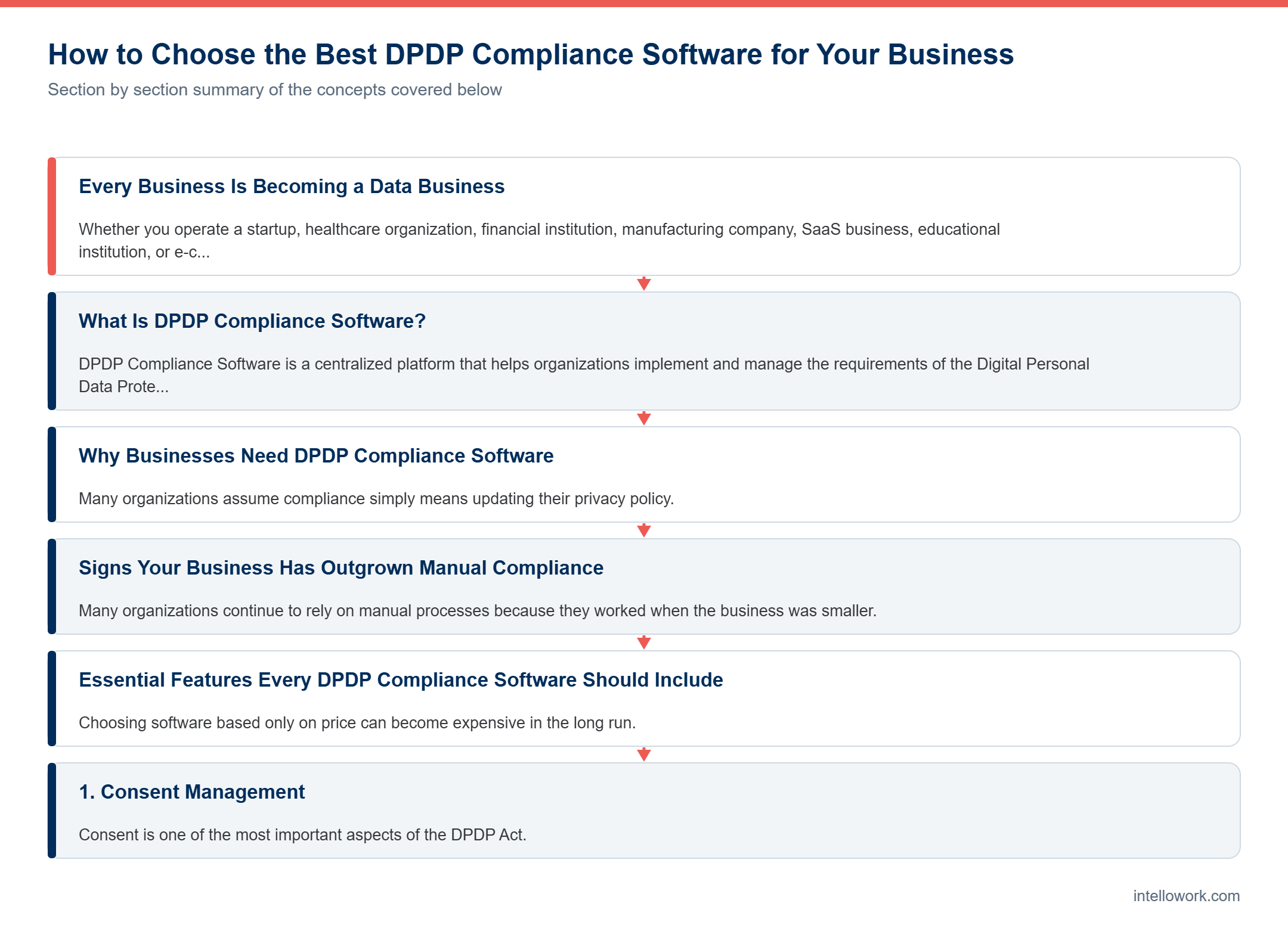
1. Consent Management
Consent is one of the most important aspects of the DPDP Act.
The platform should help organizations:
- Capture consent
- Store consent records
- Track updates
- Record withdrawals
- Maintain complete audit history
Without effective consent management, demonstrating compliance becomes much more difficult.
2. DPDP Gap Assessment
A good platform should help businesses understand where they currently stand.
Gap Assessments help identify:
- Missing controls
- Weak governance
- Documentation gaps
- Compliance risks
- Areas that require improvement
This allows organizations to prioritize corrective actions before problems arise.
3. Privacy Governance
Governance ensures privacy responsibilities are clearly defined across the organization.
Look for features that support:
- Role assignments
- Approval workflows
- Policy management
- Compliance ownership
- Task tracking
Strong governance improves accountability and operational consistency.
4. Continuous Compliance Monitoring
Privacy compliance should not depend on annual reviews.
Modern DPDP Compliance Software should continuously monitor compliance activities, helping businesses identify issues early instead of reacting after audits or customer complaints.
5. Data Principal Request Management
The DPDP Act gives individuals important rights over their personal data. Businesses should be prepared to respond quickly and accurately to these requests.
An ideal DPDP Compliance Software should help organizations manage:
- Data access requests
- Data correction requests
- Data deletion requests
- Consent withdrawal
- Grievance management
- Request tracking
- Response history
A centralized request management system improves customer trust while reducing operational complexity.
6. Audit Readiness
Preparing for compliance reviews should never become a last-minute activity.
Organizations should always maintain:
- Compliance evidence
- Consent records
- Policy documentation
- Governance reports
- Activity logs
- Risk assessment reports
A good platform ensures everything remains organized and easily accessible whenever required.
7. AI-Powered Compliance Automation
Manual compliance consumes valuable business time.
Modern organizations are increasingly adopting AI to simplify privacy operations.
AI can help organizations:
- Identify compliance gaps
- Monitor governance activities
- Reduce manual documentation
- Improve compliance visibility
- Automate repetitive workflows
- Generate compliance insights
- Detect operational risks earlier
Instead of replacing compliance teams, AI helps them become more efficient.
8. Centralized Privacy Dashboard
Managing compliance across different spreadsheets and applications often creates confusion.
A centralized dashboard provides complete visibility into:
- Compliance status
- Consent statistics
- Pending privacy tasks
- Risk assessments
- Governance activities
- Open requests
- Audit readiness
Leadership teams can make faster and more informed decisions when all compliance information is available in one place.
9. Privacy Governance Workflows
Compliance is not just about technology.
It is about creating consistent business processes.
Your software should support:
- Task assignments
- Approval workflows
- Department ownership
- Compliance reviews
- Policy updates
- Internal accountability
Well-designed governance workflows help organizations maintain consistency across every department.
10. Scalability
Many businesses purchase software that works today but cannot support future growth.
Your DPDP Compliance Software should scale with your organization.
Whether your business has:
- 20 employees
- 500 employees
- Multiple business units
- Several office locations
- International operations
The platform should continue supporting your compliance journey without requiring a complete migration.
Questions You Should Ask Before Choosing DPDP Compliance Software
Selecting compliance software is an important business decision.
Before making your choice, ask vendors the following questions:
Does the platform support DPDP compliance specifically?
Many privacy platforms focus on global regulations but provide limited support for Indian compliance requirements.
Can it manage the complete consent lifecycle?
Consent should not stop at collection.
The platform should also support updates, withdrawals, and historical records.
Does it support DPDP Gap Assessments?
Gap Assessments help organizations identify compliance weaknesses before they become larger issues.
Is compliance monitoring continuous?
Privacy is not a one-time project.
Continuous monitoring helps organizations remain prepared throughout the year.
Can the platform support future regulatory changes?
Privacy laws continue to evolve.
Your software should adapt without requiring major operational changes.
Does it simplify governance?
Strong governance improves accountability and operational efficiency across the organization.
Common Mistakes Businesses Make When Choosing DPDP Compliance Software
Choosing the Cheapest Platform
Price should never be the only deciding factor.
Low-cost solutions often lack automation, governance capabilities, and scalability.
The result is higher operational costs over time.
Focusing Only on Documentation
Many businesses purchase software that simply stores documents.
Compliance requires much more than document storage.
Organizations also need monitoring, governance, consent management, and automation.
Ignoring User Experience
If employees struggle to use the platform, adoption decreases.
A simple and intuitive interface encourages consistent compliance practices.
Overlooking Integration Capabilities
Businesses use multiple systems every day.
Your compliance platform should fit naturally into existing business operations rather than creating additional complexity.
Treating Compliance as an IT Project
Privacy affects every department.
Legal.
Human Resources.
Sales.
Marketing.
Finance.
Operations.
Leadership.
The right software should support organization-wide collaboration.
Why Businesses Across India Choose ProtectComply
Organizations need more than compliance software.
They need a platform that simplifies privacy management while supporting business growth.
ProtectComply is designed specifically to help Indian organizations implement and maintain DPDP compliance through intelligent automation and centralized governance.
Businesses choose ProtectComply because it combines privacy management, governance, AI-assisted workflows, and compliance monitoring into a single platform.
Instead of managing multiple disconnected tools, organizations gain one centralized solution for their privacy program.
Key Capabilities of ProtectComply
ProtectComply helps organizations strengthen privacy operations through:
AI-Assisted DPDP Compliance
Automate repetitive compliance activities while improving visibility across the organization.
Consent Lifecycle Management
Manage consent collection, updates, withdrawals, and records from one centralized platform.
DPDP Gap Assessments
Identify compliance gaps and prioritize corrective actions before they become business risks.
Continuous Compliance Monitoring
Monitor compliance activities throughout the year instead of relying only on periodic reviews.
Privacy Governance
Standardize privacy workflows, assign responsibilities, and improve accountability across teams.
Audit Readiness
Maintain organized documentation, reports, and compliance evidence to simplify internal reviews and regulatory assessments.
Why ProtectComply Stands Out
Selecting DPDP Compliance Software is not just about meeting today’s compliance requirements. It is about choosing a platform that can grow with your organization and support your privacy strategy for years to come.
ProtectComply has been designed to help Indian businesses simplify privacy compliance while improving operational efficiency through automation and intelligent governance.
Unlike platforms that focus only on documentation, ProtectComply provides an end-to-end approach to privacy management.
A Unified Compliance Platform
Instead of using multiple disconnected tools, businesses can manage their entire privacy program from one centralized platform.
This includes:
- DPDP Gap Assessments
- Consent Lifecycle Management
- Privacy Governance
- Compliance Monitoring
- Audit Readiness
- Data Principal Request Management
- Risk Assessment
- Compliance Reporting
A centralized approach improves visibility and reduces operational complexity.
Business Benefits of Using ProtectComply
Implementing the right compliance software delivers benefits beyond regulatory readiness.
Organizations using ProtectComply can:
Improve Operational Efficiency
Automation reduces repetitive manual work, allowing compliance teams to focus on higher-value activities.
Strengthen Customer Trust
Customers are more likely to engage with organizations that demonstrate responsible handling of personal data.
Reduce Compliance Risks
Continuous monitoring helps identify potential issues before they become larger operational problems.
Improve Governance
Clear ownership, standardized workflows, and centralized reporting strengthen accountability across departments.
Simplify Audit Preparation
Organized records and centralized documentation reduce the time required for internal reviews and external assessments.
Support Business Growth
A scalable compliance platform enables organizations to expand without increasing compliance complexity.
The Future of DPDP Compliance
Privacy regulations will continue to evolve as businesses become more digital.
Organizations will need to manage increasing volumes of personal data across cloud applications, AI systems, mobile platforms, and connected devices.
Future-ready compliance platforms will focus on:
- AI-assisted compliance
- Continuous compliance monitoring
- Intelligent risk identification
- Automated governance workflows
- Privacy analytics
- Enterprise-wide visibility
- Predictive compliance insights
Businesses that invest in modern compliance technology today will be better prepared for tomorrow’s regulatory expectations.
Why Investing in DPDP Compliance Software Is a Strategic Decision
Many organizations still consider compliance an operational expense.
In reality, strong privacy management creates long-term business value.
A structured compliance program helps organizations:
- Build stronger customer relationships
- Win enterprise contracts
- Improve regulatory confidence
- Strengthen internal governance
- Reduce business risk
- Enhance operational transparency
- Support sustainable business growth
Privacy is no longer just a legal requirement—it has become a competitive advantage.
Final Thoughts
The Digital Personal Data Protection Act has changed how organizations manage personal data.
Businesses can no longer rely on spreadsheets, manual documentation, or disconnected processes to meet growing privacy expectations.
Choosing the right DPDP Compliance Software is one of the most important decisions an organization can make.
The ideal platform should not only simplify compliance but also improve governance, automate routine tasks, strengthen customer trust, and prepare the organization for future regulatory changes.
ProtectComply brings together AI-assisted compliance, consent lifecycle management, DPDP Gap Assessments, continuous monitoring, audit readiness, and privacy governance into a single, scalable platform.
Whether you are a startup, SME, healthcare provider, financial institution, SaaS company, educational organization, or large enterprise, ProtectComply helps you build a privacy-first organization with confidence.
If your goal is to move beyond basic compliance and establish a mature privacy management program, investing in the right platform today will deliver long-term value for your business.
Frequently Asked Questions
What is DPDP Compliance Software?
DPDP Compliance Software is a platform that helps organizations manage privacy obligations under the Digital Personal Data Protection Act through consent management, governance, compliance monitoring, reporting, and automation.
Why is DPDP Compliance Software important?
It helps organizations reduce manual work, improve governance, maintain compliance records, manage consent, prepare for audits, and strengthen customer trust.
What features should I look for in DPDP Compliance Software?
Key features include:
- Consent Lifecycle Management
- DPDP Gap Assessment
- Privacy Governance
- Compliance Monitoring
- Audit Readiness
- Data Principal Request Management
- AI-powered automation
- Compliance Reporting
- Risk Assessment
How does ProtectComply help businesses?
ProtectComply provides a centralized AI-powered platform that simplifies DPDP compliance through automation, governance, consent management, continuous monitoring, audit readiness, and privacy reporting.
Can small and medium-sized businesses use ProtectComply?
Yes. ProtectComply is designed for startups, SMEs, large enterprises, healthcare organizations, financial institutions, SaaS companies, educational institutions, and other businesses that process personal data.
Related reading
- Why Your Business Is Not DPDP Compliant (And How to Fix It)
- How to Conduct a DPDP Compliance Audit for Your Business
- DPDP Compliance Platform: Why Every Indian Business Needs One Before It’s Too Late
Assistants and chatbots fall inside this scope too. Intellowork was built for that reality, with source-level access controls, audit logging and a named residency region, so conversational data does not become a gap in an otherwise sound programme.