India’s data privacy landscape is changing rapidly.
With the implementation of the Digital Personal Data Protection (DPDP) Act, businesses can no longer rely on outdated privacy policies, manual spreadsheets, and disconnected compliance processes.
Every organization that collects, processes, stores, or shares personal data must now demonstrate accountability.
The challenge is simple.
Most businesses do not know whether they are actually compliant.
They assume they are protected because they have security software, customer forms, and internal policies.
However, true compliance requires much more.
This is where a DPDP Compliance Audit becomes essential.
A structured audit helps organizations identify compliance gaps, reduce risks, strengthen governance, and prepare for future regulatory requirements.
Platforms like ProtectComply help businesses simplify DPDP compliance through AI-powered monitoring, consent management, and compliance visibility.
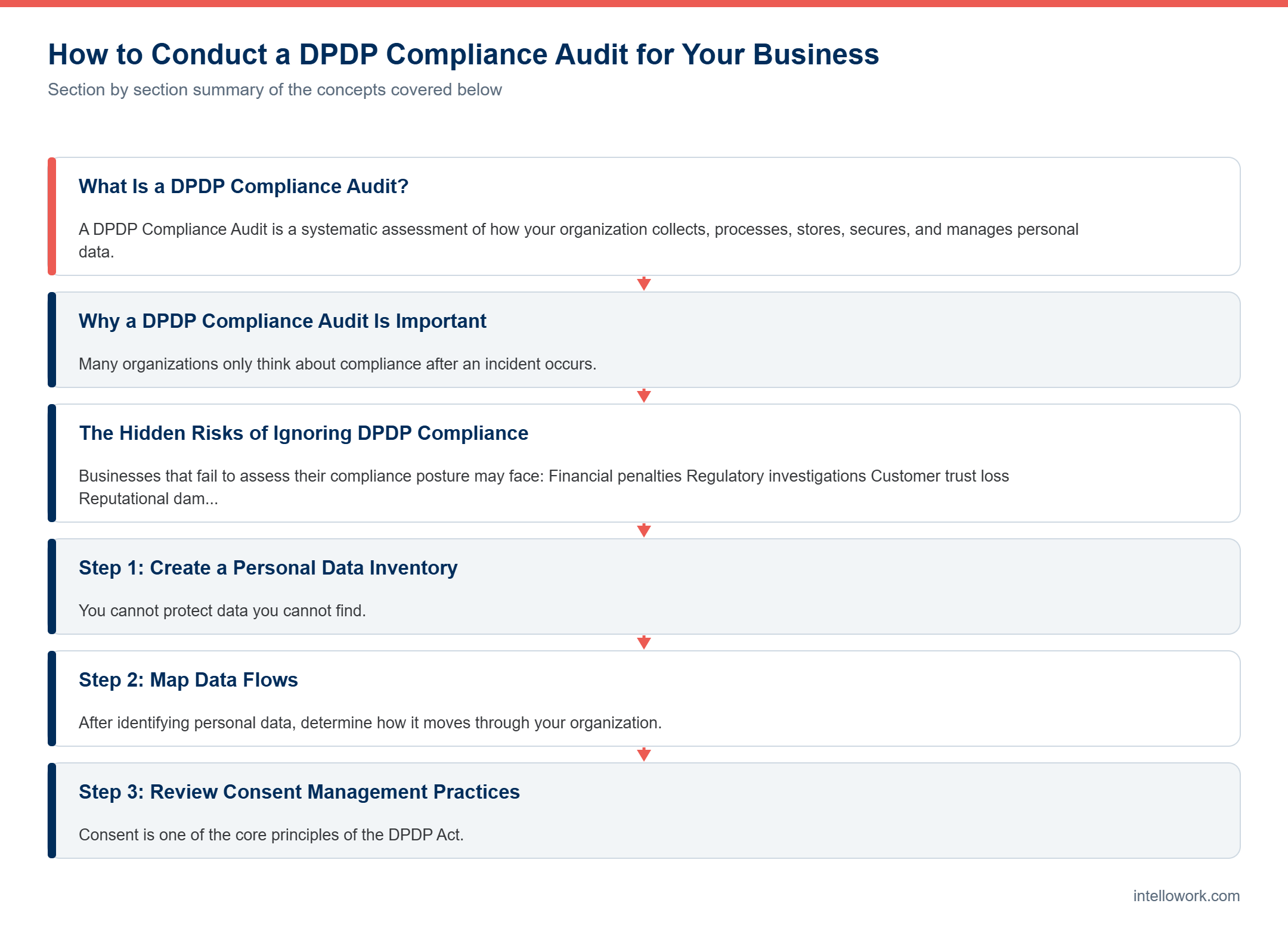
What Is a DPDP Compliance Audit?
A DPDP Compliance Audit is a systematic assessment of how your organization collects, processes, stores, secures, and manages personal data.
The goal is to identify whether your existing processes align with the requirements of India’s DPDP Act.
A comprehensive audit helps businesses answer critical questions:
- What personal data do we collect?
- Why do we collect it?
- Where is it stored?
- Who can access it?
- How is consent managed?
- Which third parties process our data?
- Are our security controls sufficient?
Without clear answers, compliance becomes difficult.
Why a DPDP Compliance Audit Is Important
Many organizations only think about compliance after an incident occurs.
By then, the damage is already done.
A compliance audit helps businesses:
- Identify privacy risks
- Improve data visibility
- Strengthen governance
- Reduce compliance gaps
- Build customer trust
- Improve security controls
Most importantly, it helps organizations proactively prepare for DPDP obligations instead of reacting to problems later.
The Hidden Risks of Ignoring DPDP Compliance
Businesses that fail to assess their compliance posture may face:
- Financial penalties
- Regulatory investigations
- Customer trust loss
- Reputational damage
- Operational disruptions
Under the DPDP Act, significant penalties can apply for serious violations involving personal data handling.
However, the financial impact is only part of the problem.
A single data incident can damage customer confidence for years.
Step 1: Create a Personal Data Inventory
You cannot protect data you cannot find.
The first step in any DPDP audit is identifying all personal data your organization collects.
This includes:
- Customer information
- Employee records
- Vendor details
- Marketing databases
- Financial information
- Website form submissions
Document:
- What data is collected
- Why it is collected
- Where it is stored
- How long it is retained
This process creates the foundation for compliance.
Step 2: Map Data Flows
After identifying personal data, determine how it moves through your organization.
Understand:
- Where data originates
- Which systems process it
- Who accesses it
- Which vendors receive it
Data often flows across:
- Websites
- Mobile applications
- CRM systems
- Cloud platforms
- Internal databases
- Third-party tools
Mapping these flows helps uncover hidden compliance risks.
Step 3: Review Consent Management Practices
Consent is one of the core principles of the DPDP Act.
Your audit should evaluate:
- How consent is collected
- Whether consent notices are clear
- How consent records are stored
- How customers can withdraw consent
Ask yourself:
- Can we prove when consent was obtained?
- Can users easily update their preferences?
- Are consent records centralized?
Poor consent management is one of the biggest compliance gaps businesses face today.
Step 4: Evaluate Access Controls
Not every employee should have access to every piece of data.
Review:
- User permissions
- Role-based access controls
- Privileged accounts
- Access approval workflows
Excessive access increases the risk of internal data exposure.
The principle is simple.
Employees should only access the information necessary for their responsibilities.
Step 5: Assess Third-Party Risks
Most organizations share data with external vendors.
This may include:
- Cloud providers
- Marketing platforms
- Payment processors
- HR systems
- Analytics tools
Your audit should identify:
- Which vendors process personal data
- What information is shared
- Whether contracts include privacy obligations
- How vendor risks are monitored
Third-party risks often become compliance risks.
Step 6: Review Data Retention Practices
Many organizations retain data longer than necessary.
Your audit should examine:
- Retention policies
- Deletion procedures
- Archiving processes
Ask:
- Why are we keeping this data?
- Do we still need it?
- Can we securely delete it?
Effective data minimization reduces risk.
Step 7: Evaluate Incident Response Readiness
Every organization should prepare for potential data incidents.
Your audit should review:
- Incident response plans
- Breach reporting procedures
- Internal escalation processes
- Communication workflows
When an incident occurs, businesses must respond quickly and effectively.
Preparation makes all the difference.
Step 8: Assess Governance and Accountability
Compliance is not a one-time project.
It requires ongoing governance.
Review:
- Privacy policies
- Internal responsibilities
- Employee training programs
- Compliance ownership
Businesses need clear accountability structures to maintain long-term compliance.
Step 9: Conduct a DPDP Gap Assessment
A gap assessment compares your current practices against DPDP requirements.
It helps identify:
- Missing controls
- Governance weaknesses
- Consent gaps
- Security risks
- Vendor issues
This creates a practical roadmap for improvement.
Without a gap assessment, organizations operate with limited visibility.
Why Manual Audits Are No Longer Enough
Traditional compliance audits rely heavily on:
- Spreadsheets
- Emails
- Manual reviews
- Static reports
These methods become difficult to manage as organizations grow.
Modern businesses need:
- Real-time visibility
- Automated monitoring
- Centralized governance
- Continuous compliance tracking
This is where technology becomes essential.
How ProtectComply Simplifies DPDP Compliance Audits
ProtectComply helps businesses streamline DPDP readiness through a centralized compliance platform.
Organizations gain access to:
- DPDP Gap Assessments
- Consent Management
- Compliance Monitoring
- Risk Visibility
- Governance Workflows
- Data Protection Controls
Instead of managing compliance manually, businesses can monitor their readiness continuously.
This helps reduce risks and improve accountability.
Common DPDP Audit Mistakes to Avoid
Many businesses make avoidable mistakes during compliance assessments.
These include:
- Ignoring third-party risks
- Focusing only on technology
- Failing to map data flows
- Overlooking consent management
- Treating compliance as a one-time activity
DPDP compliance requires continuous improvement.
The Future of Compliance Is Continuous
Regulations evolve.
Business operations change.
Data volumes grow.
Organizations need compliance systems that can adapt.
Businesses that conduct regular DPDP audits will be better prepared to:
- Protect customer trust
- Reduce privacy risks
- Strengthen governance
- Improve operational resilience
Compliance is becoming a competitive advantage.
Conclusion
The DPDP Act has transformed data privacy into a business priority.
Organizations can no longer rely on assumptions or manual processes.
A DPDP Compliance Audit helps businesses understand where they stand, identify gaps, and create a roadmap toward stronger data protection.
ProtectComply enables organizations to simplify this journey through intelligent compliance management, consent governance, and risk visibility.
The question is not whether your business needs a DPDP audit.
The real question is whether you can afford to operate without one.
Frequently Asked Questions
What is a DPDP Compliance Audit?
A DPDP Compliance Audit assesses whether an organization’s data handling practices align with the requirements of India’s DPDP Act.
How often should businesses conduct DPDP audits?
Organizations should conduct audits regularly and whenever major changes occur in data processing activities.
What areas should a DPDP audit cover?
A DPDP audit should review data inventory, consent management, access controls, vendor risks, governance, and incident response readiness.
How does ProtectComply help with DPDP audits?
ProtectComply helps businesses conduct gap assessments, monitor compliance activities, manage consent, and improve governance.
Which businesses need a DPDP Compliance Audit?
Any organization that collects, stores, processes, or shares personal data should conduct regular compliance audits.
Related reading
- How to Choose the Best DPDP Compliance Software for Your Business
- Why Your Business Is Not DPDP Compliant (And How to Fix It)
- DPDP Compliance Platform: Why Every Indian Business Needs One Before It’s Too Late
Assistants and chatbots fall inside this scope too. Intellowork was built for that reality, with source-level access controls, audit logging and a named residency region, so conversational data does not become a gap in an otherwise sound programme.