India is entering a new era of data privacy.
The Digital Personal Data Protection (DPDP) Act is no longer just a legal topic discussed by compliance professionals. It is now a business priority for every organization that collects, stores, or processes personal data.
Yet, thousands of businesses believe they are already compliant.
have a privacy policy on their website.
ask customers to accept cookies.
They use secure cloud storage.
think that’s enough.
Unfortunately, it isn’t.
Most organizations have hidden compliance gaps that could expose them to regulatory action, customer complaints, operational disruptions, and significant financial penalties.
The biggest problem is that these businesses don’t even know where those gaps exist.
This is exactly why organizations need a modern DPDP Compliance Platform like ProtectComply.
Instead of relying on manual spreadsheets and disconnected compliance processes, businesses can continuously monitor, manage, and improve their DPDP compliance from one centralized platform.
Why DPDP Compliance Is More Important Than Ever
Every business handles personal data.
Whether you operate a startup, SaaS company, hospital, educational institution, manufacturing company, financial service, or e-commerce platform, you process information such as:
- Customer names
- Email addresses
- Phone numbers
- Employee records
- Financial information
- Vendor details
- Website enquiries
The DPDP Act expects organizations to protect this information responsibly.
Compliance is no longer optional.
It is becoming a competitive advantage.
Customers increasingly trust organizations that demonstrate strong privacy practices.
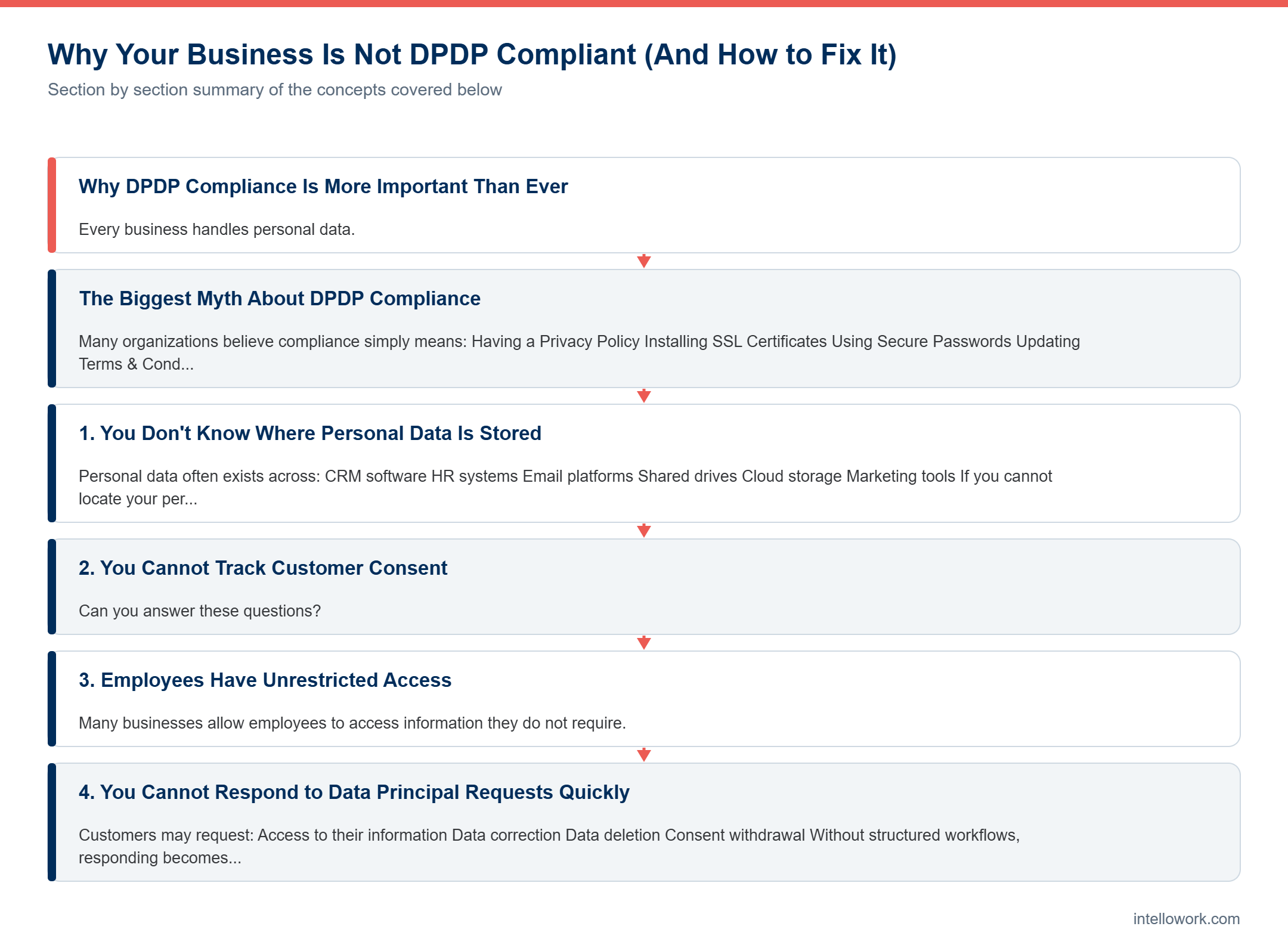
The Biggest Myth About DPDP Compliance
Many organizations believe compliance simply means:
Having a Privacy Policy
Installing SSL Certificates
Using Secure Passwords
Updating Terms & Conditions
These are important.
But they represent only a small portion of DPDP compliance.
Real compliance requires businesses to manage the complete lifecycle of personal data.
10 Signs Your Business Is Not DPDP Compliant
1. You Don’t Know Where Personal Data Is Stored
Personal data often exists across:
- CRM software
- HR systems
- Email platforms
- Shared drives
- Cloud storage
- Marketing tools
If you cannot locate your personal data quickly, you cannot protect it properly.
2. You Cannot Track Customer Consent
Can you answer these questions?
- When was consent collected?
- Which notice was accepted?
- Has the customer withdrawn consent?
- Can you produce proof during an audit?
If not, your consent management process needs improvement.
3. Employees Have Unrestricted Access
Many businesses allow employees to access information they do not require.
This increases insider risks and weakens compliance.
Role-based access controls are essential.
4. You Cannot Respond to Data Principal Requests Quickly
Customers may request:
- Access to their information
- Data correction
- Data deletion
- Consent withdrawal
Without structured workflows, responding becomes slow and inconsistent.
5. Vendor Risks Are Not Monitored
Your cloud providers, payroll vendors, CRM systems, and marketing platforms may also process personal data.
Ignoring third-party risks creates significant compliance exposure.
6. Your Compliance Is Managed Using Excel
Spreadsheets may work for small tasks.
They do not work for enterprise privacy compliance.
Manual tracking increases:
- Human error
- Missed deadlines
- Inconsistent reporting
7. No DPDP Gap Assessment Has Been Conducted
If your organization has never evaluated its compliance posture, you have no clear understanding of existing risks.
A DPDP Gap Assessment identifies weaknesses before regulators or customers do.
8. Your Team Has No Defined Privacy Responsibilities
owns compliance?
manages consent?
Who responds to privacy requests?
If these responsibilities are unclear, governance becomes weak.
9. There Is No Incident Response Process
Data breaches can happen at any organization.
Without predefined response procedures, businesses struggle to react quickly and effectively.
10. Compliance Is Viewed as a One-Time Project
Privacy compliance is continuous.
As your business grows, so do your compliance responsibilities.
Organizations need continuous monitoring instead of one-time audits.
The Hidden Cost of Non-Compliance
Many organizations focus only on regulatory penalties.
However, the real costs are often much higher.
Non-compliance can lead to:
- Loss of customer trust
- Negative media attention
- Business disruptions
- Contract losses
- Legal expenses
- Reduced brand reputation
Customers increasingly choose organizations they trust with their personal information.
Why Manual Compliance No Longer Works
Modern businesses process data across dozens of systems.
Examples include:
- CRM software
- HRMS
- ERP platforms
- Cloud storage
- Marketing automation
- Customer support tools
- Finance applications
Managing all these systems manually is nearly impossible.
Businesses need intelligent automation.
Why AI Is Transforming DPDP Compliance
Artificial Intelligence is changing how businesses manage privacy.
Instead of waiting for audits, AI enables organizations to:
- Detect risks continuously
- Monitor compliance activities
- Improve visibility
- Automate workflows
- Track consent
- Strengthen governance
AI reduces manual effort while improving compliance accuracy.
How ProtectComply Solves Every DPDP Compliance Challenge
ProtectComply is built specifically to simplify DPDP compliance for modern businesses.
Instead of using multiple disconnected tools, organizations manage everything from one platform.
DPDP Gap Assessment
Identify compliance weaknesses before they become business risks.
Consent Management
Track consent throughout its lifecycle while maintaining complete audit records.
Compliance Monitoring
Continuously monitor compliance readiness instead of waiting for annual reviews.
Risk Visibility
Identify privacy risks across the organization from a centralized dashboard.
Governance Workflows
Standardize compliance activities through structured workflows.
Audit Readiness
Maintain records required during internal and external compliance reviews.
Why Businesses Choose ProtectComply
Organizations choose ProtectComply because it helps them move beyond basic compliance.
It enables businesses to build a proactive privacy program.
Key benefits include:
- Faster compliance readiness
- Better governance
- Improved accountability
- Reduced operational risk
- Simplified consent management
- Stronger customer trust
- AI-powered compliance automation
Instead of reacting to compliance issues, businesses stay prepared.
Why ProtectComply Is One of the Best DPDP Compliance Platforms in India
Choosing the right compliance platform can determine how effectively your organization manages privacy obligations.
ProtectComply combines:
- AI-powered compliance workflows
- DPDP Gap Assessment
- Consent Lifecycle Management
- Privacy Governance
- Compliance Monitoring
- Risk Assessment
- Audit Support
- Enterprise-ready security
Whether you are a startup, SME, or large enterprise, ProtectComply provides a scalable approach to DPDP compliance.
The Future of Data Privacy Starts Today
The DPDP Act is only the beginning.
Privacy regulations will continue to evolve.
Businesses that invest in strong governance today will be better prepared for tomorrow.
Organizations that delay compliance will face increasing operational and regulatory challenges.
The smartest businesses are not waiting for penalties.
They are building privacy-first operations today.
Conclusion
If your business still relies on manual processes, scattered records, or outdated compliance practices, now is the time to act.
DPDP compliance is not just about avoiding penalties.
It is about protecting customer trust, strengthening governance, and building a resilient business.
ProtectComply empowers organizations with AI-driven compliance tools, centralized governance, intelligent consent management, and continuous compliance monitoring.
For businesses that want to stay ahead of evolving privacy requirements, ProtectComply is more than a compliance platform.
It is a long-term partner in building a privacy-first organization.
Frequently Asked Questions
What is a DPDP Compliance Platform?
A DPDP Compliance Platform helps organizations manage data privacy obligations under the Digital Personal Data Protection Act through consent management, compliance monitoring, governance, and risk assessment.
Why do businesses need ProtectComply?
ProtectComply simplifies DPDP compliance by providing AI-powered automation, gap assessments, consent management, compliance monitoring, and audit readiness.
What is a DPDP Gap Assessment?
A DPDP Gap Assessment identifies differences between an organization’s current practices and DPDP Act requirements, helping businesses prioritize improvements.
Can startups use ProtectComply?
Yes. ProtectComply is designed for startups, SMEs, and enterprises looking to strengthen privacy governance and prepare for DPDP compliance.
How does ProtectComply improve compliance?
It centralizes compliance activities, automates workflows, improves visibility, manages consent, and helps organizations continuously monitor their DPDP readiness.
Related reading
- DPDP Compliance Platform: Why Every Indian Business Needs One Before It’s Too Late
- How to Choose the Best DPDP Compliance Software for Your Business
- Why Every Business Needs a Consent Management Platform Under the DPDP Act
Assistants and chatbots fall inside this scope too. Intellowork was built for that reality, with source-level access controls, audit logging and a named residency region, so conversational data does not become a gap in an otherwise sound programme.