India’s data privacy landscape has changed forever.
The Digital Personal Data Protection (DPDP) Act and the operational DPDP Rules have made data protection a boardroom-level responsibility rather than just an IT concern. Organizations are now expected to manage consent, secure personal data, implement governance controls, and establish accountability mechanisms.
The problem?
Most businesses believe they are ready.
In reality, many organizations still do not know:
- What personal data they collect
- Where that data is stored
- Who has access to it
- How consent is managed
- Whether they can respond to a data breach effectively
This is exactly why businesses must start preparing now.
The companies that wait until regulators start asking questions will already be too late.
And with penalties reaching up to ₹250 crore for serious violations, DPDP compliance is no longer optional.
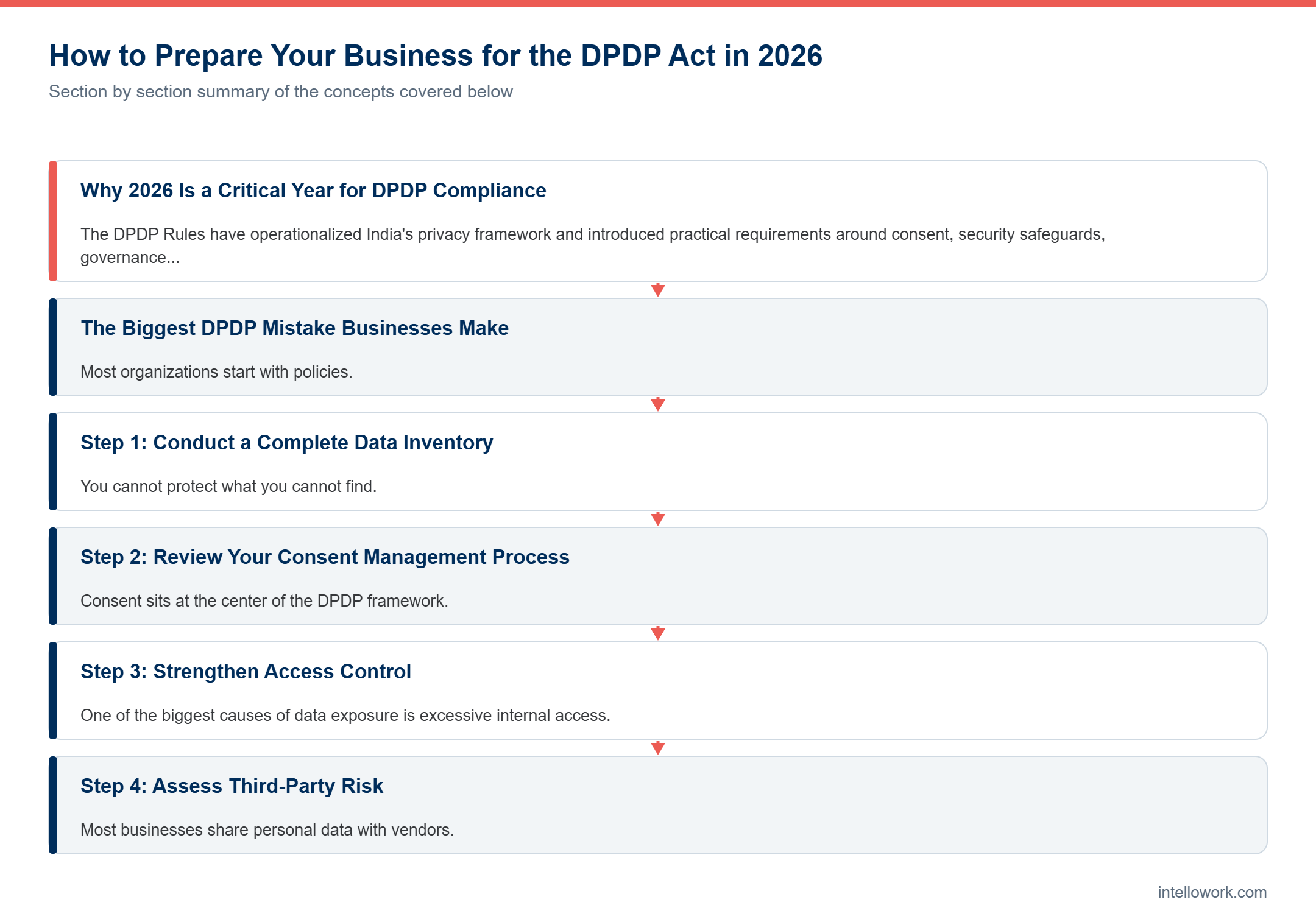
Why 2026 Is a Critical Year for DPDP Compliance
The DPDP Rules have operationalized India’s privacy framework and introduced practical requirements around consent, security safeguards, governance, and accountability. Organizations are being given a phased timeline to achieve compliance, but experts continue to warn that many businesses are underestimating the work required.
The businesses that start preparing today will have a significant advantage over those scrambling to comply later.
DPDP readiness is no longer just about avoiding penalties.
It is about:
- Protecting customer trust
- Building a privacy-first reputation
- Reducing business risk
- Strengthening governance
- Creating competitive advantage
The Biggest DPDP Mistake Businesses Make
Most organizations start with policies.
But compliance does not start with policies.
It starts with understanding your data.
Many businesses cannot answer simple questions:
- What personal data do we collect?
- Why do we collect it?
- Where is it stored?
- Who can access it?
- How long do we retain it?
Without these answers, compliance becomes impossible.
This is why the first step toward DPDP readiness is visibility.
Step 1: Conduct a Complete Data Inventory
You cannot protect what you cannot find.
Every business should begin by identifying:
- Customer data
- Employee data
- Vendor data
- Partner information
- Marketing databases
- Application data
The goal is to understand:
- What data exists
- Where it exists
- How it moves across systems
Data mapping is widely considered one of the most important foundations of DPDP compliance.
Step 2: Review Your Consent Management Process
Consent sits at the center of the DPDP framework.
Organizations must ensure that consent is:
- Clear
- Specific
- Informed
- Easy to withdraw
Businesses relying on outdated forms, unclear notices, or inconsistent consent records face significant compliance risk. The DPDP Rules emphasize transparent notices and stronger consent management practices.
This is where a dedicated consent management system becomes essential.
Step 3: Strengthen Access Control
One of the biggest causes of data exposure is excessive internal access.
Many organizations still allow employees to access information they do not need.
Businesses should implement:
- Role-based access controls
- Privileged access reviews
- User activity monitoring
- Access approval workflows
The fewer people who can access sensitive information, the lower the compliance risk.
Step 4: Assess Third-Party Risk
Most businesses share personal data with vendors.
This includes:
- Cloud providers
- Marketing platforms
- Payment gateways
- HR systems
- Analytics providers
The challenge?
Many organizations do not fully understand where data goes after it leaves their systems.
DPDP readiness requires businesses to review vendor relationships and data processing arrangements carefully.
Step 5: Prepare for Data Breach Response
Every business assumes a breach will never happen.
Unfortunately, breaches happen every day.
Organizations should have:
- Incident response plans
- Escalation procedures
- Breach investigation processes
- Communication workflows
The DPDP framework places significant emphasis on handling and reporting personal data incidents appropriately.
The question is not whether you will face a security challenge.
The question is whether you are prepared for it.
Step 6: Build a Privacy Governance Framework
Compliance is not a one-time project.
It is an ongoing process.
Businesses should establish:
- Privacy policies
- Governance committees
- Compliance ownership
- Internal accountability structures
For many organizations, this includes appointing responsible personnel and establishing oversight mechanisms for privacy operations.
Step 7: Conduct a DPDP Gap Assessment
This is where most businesses discover the truth.
They realize they are far less prepared than they assumed.
A DPDP Gap Assessment helps organizations identify:
- Missing controls
- Governance weaknesses
- Consent issues
- Access management gaps
- Vendor risks
- Security deficiencies
Without a gap assessment, businesses are essentially operating blind.
Why Businesses Need a DPDP Compliance Platform
Trying to manage DPDP compliance manually is becoming increasingly difficult.
Modern organizations process personal data across:
- Websites
- Mobile apps
- CRMs
- Marketing systems
- Internal platforms
- Cloud environments
Manual tracking cannot keep up.
Businesses need:
- Automation
- Visibility
- Governance
- Monitoring
This is where modern DPDP compliance platforms create value.
Why ProtectComply Is Built for the DPDP Era
ProtectComply is designed specifically to help organizations prepare for modern privacy and compliance challenges.
Instead of relying on spreadsheets and disconnected workflows, businesses gain a centralized platform for:
- DPDP Gap Assessment
- Consent Management
- Compliance Monitoring
- Privacy Governance
- Risk Visibility
- Data Protection Operations
This allows organizations to move from reactive compliance to proactive compliance.
What Makes ProtectComply Different?
Most businesses do not need another dashboard.
They need answers.
ProtectComply helps organizations answer critical questions:
- Are we DPDP ready?
- Where are our compliance gaps?
- How do we manage consent?
- Who can access sensitive information?
- What risks need immediate attention?
These answers are essential for long-term compliance success.
The Cost of Waiting
Many businesses believe they still have time.
But compliance preparation takes months, not weeks.
Organizations must:
- Map data
- Update policies
- Implement governance
- Improve security
- Review vendors
- Build accountability
The businesses that start today will be significantly better prepared than those that wait until compliance deadlines approach.
Why DPDP Compliance Is a Competitive Advantage
Businesses often see compliance as a burden.
The smartest organizations see it differently.
Strong privacy practices help:
- Build customer trust
- Improve brand reputation
- Reduce operational risk
- Strengthen governance
- Increase customer confidence
Privacy is becoming a business differentiator.
Not just a legal requirement.
Conclusion
The DPDP Act is transforming how businesses manage personal data in India.
Organizations that continue relying on outdated compliance approaches will face increasing challenges.
Preparing for DPDP compliance in 2026 requires:
- Data visibility
- Consent management
- Governance controls
- Security safeguards
- Compliance monitoring
ProtectComply helps businesses build these capabilities through a centralized platform designed specifically for the realities of the DPDP era.
The best time to prepare for DPDP compliance was yesterday.
The second-best time is today.
Frequently Asked Questions (FAQ)
What is the DPDP Act?
The Digital Personal Data Protection Act is India’s framework for protecting digital personal data and establishing obligations for organizations handling such information.
Why should businesses prepare for DPDP compliance now?
DPDP compliance requires significant preparation, including data mapping, consent management, governance improvements, and security controls.
What is a DPDP Gap Assessment?
A DPDP Gap Assessment identifies the difference between your current practices and DPDP compliance requirements.
How does ProtectComply help?
ProtectComply helps businesses improve DPDP readiness through consent management, compliance monitoring, governance support, and gap assessments.
Can small businesses be affected by DPDP requirements?
Yes. Any organization processing personal data should understand and prepare for applicable DPDP obligations.
Related reading
- Why Every Business Needs a Consent Management Platform Under the DPDP Act
- How to Choose the Best DPDP Compliance Software for Your Business
- Privacy by Design Under the DPDP Act: A Complete Guide for Businesses
Assistants and chatbots fall inside this scope too. Intellowork was built for that reality, with source-level access controls, audit logging and a named residency region, so conversational data does not become a gap in an otherwise sound programme.