India’s digital economy is growing rapidly.
Businesses collect and process vast amounts of personal data every day through websites, mobile applications, customer support systems, marketing platforms, and internal business operations.
However, with the implementation of the Digital Personal Data Protection (DPDP) Act, organizations can no longer treat personal data as just another business asset.
They now have clear legal responsibilities.
At the center of the DPDP Act is a critical concept every business must understand:
Data Fiduciary.
If your organization determines why and how personal data is processed, you are likely a Data Fiduciary.
The challenge is simple.
Many businesses do not realize their responsibilities under the DPDP Act until compliance issues arise.
This can lead to:
- Financial penalties
- Regulatory scrutiny
- Customer trust loss
- Data breaches
- Operational disruption
- Brand reputation damage
This is why understanding the role of a Data Fiduciary is the first step toward DPDP compliance.
Platforms like ProtectComply help organizations simplify compliance, strengthen governance, and manage data protection responsibilities effectively.
What Is a Data Fiduciary Under the DPDP Act?
Under the DPDP Act, a Data Fiduciary is any person, company, organization, or government entity that determines the purpose and means of processing personal data.
Simply put, if your business decides:
- What personal data to collect
- Why it is collected
- How it will be used
- Who can access it
- How long it will be retained
Your organization is a Data Fiduciary.
Examples include:
- E-commerce platforms
- Healthcare providers
- Banks and financial institutions
- SaaS companies
- Educational institutions
- Mobile application providers
- Marketing agencies
If you handle personal data, the DPDP Act likely applies to your business.
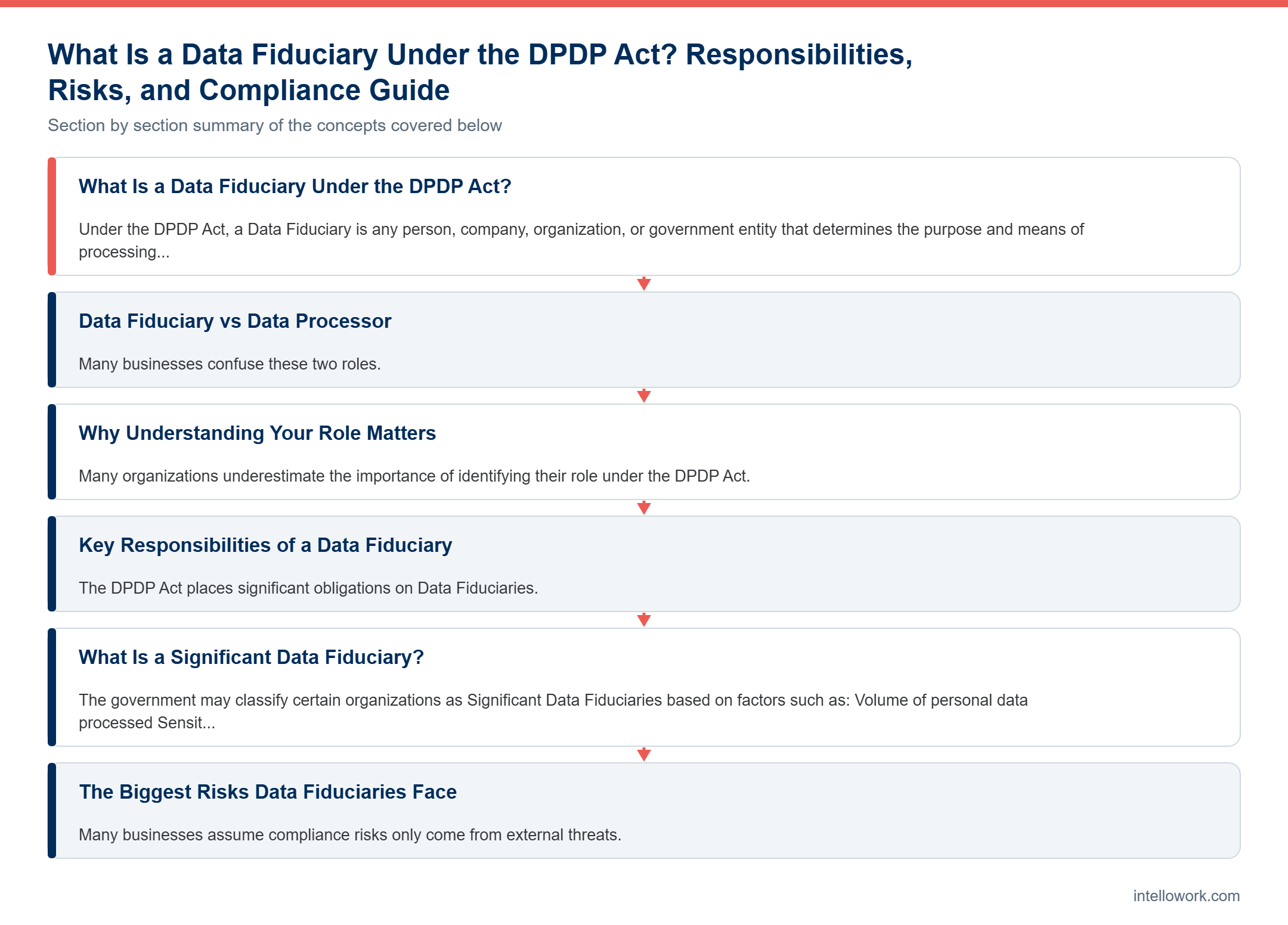
Data Fiduciary vs Data Processor
Many businesses confuse these two roles.
A Data Fiduciary decides why and how personal data is processed.
A Data Processor processes personal data on behalf of the Data Fiduciary.
For example:
An e-commerce company collecting customer information is the Data Fiduciary.
A cloud service provider storing that information may act as the Data Processor.
However, the responsibility for compliance remains with the Data Fiduciary.
This means organizations cannot outsource accountability.
Why Understanding Your Role Matters
Many organizations underestimate the importance of identifying their role under the DPDP Act.
Without clarity, businesses struggle to:
- Build compliance programs
- Define responsibilities
- Implement governance frameworks
- Manage third-party risks
- Respond to Data Principal requests
Understanding your role helps establish accountability from the beginning.
Key Responsibilities of a Data Fiduciary
The DPDP Act places significant obligations on Data Fiduciaries.
Provide Clear Notice
Organizations must inform individuals about:
- What data is collected
- Why it is collected
- How it will be processed
- How individuals can exercise their rights
Transparency is essential.
Obtain Valid Consent
Consent must be:
- Free
- Specific
- Informed
- Unambiguous
Businesses must maintain records demonstrating when and how consent was obtained.
Protect Personal Data
Data Fiduciaries must implement reasonable security safeguards to prevent:
- Unauthorized access
- Data breaches
- Data misuse
- Information leakage
Respect Data Principal Rights
Organizations must establish processes to manage:
- Access requests
- Correction requests
- Erasure requests
- Consent withdrawal
- Grievance redressal
Ensure Data Accuracy
Businesses should take reasonable steps to maintain accurate and updated information.
Manage Data Retention
Personal data should not be retained longer than necessary.
Organizations need clear retention and deletion policies.
Oversee Third Parties
If vendors or service providers process personal data, Data Fiduciaries remain accountable.
Third-party risks must be monitored continuously.
What Is a Significant Data Fiduciary?
The government may classify certain organizations as Significant Data Fiduciaries based on factors such as:
- Volume of personal data processed
- Sensitivity of information
- Risk to individual rights
- Impact on national interests
Significant Data Fiduciaries may face additional obligations, including:
- Appointing a Data Protection Officer
- Conducting periodic audits
- Performing impact assessments
- Implementing stronger governance controls
Organizations handling large volumes of personal data should prepare early.
The Biggest Risks Data Fiduciaries Face
Many businesses assume compliance risks only come from external threats.
In reality, risks often originate internally.
Common challenges include:
- Weak access controls
- Unclear consent records
- Poor vendor management
- Lack of data visibility
- Inadequate security measures
- Manual compliance processes
Without strong governance, these gaps can become serious liabilities.
What Happens If a Data Fiduciary Fails to Comply?
Non-compliance can create significant consequences.
Potential outcomes include:
- Regulatory investigations
- Customer complaints
- Operational disruptions
- Reputational damage
- Financial penalties
Under the DPDP Act, penalties for serious violations can reach up to ₹250 crore.
However, the long-term impact often goes beyond financial loss.
Trust is difficult to rebuild once it is lost.
Why Manual Compliance Is No Longer Enough
Many organizations still rely on:
- Spreadsheets
- Email approvals
- Manual audits
- Static policies
These approaches create compliance gaps.
Modern businesses process personal data across:
- Websites
- Mobile applications
- CRM systems
- Cloud environments
- Marketing platforms
- Internal tools
Managing compliance manually becomes increasingly difficult.
Businesses need automation, visibility, and centralized governance.
How ProtectComply Helps Data Fiduciaries
ProtectComply is built to help organizations meet their responsibilities under the DPDP Act.
The platform helps businesses manage:
- Consent management
- Data Principal requests
- DPDP gap assessments
- Compliance audits
- Risk monitoring
- Governance workflows
- Access controls
Instead of relying on disconnected processes, organizations gain a centralized compliance platform.
Key Benefits of ProtectComply
Improve Compliance Readiness
Identify gaps before they become risks.
Strengthen Governance
Create structured compliance workflows.
Enhance Visibility
Understand where personal data exists and how it is used.
Reduce Operational Risk
Automate critical compliance processes.
Build Customer Trust
Demonstrate a commitment to privacy and data protection.
Why DPDP Compliance Is a Competitive Advantage
Many businesses view compliance as a burden.
Forward-thinking organizations see it differently.
Strong privacy practices help businesses:
- Build customer confidence
- Improve brand reputation
- Strengthen governance
- Reduce risk exposure
- Create long-term trust
Data protection is becoming a business differentiator.
Not just a regulatory requirement.
The Future of Data Protection in India
The DPDP Act marks a major shift toward privacy-first business practices.
Organizations that invest in compliance today will be better prepared for:
- Future regulations
- Customer expectations
- Emerging risks
- Digital transformation initiatives
The businesses that succeed will be those that treat privacy as a core business function.
Conclusion
If your organization collects or processes personal data, understanding your responsibilities as a Data Fiduciary is essential.
The DPDP Act has created a new standard for accountability, transparency, and data protection.
Organizations can no longer rely on manual processes and reactive compliance strategies.
ProtectComply helps businesses simplify DPDP compliance through intelligent workflows, consent management, governance support, and continuous monitoring.
For modern businesses, compliance is no longer optional.
It is a strategic necessity.
Frequently Asked Questions
What is a Data Fiduciary under the DPDP Act?
A Data Fiduciary is an organization or individual that determines the purpose and means of processing personal data.
Who can be a Data Fiduciary?
Any business, government entity, or organization that collects and processes personal data can be a Data Fiduciary.
What is the difference between a Data Fiduciary and a Data Processor?
A Data Fiduciary decides why and how data is processed, while a Data Processor processes data on behalf of the Data Fiduciary.
What are the responsibilities of a Data Fiduciary?
Responsibilities include obtaining consent, protecting data, respecting Data Principal rights, and implementing security safeguards.
How does ProtectComply help Data Fiduciaries?
ProtectComply helps organizations manage consent, monitor compliance, conduct gap assessments, and strengthen privacy governance.
Related reading
- How to Handle Data Principal Requests Under the DPDP Act
- Privacy by Design Under the DPDP Act: A Complete Guide for Businesses
- Why Every Business Needs a Consent Management Platform Under the DPDP Act
Where an AI assistant touches personal data, treat it as part of the same programme. Intellowork supports single sign-on, source-level access control lists and regional data residency, so the assistant inherits your existing controls rather than bypassing them.