The DPDP Act Is Here. Is Your Business Ready?
The Digital Personal Data Protection (DPDP) Act has changed the way organizations in India collect, process, store, and manage personal data.
For many businesses, compliance is still viewed as a legal obligation.
However, organizations that treat the DPDP Act as only a legal requirement often struggle with implementation.
Compliance is much more than updating a privacy policy or adding a consent checkbox to your website.
It requires a structured framework, clearly defined responsibilities, continuous monitoring, and the right technology.
Businesses that delay implementation expose themselves to operational risks, customer complaints, and regulatory scrutiny.
The good news is that implementing the DPDP Act does not have to be complicated.
With the right roadmap and a modern compliance platform like ProtectComply, organizations can simplify implementation while building a stronger privacy culture.
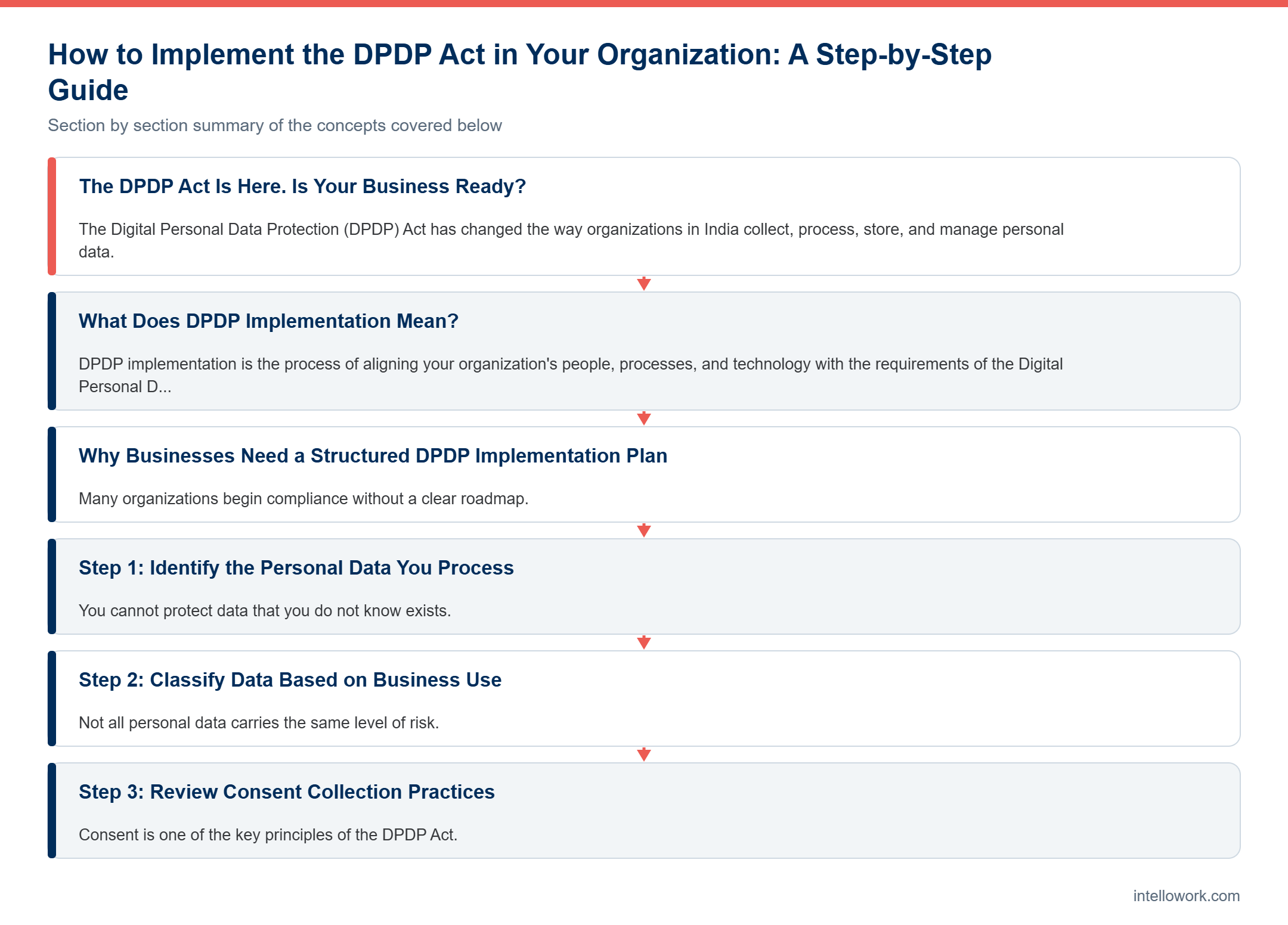
What Does DPDP Implementation Mean?
DPDP implementation is the process of aligning your organization’s people, processes, and technology with the requirements of the Digital Personal Data Protection Act.
It includes:
- Understanding what personal data you collect
- Managing consent properly
- Protecting personal information
- Responding to Data Principal requests
- Monitoring compliance
- Maintaining governance
- Preparing for audits
Rather than treating compliance as a one-time project, businesses should build an ongoing privacy management program.
Why Businesses Need a Structured DPDP Implementation Plan
Many organizations begin compliance without a clear roadmap.
As a result, they often experience:
- Duplicate compliance efforts
- Missing documentation
- Weak governance
- Inconsistent consent practices
- Increased compliance costs
A structured implementation plan helps organizations prioritize activities and reduce risks.
Step 1: Identify the Personal Data You Process
You cannot protect data that you do not know exists.
The first step is creating a complete inventory of personal data across your organization.
Review systems such as:
- Websites
- Mobile applications
- CRM platforms
- HR systems
- ERP software
- Marketing tools
- Customer support platforms
- Cloud storage
Document:
- What data is collected
- Why it is collected
- Where it is stored
- Who has access
- How long it is retained
A comprehensive data inventory becomes the foundation of your compliance program.
Step 2: Classify Data Based on Business Use
Not all personal data carries the same level of risk.
Businesses should classify data according to:
- Customer information
- Employee records
- Vendor information
- Financial details
- Marketing data
Data classification helps organizations apply appropriate privacy controls.
Step 3: Review Consent Collection Practices
Consent is one of the key principles of the DPDP Act.
Organizations should evaluate whether consent is:
- Free
- Specific
- Informed
- Unambiguous
Businesses should also ensure that individuals can withdraw consent easily.
Maintaining accurate consent records is equally important.
Step 4: Strengthen Privacy Governance
Governance defines how compliance responsibilities are managed.
Every organization should establish:
- Privacy ownership
- Internal approval workflows
- Compliance reporting
- Accountability structures
Without governance, privacy initiatives often become inconsistent.
Step 5: Implement Security Controls
Privacy and security work together.
Organizations should strengthen controls including:
- Role-based access
- Multi-factor authentication
- Data encryption
- Backup policies
- Access reviews
- Incident response procedures
Strong security reduces the likelihood of unauthorized access and data breaches.
Step 6: Prepare for Data Principal Requests
The DPDP Act grants individuals several rights regarding their personal data.
Organizations should be prepared to manage requests involving:
- Data access
- Data correction
- Data deletion
- Consent withdrawal
- Grievance resolution
Well-defined workflows improve efficiency and customer trust.
Step 7: Conduct a DPDP Gap Assessment
A Gap Assessment compares your current privacy practices against DPDP requirements.
It helps identify:
- Missing controls
- Weak governance
- Consent gaps
- Documentation issues
- Operational risks
Organizations that perform regular assessments can improve compliance before issues escalate.
Step 8: Evaluate Third-Party Risks
Many businesses share personal data with external vendors.
Examples include:
- Cloud providers
- Payment gateways
- Payroll systems
- CRM vendors
- Marketing agencies
Review vendor agreements and ensure third parties maintain appropriate privacy standards.
Vendor governance should be part of your implementation strategy.
Step 9: Train Employees
Technology alone cannot achieve compliance.
Employees should understand:
- Privacy responsibilities
- Secure data handling
- Consent requirements
- Incident reporting procedures
- Data protection best practices
Regular awareness training strengthens your organization’s privacy culture.
Step 10: Monitor Compliance Continuously
Compliance is not a one-time exercise.
Business processes, systems, and regulations continue to evolve.
Organizations should monitor:
- Consent records
- Privacy incidents
- Compliance tasks
- Governance activities
- Risk assessments
Continuous monitoring helps businesses remain prepared for future regulatory expectations.
Common DPDP Implementation Challenges
Many organizations face similar obstacles during implementation.
These include:
- Lack of visibility into personal data
- Manual compliance tracking
- Inconsistent documentation
- Weak vendor governance
- Limited privacy expertise
- Difficulty managing consent
Recognizing these challenges early helps businesses build a stronger implementation strategy.
How ProtectComply Simplifies DPDP Implementation
Implementing the DPDP Act manually can be time-consuming and resource-intensive.
ProtectComply provides a centralized platform that helps organizations manage privacy compliance more efficiently.
DPDP Gap Assessments
Identify compliance gaps and prioritize corrective actions.
Consent Management
Maintain organized consent records with complete lifecycle tracking.
Compliance Monitoring
Track compliance activities continuously instead of relying on periodic reviews.
Privacy Governance
Standardize workflows, assign responsibilities, and improve accountability.
Audit Readiness
Maintain documentation and records required for internal reviews and external assessments.
AI-Assisted Compliance
Use intelligent workflows to simplify repetitive compliance activities and improve visibility across the organization.
Why Businesses Choose ProtectComply
Organizations across India are strengthening their privacy programs with ProtectComply because it helps them:
- Simplify DPDP implementation
- Improve compliance visibility
- Reduce manual effort
- Strengthen governance
- Manage consent effectively
- Prepare for audits
- Build long-term compliance maturity
Rather than managing privacy through disconnected tools, businesses gain a structured and scalable compliance solution.
DPDP Compliance Is a Business Opportunity
Organizations that implement strong privacy practices gain more than regulatory compliance.
They also benefit from:
- Greater customer trust
- Stronger enterprise partnerships
- Better governance
- Improved operational efficiency
- Reduced business risk
Privacy has become a competitive differentiator.
Businesses that invest early will be better positioned for future growth.
Final Thoughts
Implementing the DPDP Act is not simply about avoiding penalties.
It is about creating a culture of accountability, transparency, and responsible data management.
A structured implementation roadmap helps organizations reduce risks while improving operational efficiency.
ProtectComply enables businesses to simplify every stage of DPDP implementation—from data discovery and consent management to governance, compliance monitoring, and audit readiness.
The organizations that succeed under the DPDP Act will not be those that react after a compliance issue arises.
They will be the businesses that build privacy into every process from the very beginning.
Frequently Asked Questions
What is DPDP implementation?
DPDP implementation is the process of aligning your organization’s policies, processes, technology, and governance with the Digital Personal Data Protection Act.
Why is a DPDP implementation roadmap important?
A roadmap helps businesses identify priorities, reduce compliance gaps, improve governance, and implement privacy controls systematically.
What are the first steps in DPDP implementation?
The first steps include identifying personal data, classifying information, reviewing consent practices, and establishing governance.
How does ProtectComply help with DPDP implementation?
ProtectComply provides DPDP Gap Assessments, consent management, compliance monitoring, governance workflows, AI-assisted compliance, and audit readiness through a centralized platform.
Can startups implement the DPDP Act?
Yes. Startups, SMEs, and enterprises can all implement the DPDP Act by adopting appropriate privacy practices and using scalable compliance platforms like ProtectComply.
Related reading
- How to Build a Privacy-First Organization Under the DPDP Act
- Privacy by Design Under the DPDP Act: A Complete Guide for Businesses
- Why Every Business Needs a Consent Management Platform Under the DPDP Act
Where an AI assistant touches personal data, treat it as part of the same programme. Intellowork supports single sign-on, source-level access control lists and regional data residency, so the assistant inherits your existing controls rather than bypassing them.